silicate
Peridot
Gem-quality forsterite olivine coloured by iron; yellow-green to olive green, Mohs 6.5–7.
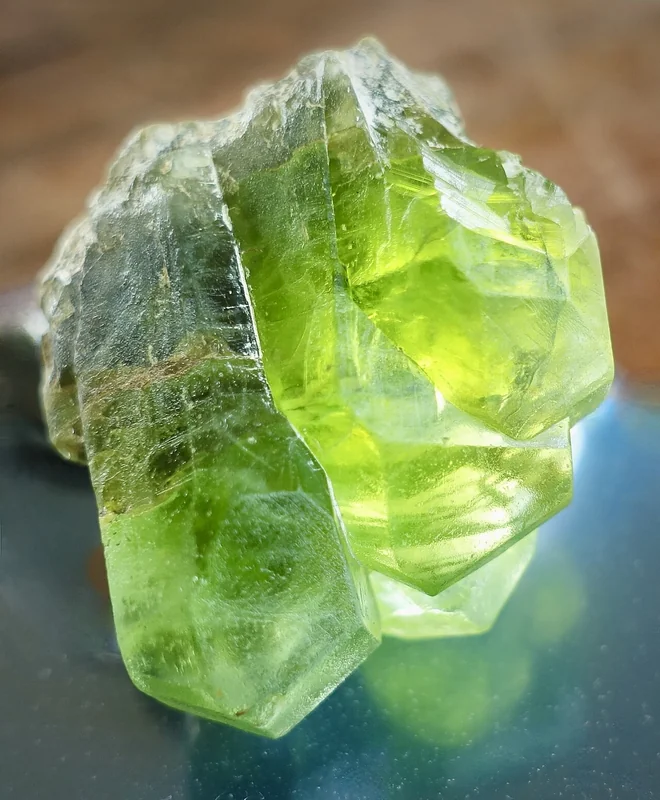
Peridot is the gem variety of forsterite, the magnesium end-member of the olivine solid-solution series (Mg,Fe)2SiO4. Its colour — ranging from yellowish-green through olive to brownish-green — is produced intrinsically by iron (Fe2+) in the crystal structure, meaning it is an idiochromatic gem: the colouring element is part of the mineral's chemistry rather than a trace impurity. Olivine crystallises in the orthorhombic system and rates 6.5–7 on the Mohs scale. The primary gem-quality source historically was Zabargad Island (St. John's Island) in the Egyptian Red Sea; today Pakistan's Kohistan-Sapat area and Arizona's San Carlos Apache Reservation produce most commercial supply.
Quick facts
- Item type
- Mineral
- Mineral class
- silicate
- Mohs hardness
- 6.75
- Crystal system
- orthorhombic
- Chemical formula
- (Mg,Fe)2SiO4
- Color range
- yellowish-green, olive-green, brownish-green
- Notable localities
- Zabargad Island (St. John's Island), Egypt (historic source since 1500 BCE); Kohistan-Sapat, Pakistan (fine yellow-green crystals); San Carlos Apache Reservation, Arizona, USA; Zebirget, Egypt (same as Zabargad, alternate name); Mogok Valley, Myanmar
Idiochromatic Colour: Iron in Olivine
Peridot is idiochromatic — its colour comes from Fe2+ ions that are a fundamental part of the crystal structure rather than a trace impurity. In forsterite (Mg2SiO4), some Mg2+ sites are occupied by Fe2+, and the ratio Mg:Fe varies continuously to the iron end-member fayalite (Fe2SiO4). Gem-quality peridot has Fe/(Fe+Mg) ratios of about 10–15 mol%; higher iron content increases absorption, darkening the stone toward brown-green. The Fe2+ ion absorbs blue and red wavelengths, transmitting green-yellow. Because the colouring element is structural, heat treatment and irradiation do not change peridot's colour. Peridot is strongly birefringent (0.036) and doubly refractive; looking through the table facet at depth, the back facets appear doubled — a diagnostic feature.
Zabargad and Geological Setting
Zabargad Island (also Zebirget or St. John's Island), located in the Egyptian Red Sea approximately 50 km from the coast, has been mined for peridot since at least 1500 BCE; it is one of the oldest known gem mining sites in the world. The deposits occur in dunite (nearly pure olivine rock) and peridotite within the island's igneous/metamorphic basement. The finest stones from Zabargad can exceed 100 ct and show exceptional transparency. The island was mined intermittently through antiquity, the medieval Islamic caliphate period, and was rediscovered by European traders in the early 20th century. Contemporary production is minimal. Pakistan's Kohistan-Sapat deposit, discovered in the 1990s, now provides much of the fine gem-quality supply.
Extraterrestrial Peridot
Olivine (forsterite-fayalite series) is one of the most abundant silicate minerals in the Solar System and is found in stony-iron meteorites (pallasites) as olivine crystals embedded in iron-nickel metal. Gem-quality peridot crystals recovered from pallasites (notably the Esquel meteorite from Argentina and the Fukang meteorite from China) are available in small quantities as genuine extraterrestrial gemstones. Olivine is also a major component of the upper mantle and has been detected in cometary dust and around young stars in the interstellar medium by infrared spectroscopy. The term 'space peridot' or 'meteoritic peridot' in trade designations refers specifically to olivine recovered from pallasite meteorites.
Sources & further reading (3)
- gemological-institute — accessed 2026-05-08
- encyclopedia — accessed 2026-05-08
- mineral-database — accessed 2026-05-08
Frequently asked questions
Why is peridot always green?
Peridot is green because iron (Fe2+) is a structural component of forsterite olivine, not an accidental impurity. The Fe2+ ions occupy specific Mg2+ sites in the crystal lattice, and their crystal-field effect absorbs blue and red wavelengths, leaving green-yellow transmitted light. Since iron is intrinsic to the chemistry, peridot cannot be colourless — any gem-quality olivine with sufficient transparency is, by definition, coloured green by iron. The intensity of green varies with iron content; higher Fe2+:Mg2+ ratios produce darker, more yellowish or brownish-green.
Can peridot be found in meteorites?
Yes. Olivine (the mineral family of peridot) occurs as large transparent crystals in a class of stony-iron meteorites called pallasites, which formed at the core-mantle boundary of early planetesimals. Gem-quality olivine crystals from the Esquel, Fukang, and other pallasite meteorites are faceted into small stones and sold as 'meteoritic peridot' or 'space peridot'. They are chemically identical to terrestrial peridot but typically have higher Fe:Mg ratios. The phenomenon of olivine in space is widespread — infrared observations have detected olivine around young stars, in cometary trails, and in the interstellar medium.
How old is the Zabargad peridot mine?
Zabargad Island in Egypt's Red Sea is one of the world's oldest documented gem mines, with evidence of peridot extraction dating to at least 1500 BCE. Ancient Egyptian records and the writings of Pliny the Elder reference 'topazos' from a Red Sea island — now understood to be peridot from Zabargad. The mine was worked during the pharaonic, Ptolemaic, and Islamic caliphate periods, then fell into obscurity until French naturalists documented it in the early 20th century. Historic stones from Zabargad appear in major museum collections and in European royal jewellery.