silicate
Paraiba Tourmaline
Copper-bearing elbaite tourmaline with neon blue-green colour; Brazil, Nigeria, Mozambique.
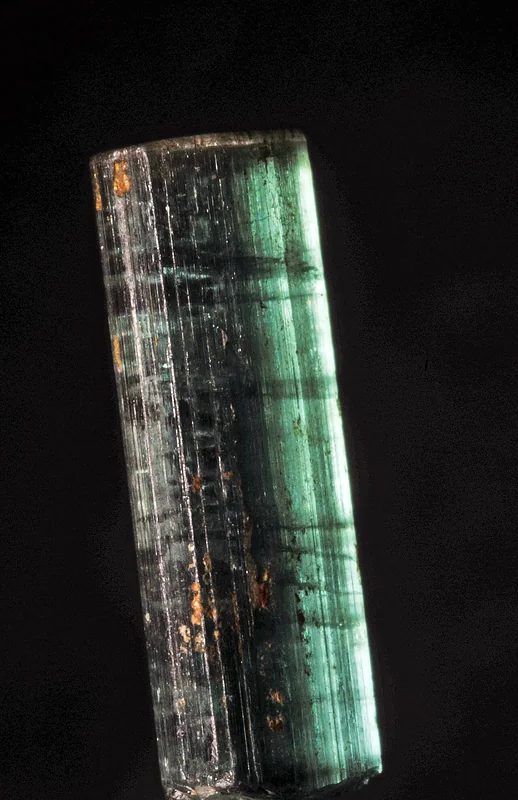
Paraiba tourmaline is the copper-bearing variety of elbaite tourmaline, characterised by an intense neon blue-green to green-blue colour unique among gemstones. The colour results from Cu2+ (cyan-blue) and Mn3+ (violet-red) in the tourmaline crystal, which together create an absorption profile transmitting an extraordinarily vivid blue-green. The original deposit in Paraiba state, Brazil, was discovered in 1989 by Heitor Dimas Barbosa after a decade of systematic searching; comparable copper-bearing tourmaline was subsequently found in Nigeria (2001) and Mozambique (2005). The LMHC definition requires copper as the essential colourant regardless of geographic origin. Brazilian material, with its original discovery and historical priority, commands premium prices.
Quick facts
- Item type
- Variety
- Mineral class
- silicate
- Mohs hardness
- 7.25
- Crystal system
- trigonal
- Chemical formula
- Na(Li,Al)3Al6(Si6O18)(BO3)3(OH)4
- Color range
- neon blue-green, turquoise-blue, violet-blue, green
- Notable localities
- Sao Jose da Batalha, Paraiba state, Brazil (original deposit, 1989); Mulungu district, Rio Grande do Norte, Brazil (later Brazilian find); Oyo State, Nigeria (copper tourmaline, 2001); Mozambique (copper tourmaline, 2005)
The Copper Chromophore
Conventional elbaite tourmaline is coloured by iron, manganese, or chromium occupying the Y octahedral site. Paraiba tourmaline's exceptional colour arises from Cu2+ in the same site — an element not found in significant concentrations in any other gem-quality tourmaline deposit. Cu2+ has a broad, very strong absorption band covering orange through red wavelengths (~700 nm), transmitting the blue-green range with unusual intensity. Mn3+ co-present in many specimens adds a secondary violet-red absorption, shifting the final colour. The resulting transmission window is extremely narrow and intense — producing a 'neon' quality where the colour appears to glow even in low light. Even small stones in the 0.5–1 ct range show vivid saturated colour due to copper's high molar extinction coefficient.
Discovery and Brazilian Deposits
Heitor Dimas Barbosa spent nearly a decade digging tunnels in a hillside in Sao Jose da Batalha municipality, Paraiba state, Brazil, based on an intuition about an unusual deposit. In 1989 his team began recovering small blue-green crystals that proved to be copper-bearing tourmaline. The discovery caused an immediate sensation in the gem trade; early stones sold rapidly for exceptional prices. The original Batalha mine was largely exhausted within a few years. Brazilian Paraiba tourmalines are typically smaller than those from Nigeria and Mozambique; sizes above 2 ct are relatively rare from the original locality. The total production from all Brazilian sites is estimated at a few thousand carats of gem-quality material.
Nigerian and Mozambican Copper Tourmaline
Copper-bearing tourmaline was discovered in Nigeria in 2001 and Mozambique (Mozambique district and Zambezia province) around 2005. Both produced material with the same copper-driven neon colour as Brazilian Paraiba. The LMHC ruled in 2006 that material may be called 'Paraiba tourmaline' regardless of geographic origin provided copper is confirmed as the primary colourant by laboratory analysis. Nigerian and Mozambican stones tend to be larger than Brazilian material — individual crystals of 5–20 ct are found. The trade assigns geographic origin premium: Brazilian > Nigerian > Mozambican for comparable quality, reflecting historical priority and limited supply. All require copper confirmation by ICP-MS trace element analysis.
Sources & further reading (3)
- gemological-institute — accessed 2026-05-08
- encyclopedia — accessed 2026-05-08
- mineral-database — accessed 2026-05-08
Frequently asked questions
What makes Paraiba tourmaline so valuable?
Paraiba tourmaline's combination of extreme rarity and uniquely vivid colour drives high prices. The original Brazilian deposit produced limited quantities before near-exhaustion; subsequent sources (Nigeria, Mozambique) increased supply but total production remains small. The copper-driven neon blue-green colour is unmatched by any other natural mineral at commercial scale — no other gem achieves this specific colour from natural processes. The small crystal sizes from Brazil further limit the per-carat supply of clean stones. Fine specimens from the original Sao Jose da Batalha deposit carry the highest premiums in the copper tourmaline market.
How do labs distinguish Brazilian from Nigerian and Mozambican Paraiba?
Geographic origin determination for Paraiba tourmaline uses trace element chemistry (primarily by LA-ICP-MS or SIMS), inclusion mineralogy, and sometimes spectroscopic fingerprinting. Brazilian material tends to have higher manganese and lower iron concentrations relative to copper compared to African sources. Inclusion assemblages also differ by geological environment. However, boundary cases exist, and different labs can sometimes disagree on origin for intermediate compositions. Origin determination is performed by GIA, Gübelin Gem Lab, SSEF, and Lotus Gemology, among others.
Is all blue-green tourmaline 'Paraiba'?
No. The Paraiba designation specifically requires confirmed copper as the primary colourant, verified by chemical analysis. Blue-green tourmaline coloured by iron or other elements (without copper) does not qualify as Paraiba tourmaline regardless of colour appearance. The trade term is protected by the LMHC definition requiring laboratory confirmation of copper. A blue-green tourmaline without a lab report confirming copper may be sold as 'blue tourmaline' or 'indicolite' but should not be called Paraiba. Some dealers use 'Paraiba-like' or 'Paraiba-type' loosely; this practice is misleading to buyers.