oxide
Padparadscha Sapphire
Rare salmon-pink corundum with orange-pink hue range; name from Sinhalese for lotus flower.
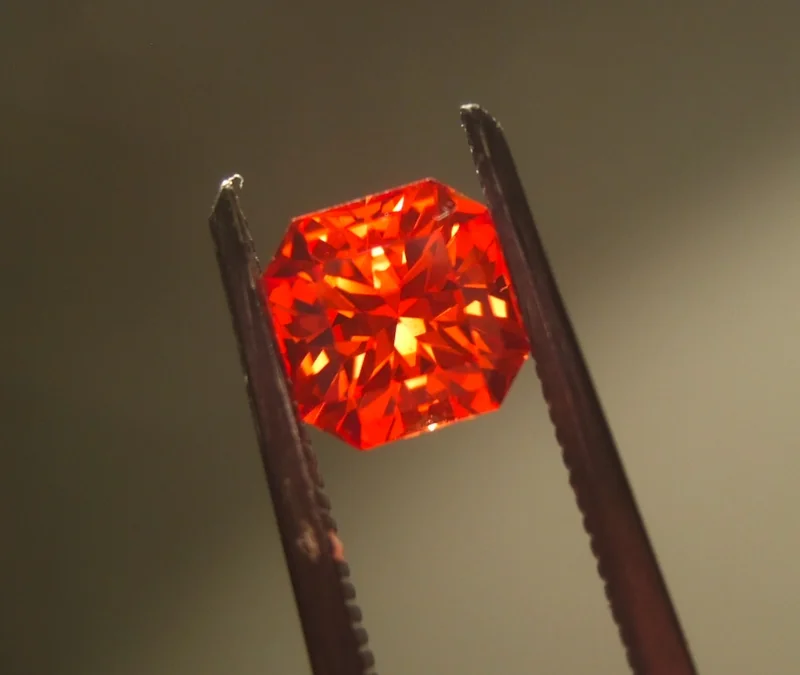
Padparadscha is the rarest colour variety of sapphire — a pinkish-orange to orangy-pink corundum (Al2O3) with a delicate salmon colour reminiscent of a Sri Lankan lotus blossom. The name derives from the Sinhalese word 'padmaraga' or Sanskrit 'padmaraga' (lotus flower colour). Colour arises from a combination of chromium (pink-red component) and iron with possible colour centres (orange component) in the corundum lattice. Sri Lanka's gem gravels are the historic source; Madagascar and Tanzania also produce padparadscha. The colour boundary definition is debated among laboratories: GIA, Gübelin, and SSEF each use slightly different saturation thresholds. Stones must be simultaneously pink and orange — neither predominantly pink (which would make them pink sapphire) nor predominantly orange.
Quick facts
- Item type
- Variety
- Mineral class
- oxide
- Mohs hardness
- 9
- Crystal system
- trigonal
- Chemical formula
- Al2O3
- Color range
- pinkish-orange, orangy-pink, salmon
- Notable localities
- Ratnapura district, Sri Lanka (gem gravels; type locality); Ilakaka, Madagascar; Tunduru, Tanzania; Mogok, Myanmar (minor)
Colour Definition and the Boundary Problem
Padparadscha occupies a specific and narrow zone of the sapphire colour space: it must display both orange and pink simultaneously, at sufficient saturation that neither the orange nor the pink component dominates to the point of reclassifying the stone. The GIA defines padparadscha as a 'pinkish-orange to orangy-pink' sapphire with light to medium saturation. Gübelin's definition requires a 'certain' salmon-pink-orange combination typical of lotus blossoms. SSEF requires a balanced mix of pink and orange with 'no predominance of one of the two hues'. Colour assessors evaluate under multiple light sources (daylight and incandescent); stones that shift toward pure orange or pure pink under lighting changes may not qualify. The boundary with pink sapphire at one end and orange sapphire at the other is subjective; borderline stones can receive different designations from different labs.
Origin and Geological Setting
Sri Lanka's Ratnapura (City of Gems) district, in alluvial gem gravels (illam) derived from metamorphic rocks of the Highland Series, has produced padparadscha sapphire for centuries. The exact colour is produced by the specific combination of Cr3+ (pink-red), Fe3+ (orange component via charge-transfer), and heat treatment history of individual crystals from the Sri Lankan metamorphic suite. Madagascar's Ilakaka placer deposit (discovered 1998) emerged as a major sapphire source; some Ilakaka material reaches padparadscha quality. Tanzania's Tunduru alluvial deposits also produce padparadscha. Heat treatment at moderate temperatures is frequently applied to Sri Lankan stones to improve colour by reducing unwanted brown tones.
Rarity and Gemological Identification
Padparadscha is among the rarest sapphire colours — even in Sri Lanka, it represents a small fraction of production. The combination of Cr3+ and Fe3+/colour centres at the precise concentrations needed for the salmon hue is uncommon in most sapphire deposits. Detecting beryllium diffusion treatment — which can shift pink or brownish stones toward orange-pink — is critical in padparadscha grading. Diffusion treatment with beryllium penetrates only the surface of the crystal; GIA and other labs detect it by laser ablation analysis of the rim vs. core chemistry. A treated padparadscha commands far lower value than an untreated stone of the same colour. Laboratory origin determination (Sri Lanka, Madagascar, Tanzania) provides additional market context.
Sources & further reading (3)
- gemological-institute — accessed 2026-05-08
- encyclopedia — accessed 2026-05-08
- gemological-institute — accessed 2026-05-08
Frequently asked questions
Why is padparadscha considered rarer than regular pink sapphire?
Pink sapphire is relatively common among sapphire colours; padparadscha requires the simultaneous presence of both a pink component (chromium) and an orange component (iron or colour centres) at precisely the right concentrations and in the right balance. If the orange dominates, the stone is classified as orange sapphire; if the pink dominates, it is pink sapphire. The narrow zone where both contribute equally to produce salmon is statistically uncommon in any sapphire deposit. Sri Lanka's specific metamorphic chemistry produces it most reliably, but even there it is a small fraction of production.
What does 'padparadscha' mean?
Padparadscha derives from the Sinhalese (Sri Lankan) word for the aquatic lotus blossom — specifically the lotus flower (Nelumbo nucifera) in its pinkish-orange colour form. The Sanskrit root 'padmaraga' means 'lotus colour'. The term entered gemological use through the Sri Lankan gem trade to describe this specific salmon-hued corundum, and was adopted by international gem labs in the 20th century. It remains primarily a gem-trade term; no single universally agreed mineralogical or colorimetric definition exists.
Can beryllium treatment create padparadscha colour?
Yes, and this is a major concern in the trade. Beryllium diffusion treatment — introduced commercially around 2002 — involves heating corundum in a beryllium-bearing flux at high temperatures. Beryllium diffuses into the surface layer of the crystal and modifies the charge compensation of existing iron and chromium, shifting pinkish-brown or yellowish-orange stones toward orange-pink. The result can mimic padparadscha colour. Detection requires laser ablation inductively coupled plasma mass spectrometry (LA-ICP-MS) to measure beryllium in the outer rim and compare with the core. All reputable labs routinely test for this treatment; treated stones are disclosed on certificates.