November Birthstone
Topaz and citrine — November's golden pair reflect late autumn's amber light.
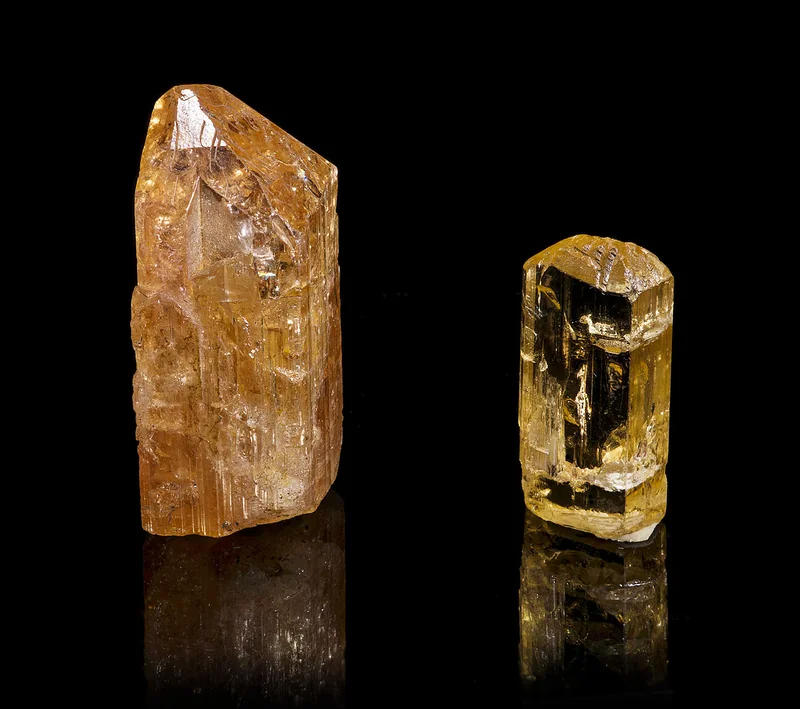
November has two birthstones: topaz (traditionally the primary stone) and citrine (added as an alternative). Topaz is a fluorine-bearing aluminium silicate (Al₂SiO₄(F,OH)₂) that occurs in many colours; the traditional November topaz is golden/imperial topaz (orange-yellow to orange-pink). Citrine is yellow to orange-yellow quartz (SiO₂), coloured by iron and often heat-treated from amethyst. Both stones share the warm yellow-to-orange colour palette of November's autumn light, falling leaves, and harvest-end season. Topaz rates 8 Mohs — harder than quartz (7) but with perfect basal cleavage that requires protective settings; citrine rates 7 Mohs. Imperial topaz from the Ouro Preto region of Brazil is among the finest coloured gems, and fine specimens command significant prices.
Quick facts
- Item type
- Birthstone month
- Color range
- imperial orange-yellow (topaz), orange-pink (topaz), blue topaz (treated), yellow (citrine), orange (citrine), golden orange (madeira citrine)
- Birthstone month
- November (traditional)
Imperial Topaz: The November Gem
The 'imperial' or 'precious' topaz trade name refers to orange to orange-pink (with a slight pink to red secondary hue) topaz from the Ouro Preto mining district in Minas Gerais, Brazil. This colour — produced by colour centres associated with chromium and structural imperfections — is the most valued topaz variety, commanding premiums over the more common blue topaz (which is almost entirely treated). Imperial topaz owes its colour to natural irradiation and the presence of trace elements during crystal growth; it is not routinely treated and the colour is stable. Topaz crystallises in the orthorhombic system and has perfect basal (001) cleavage — it will cleave cleanly along a direction perpendicular to the crystal's length if struck correctly. This cleavage requires care in setting and cutting: cutters orient the table perpendicular to the c-axis to avoid exposing the cleavage direction as the face-up view.
Citrine: The Accessible Alternative
Citrine is yellow to orange-yellow quartz, occurring naturally but most commonly produced by heat treating amethyst or smoky quartz. Natural citrine is relatively rare; the yellow colour comes from Fe³⁺ at trace levels. Heat treatment of amethyst above approximately 470°C converts the purple Fe³⁺-related colour centres to yellow/orange, producing citrine that is chemically and optically identical to natural citrine. Most commercial citrine originates from Brazilian amethyst geodes treated at Minas Gerais or Rio Grande do Sul. The Madeira citrine designation describes a deep reddish-orange citrine; the Palmeira designation describes a pale lemon yellow. Ametrine (amethyst-citrine bicolour) occurs naturally only at the Anahi mine in Bolivia. Citrine at Mohs 7 is widely available in large sizes at affordable prices, making it a practical November birthstone alternative for those who desire November colour without the imperial topaz price.
Zodiac Connection: Scorpius
November birthstones align with Scorpius (the scorpion), governing approximately October 23 to November 21. Scorpius is a water sign associated with depth, transformation, intensity, and penetrating insight — the sign that governs the darkest and most introspective part of autumn as the year moves toward winter. Imperial topaz's orange-gold colour contains an intensity that suits Scorpius's character: the warm fire within a darkening season. In traditional astrology, topaz was associated with Jupiter (the planet of wisdom and expansion) and was believed to strengthen the bearer's resolve and cool anger — attributes suited to Scorpius's passionate temperament. The Latin name 'scorpius' gives its name to the constellation and the month's deep-autumn character; the warm amber and golden tones of both November birthstones represent the last warmth before winter's approach, reflecting the transformation that Scorpius governs.
Sources & further reading (3)
- gemological-institute — accessed 2026-05-08
- gemological-institute — accessed 2026-05-08
- encyclopedia — accessed 2026-05-08
Frequently asked questions
Is blue topaz a natural colour?
Natural blue topaz exists but is rare. Almost all commercial blue topaz — the widely available 'Sky Blue,' 'Swiss Blue,' and 'London Blue' — is produced by irradiation (neutron or electron bombardment) followed by heat treatment to stabilise colour. The irradiation creates colour centres that produce blue; the heat treatment stabilises the blue and may adjust hue. The process is safe, permanent, and the resulting gems are not radioactive at commercial sale levels. Natural blue topaz from Siberia and some Brazilian localities is pale to medium blue, closely resembling aquamarine; the treated stones are considerably more saturated. Blue topaz must be disclosed as treated per FTC guidelines and gem trade ethics. The abundance and affordability of treated blue topaz (often $5–$50/ct for commercial quality) make it the most commercially significant topaz variety, though it has no traditional November association — that belongs to golden imperial topaz.
How can I tell natural citrine from heat-treated amethyst sold as citrine?
Distinguishing natural from heat-treated citrine is essentially impossible by standard gemological testing — both are chemically SiO₂ with iron-related colour centres, and routine refractometer, density, or spectroscopy tests do not distinguish origin. Advanced techniques (EPR — electron paramagnetic resonance spectroscopy) can sometimes detect differences in the specific iron defect sites. In practice, several visual indicators suggest treatment origin: heat-treated amethyst citrine often shows orange to reddish-orange colour concentrations at crystal terminations (the tips) because heating turns the originally higher-concentration amethyst colour zones to orange; natural citrine typically shows more even colour distribution. The presence of soot-like smoke inclusions in orange-brown 'Madeira' type citrine from Brazil is also consistent with heat-treated amethyst. Trade disclosure of treatment origin is required but not always reliable for mass-market citrine.
Why does topaz have a 'cleavage' problem in jewellery?
Topaz has perfect basal cleavage — it will split cleanly and completely along a plane perpendicular to the crystal's long axis if subjected to mechanical shock at the right angle. Cleavage in minerals means perfect planes of weak bonding in the crystal structure; in topaz, the fluorine-bearing (001) plane is significantly weaker than all other directions. Unlike diamond, which cleaves in four directions but is so hard that everyday impacts rarely initiate a cleavage, topaz is softer (Mohs 8) and its cleavage is perfect and easily initiated. A sharp knock to the edge of a topaz stone in the cleavage direction will produce a flat, glassy fracture that cannot be polished away without re-cutting. Protective settings (bezel or closed-back) reduce the risk. Ultrasonic cleaners that produce vibration can also initiate cleavage in topaz and are contraindicated. These limitations require more careful handling than hardness alone (Mohs 8) would suggest.