May Birthstone
Emerald — vivid green beryl of rebirth and nature; the most prized coloured gemstone.
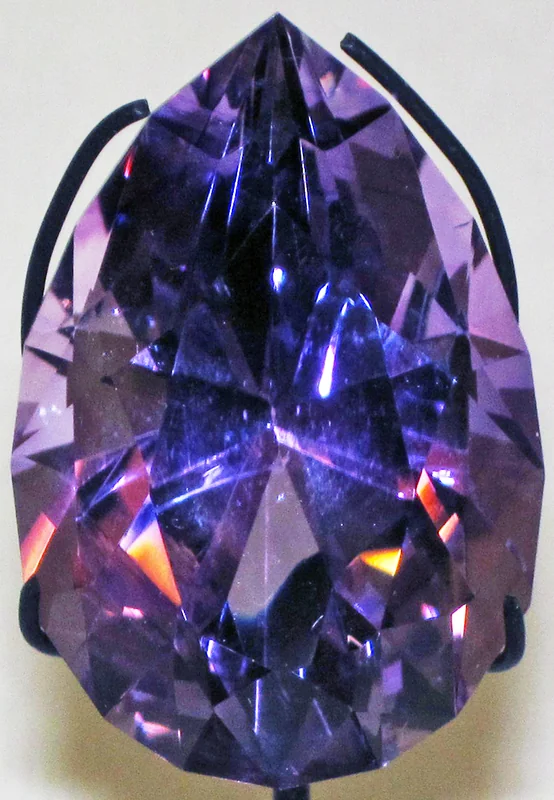
May's birthstone is emerald, the vivid green variety of beryl (Be₃Al₂Si₆O₁₈) coloured by chromium (Cr³⁺) and occasionally vanadium (V³⁺). Emerald is considered the most precious of coloured gems alongside ruby and sapphire, and fine-quality specimens per carat can exceed diamond prices. The vivid green of emerald — a saturated, slightly bluish green — has been associated with spring, rebirth, and nature across ancient cultures from Egypt to Mesoamerica. Major sources are Colombia (Muzo, Chivor, Coscuez mines — finest quality), Zambia (Kagem mine), Brazil, Zimbabwe, and Afghanistan. Emerald rates 7.5–8 Mohs but is significantly more included than other beryl — inclusions (called 'jardin') are universally present and accepted as part of the stone's character.
Quick facts
- Item type
- Birthstone month
- Color range
- vivid green, bluish green, yellowish green, medium green
- Birthstone month
- May (traditional)
Emerald's Colour and Jardin
Emerald's vivid green results from Cr³⁺ ions (and sometimes V³⁺) substituting for Al³⁺ in the beryl crystal structure, absorbing red and violet wavelengths and transmitting a saturated green. The ideal emerald colour is medium to medium-dark, vivid, bluish-green — referred to in the trade as 'pure green' with no yellow or gray modifier. Colombian emeralds are prized for this pure colour quality. Zambian emeralds tend toward a slightly darker, bluer-green; Brazilian emeralds are often lighter and more yellowish. Virtually all natural emerald contains inclusions and fractures collectively called 'jardin' (French for garden), caused by the conditions of emerald's hydrothermal formation. Unlike diamond (where eye-clean clarity is expected), emerald trade accepts jardin as characteristic — emerald is typically graded by eye rather than loupe, and 'eye-clean' emerald without obvious inclusions is considered exceptional quality regardless of what magnification reveals.
The Emerald Enhancement Trade
Almost all commercial emerald is treated with resin, oil, or wax to fill surface-reaching fractures and improve apparent clarity — a practice that has been standard in the gem trade for centuries. Cedar oil (refractive index close to emerald's) was traditional; modern fillers include Opticon resin and proprietary compounds. GIA and other labs grade the degree of enhancement (none, minor, moderate, significant) and disclose it on reports. Enhanced emerald is not considered inferior per se — the practice is ancient and accepted — but the degree of enhancement significantly affects price. 'F1' (none) and minor enhancement emeralds command significant premiums. Disclosure is required by FTC rules and gem trade ethics. Cleaning emeralds with ultrasonic cleaners or steamers is explicitly warned against because the vibration and heat can dislodge or further deteriorate fracture fillings.
Zodiac Connection: Taurus
May birthstones align with Taurus (the bull), governing approximately April 20 to May 20. Taurus is an earth sign associated with growth, material beauty, the natural world, and the fullness of spring — the sign that presides over May's maximum vegetation and fertility. Emerald's vivid green colour is the most immediate visual expression of spring and plant life, making it the most apt gem-constellation pairing in the birthstone calendar. Ancient Egyptians harvested emeralds from the Cleopatra mines near the Red Sea as early as 1500 BCE, associating the green stone with Osiris and eternal fertility. Venus, Taurus' ruling planet, was associated with emerald in multiple astrological traditions — emerald was the gem of Venus in Vedic (jyotish) astrology, where it strengthens Mercury but was broadly linked to material abundance and beauty.
Sources & further reading (2)
- gemological-institute — accessed 2026-05-08
- encyclopedia — accessed 2026-05-08
Frequently asked questions
Why are emeralds always included and what does jardin mean?
Emerald forms in hydrothermal environments where beryllium-bearing fluids interact with chromium-bearing country rocks at relatively low temperatures and variable pressures. These conditions almost invariably produce fractures, fluid inclusions, crystal inclusions (pyrite, actinolite, calcite), and healed fractures filled with mineral matter during crystal growth. The term 'jardin' (French: garden) was coined by French gem dealers in the 19th century to describe this internal landscape of inclusions — viewing a fine emerald under magnification reveals what looks like garden vegetation, frozen in crystal. Unlike other coloured gems (sapphire, ruby) where loupe-clean specimens exist in abundance, truly inclusion-free emerald essentially does not exist in gem quality material. The trade accepts and even celebrates jardin as evidence of natural origin — heavily included emerald is still valued highly if colour is exceptional, and jardin can be used as a provenance indicator for specific mines.
What is the difference between Colombian, Zambian, and Brazilian emerald?
Origin significantly affects emerald price and character. Colombian emeralds from the Muzo, Chivor, and Coscuez mines are considered the global benchmark — Muzo stones have a warm, vivid, slightly yellowish-green; Chivor stones tend toward a cooler, slightly bluish-green; both command premiums over non-Colombian sources for equivalent colour. The difference lies in geology: Colombian emeralds form in black shale/evaporite sequences, producing a particular chromium+vanadium chemistry that creates the 'pure' colour prized by the trade. Zambian emeralds (Kagem mine) are slightly darker, bluer, and often more heavily included but can rival Colombian quality at lower price points. Brazilian emeralds (Carnaiba, Nova Era) tend toward lighter yellowish-green. Fine specimens from any origin can command top prices, but at equivalent quality, Colombian origin adds 20–100% or more premium.
Can emerald be used in everyday jewellery?
Emerald requires protective settings and careful handling for jewellery use. At Mohs 7.5–8, emerald is hard enough to resist most scratching, but its extensive jardin makes it more fragile than aquamarine (also Mohs 7.5–8 but far less included) — a surface-reaching fracture can propagate under mechanical stress. Emergency ring settings (bezel or collet) protect the girdle and reduce chipping risk; claw/prong settings expose the edges. Ultrasonic and steam cleaners are strictly prohibited because vibration can crack filled fractures and remove oil/resin treatment. Warm soapy water with a soft brush is safe. For rings, moderate wear is acceptable but high-impact use (sports, construction) risks chipping. For earrings and pendants, emerald is durable enough for regular use. Periodic re-oiling by a jeweller can restore appearance after cleaning removes surface fillers.