Marquise Cut
Elongated navette-shaped brilliant cut with pointed ends; maximises apparent size per carat.
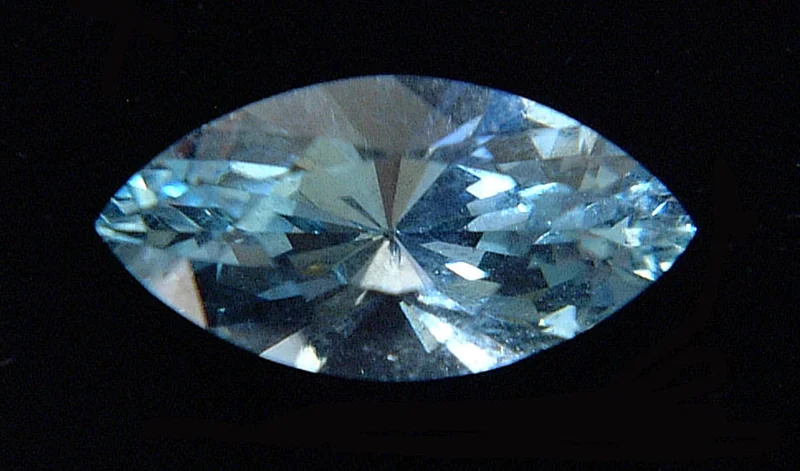
The marquise cut (also called navette cut, French for 'little boat') is a modified brilliant cut with an elongated elliptical outline terminating in pointed cusps at both ends. It typically has 55 to 58 facets arranged in the brilliant pattern adapted to the navette outline. The marquise cut produces one of the largest apparent face-up surface areas per carat of any diamond shape — approximately 15% more surface area than a round brilliant of equivalent weight — making stones appear larger than their carat weight suggests. Standard length-to-width ratios range from 1.85:1 to 2.10:1 for most commercially desirable marquise cuts. The cut is traditionally attributed to a commission by King Louis XV of France inspired by the Marquise de Pompadour, c. mid-18th century.
Quick facts
- Item type
- Cut
Geometry and Optical Properties
The marquise cut has two points (cusps) at the ends of its long axis and a curved girdle forming the navette shape. Facets follow the brilliant pattern: table, bezel facets, star facets, and upper girdle facets on the crown; pavilion main facets, lower girdle facets, and culet below. The elongated outline means the crown facets must be adapted from the radially symmetric round brilliant pattern to fit the longer axis. Proportions significantly affect optical performance: a standard marquise with optimal depth (59–63%) and balanced length-to-width ratio produces strong brilliance; deviations cause a 'bow-tie effect' — a dark shadow across the center of the stone visible face-up, caused by light escaping through the pavilion in the central area where the stone is thinnest relative to its width. All marquise-cut diamonds have some degree of bow-tie; the goal is minimising its severity.
Historical Attribution and Naming
The marquise cut's name and origin story are widely cited but historically uncertain. The most common attribution is that Louis XV of France (reigned 1715–1774) commissioned a diamond cut to resemble the smile of his mistress Jeanne Antoinette Poisson, the Marquise de Pompadour. No contemporary documentation confirms this specific commission, but the shape was certainly in use in 18th-century French court jewellery. The term 'navette' (little boat) is the older and more precise French term for the shape; 'marquise' became the dominant English-language term. The cut was popular in Victorian and Edwardian jewellery for its elegant, elongating form. It returned to fashion in the 1970s–1980s and remains a standard shape for diamond engagement rings, particularly in three-stone settings where the center marquise flanks with tapered baguettes or matching smaller marquises.
The Bow-Tie Effect
The bow-tie effect is a characteristic optical artifact in marquise (and pear) cut diamonds: a darkened area resembling a bow tie visible face-up across the narrow center of the stone. It results from the pavilion geometry — in the central region of the stone, the pavilion facets cannot achieve total internal reflection at the same efficiency as near the cusps, allowing some light to pass through and appear dark to the observer. Bow-tie severity varies from negligible (barely visible) to severe (obvious dark band across the center). Cut quality assessments for marquise diamonds specifically evaluate bow-tie. Optimising pavilion depth, culet position, and pavilion facet angles for the specific length-to-width ratio of the stone reduces bow-tie severity. Since GIA does not issue a cut grade for marquise diamonds, buyer assessment must occur in-person or through detailed proportion data.
Sources & further reading (2)
- gemological-institute — accessed 2026-05-08
- encyclopedia — accessed 2026-05-08
Frequently asked questions
Why does the marquise cut make diamonds look larger?
The marquise cut produces a larger face-up surface area per carat than most other cuts because it distributes the stone's mass in a spread-out flat oval rather than concentrating depth in the pavilion. A 1-carat round brilliant has a diameter of approximately 6.5 mm (face-up area approximately 33 mm²); a 1-carat marquise measures approximately 10.5 × 5.3 mm (face-up area approximately 43 mm²), appearing noticeably larger face-up. The elongated shape also visually elongates the wearer's finger when worn on a ring in the traditional north-south orientation, an aesthetic advantage cited by jewellery designers. However, larger spread comes at the cost of reduced depth, which can reduce brilliance if proportions are too shallow.
How should a marquise diamond be set to protect the points?
The marquise cut's two cusps (points at each end) are the most vulnerable parts of the stone — they can chip if struck. Standard protective settings include V-prongs (or claw prongs shaped to cap each point) at both ends. A bezel or half-bezel setting provides maximum protection but hides the point shape somewhat. In solitaire settings, the minimum is two V-prongs at the ends plus two or four prongs at the middle of the curved sides. The north-south orientation (points toward the finger end and knuckle) is traditional and positions the vulnerable cusps along the finger's long axis where they are less likely to be struck in daily wear compared to east-west orientation.
Is the marquise cut still popular for engagement rings?
The marquise cut is less dominant today than in its 1970s–1980s peak but remains a standard option offered by major jewellers. It is particularly favoured for three-stone and halo settings where its elongated form creates elegant visual lines. The marquise's finger-elongating visual effect remains a consistent selling point. In recent years (approximately 2015–2025), elongated fancy shapes in general have seen renewed popularity — the elongated oval, the pear, and the marquise have all benefited from a trend toward non-round silhouettes in engagement jewellery. Laboratory-grown diamond availability at lower prices has also renewed interest in marquise cuts among buyers seeking visual impact per budget.