silicate
Lapis Lazuli
Deep-blue metamorphic rock composed of lazurite, calcite, and pyrite; Mohs 5–6.
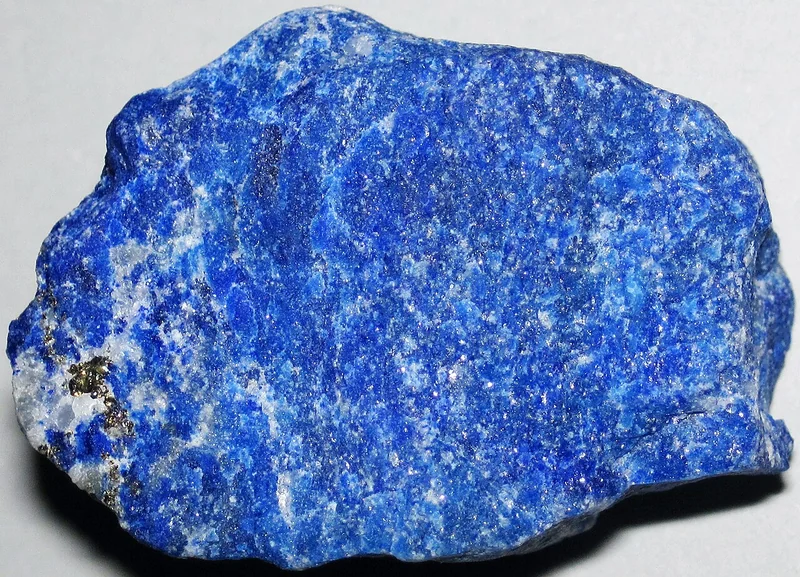
Lapis lazuli is not a single mineral but a metamorphic rock composed primarily of lazurite (a blue feldspathoid mineral, (Na,Ca)8(AlSiO4)6(S,SO4,Cl)2), along with calcite (CaCO3) and pyrite (FeS2). The intense blue colour comes from sulfur radical S3- in the sodalite-group lazurite structure. It rates 5–6 on the Mohs scale. The Afghan deposit at Sar-e-Sang in Badakhshan Province has been continuously mined for at least 7,000 years, making it one of the oldest operating gemstone mines in the world. Lapis lazuli was historically ground into ultramarine pigment (used by Raphael, Michelangelo, Vermeer), and was traded across the ancient world from Afghanistan to Egypt and Mesopotamia.
Quick facts
- Item type
- Mineral
- Mineral class
- silicate
- Mohs hardness
- 5.5
- Crystal system
- cubic
- Chemical formula
- Complex aggregate: lazurite (Na,Ca)8(AlSiO4)6(SO4,S,Cl)2 + calcite + pyrite
- Color range
- deep-blue, royal-blue, blue-violet
- Notable localities
- Sar-e-Sang, Kokcha Valley, Badakhshan, Afghanistan (oldest mine, finest quality); Lake Baikal region, Russia (lighter blue, lower lazurite content); Ovalle, Coquimbo Region, Chile (denim blue); Cerro Sapo, Minas Gerais, Brazil (minor commercial)
Mineralogy: Lazurite and the Rock Aggregate
Lapis lazuli is classified as a rock rather than a mineral because it consists of multiple minerals. The principal colouring component is lazurite, a sulfur-bearing member of the sodalite group with the ideal formula Na8(AlSiO4)6S3. The intense blue is produced by trisulfur radical anions (S3-) trapped in cage-like sodalite cages within the lazurite structure — the same chromophore responsible for the blue-green colour of natural ultramarine pigment. Calcite (white) occurs as vein fillings and grains within the lazurite mass, and pyrite (gold) as metallic flakes and disseminated grains. The ratio of lazurite to calcite and pyrite determines grade: the finest Afghan material is deep, uniform blue with minimal white calcite veining and dispersed (rather than heavy) pyrite. Lazurite crystallises in the cubic system.
The Sar-e-Sang Mine and Ancient Trade
The Sar-e-Sang deposit in the Kokcha River valley of Badakhshan Province, Afghanistan, has produced lapis lazuli continuously since approximately 7000 BCE — one of the world's oldest operational mines. Mining occurs by fire-setting (heating the rock and dousing with cold water to fracture it) in narrow tunnels at altitudes above 3000 m. Artifacts containing lapis lazuli have been found in Mesopotamian sites (Ur) dated to 3100 BCE, Egyptian Predynastic graves (c. 3200 BCE), and the Indus Valley civilisation, indicating an extensive Bronze Age trade network centred on the Afghan source. The Afghan lapis lazuli trade route was one of the oldest continuously operated long-distance trade routes in human history, predating the Silk Road.
Ultramarine Pigment
Before 1826, natural ultramarine — produced by grinding lapis lazuli and removing calcite and pyrite through a laborious washing process with clay and oil — was the most expensive blue pigment in Europe, more costly than gold by weight. Medieval and Renaissance artists reserved it for the most significant elements in paintings, particularly the Virgin Mary's robe. The production process was a closely guarded secret of certain studios. Raphael, Vermeer, and Michelangelo used it extensively; its characteristic deep blue is visible in paintings that have retained their colour because natural ultramarine is chemically very stable. In 1826, French chemist Jean-Baptiste Guimet synthesised artificial ultramarine (synthetic lazurite equivalent) at a fraction of the cost, ending the trade in natural pigment within decades.
Sources & further reading (3)
- gemological-institute — accessed 2026-05-08
- encyclopedia — accessed 2026-05-08
- mineral-database — accessed 2026-05-08
Frequently asked questions
What causes the blue colour of lapis lazuli?
The blue comes from trisulfur radical anions (S3-) trapped inside sodalite cage structures in the lazurite component. These radical anions have a strong absorption band around 600 nm (red and orange), leaving blue-violet transmitted and reflected light. The S3- radical is the same chromophore found in synthetic ultramarine, sodalite, and some blue minerals related to the feldspathoid group. The pyrite in lapis lazuli does not contribute to the blue colour — it appears as golden metallic flakes. Calcite veins appear white and reduce the uniformity of colour.
How is lapis lazuli graded?
Lapis lazuli grading considers colour uniformity and intensity, ratio of lazurite to calcite and pyrite, and overall appearance. Grade 1 (AAA) is deep, uniform royal blue with minimal calcite veins and evenly distributed fine pyrite sparkle. Lower grades have more white calcite veining (which reduces the depth and uniformity of blue), larger pyrite patches, or less saturated colour. The best Afghan material (Sar-e-Sang, top grade) has the deepest, most uniform blue. Chilean lapis is generally lighter and more purplish. Russian lapis tends toward a denim blue with more calcite.
Why does lapis lazuli contain gold flecks?
The gold flecks in lapis lazuli are pyrite (FeS2), an opaque iron sulfide mineral with a brassy metallic lustre. Pyrite crystallises alongside lazurite in the contact metamorphic environment where lapis forms (limestone contact with igneous intrusions). The pyrite is not associated with gold in any commercial sense — it is sometimes called 'fool's gold' because it can superficially resemble gold flakes. The amount of pyrite varies; some buyers prefer stones with scattered fine pyrite sparkle as a decorative feature, while others prefer stones with minimal pyrite and maximum blue uniformity.