June Birthstone
Pearl, alexandrite, and moonstone — June's trio includes the sea's gem and a colour-changing chrysoberyl.
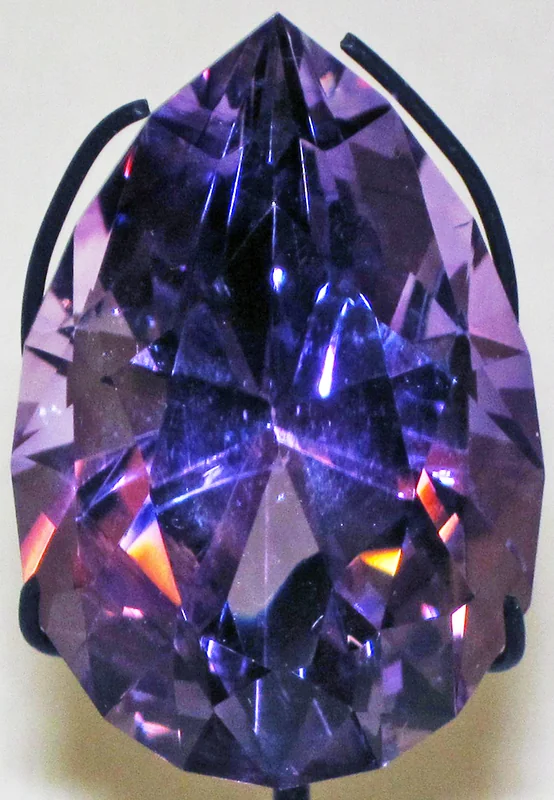
June is one of only three months with three modern birthstones: pearl, alexandrite, and moonstone. Pearl (the traditional primary stone) is the only gem produced by a living organism — a mollusc that deposits nacre layers around an irritant to form a sphere. Alexandrite is a rare colour-change chrysoberyl (BeAl₂O₄) that appears green in daylight and red under incandescent light. Moonstone is an orthoclase feldspar (KAlSi₃O₈) with adularescence — a floating, milky glow. The three June stones are distinct materials sharing June only by convention. Pearl symbolises purity, wisdom, and the sea; alexandrite symbolises luck and change; moonstone evokes intuition and the lunar cycle. Pearl was formalised for June in the 1912 ANJA list; alexandrite and moonstone were added in 20th-century updates.
Quick facts
- Item type
- Birthstone month
- Color range
- white (pearl), cream (pearl), green-red (alexandrite), white-blue (moonstone), black (Tahitian pearl)
- Birthstone month
- June (traditional)
Pearl: The Organic Gem
Pearl is formed when a mollusc — typically an oyster (Pinctada species) or freshwater mussel — deposits concentric layers of nacre (aragonite platelets embedded in conchiolin protein) around an irritant inside its mantle. Natural pearls form entirely from the mollusc's response to a natural irritant; cultured pearls are initiated by human implantation of a bead or tissue graft. The cultivation of pearls by Mikimoto Kōkichi from the early 1900s transformed pearl from a rare luxury to a widely accessible gem, and today virtually all commercial pearls are cultured. Major types include Akoya (Japan/China, white/cream, 6–9 mm), Tahitian (French Polynesia, dark/black, 8–15 mm), South Sea (Australia/Philippines, white/gold, 10–18 mm), and freshwater (China, various). Pearl quality is assessed by lustre (mirror-like surface reflection), surface cleanliness, shape, colour, and size. Pearl rates only 2.5–4.5 Mohs — extremely fragile compared to other gems — and should never contact acid, hairspray, or abrasives.
Alexandrite: The Colour-Change Chrysoberyl
Alexandrite was first described from the Ural Mountains of Russia in 1830 (named for Tsar Alexander II). Its dramatic colour change — green in daylight/fluorescent light and red-purple under incandescent light — is caused by Cr³⁺ ions creating an absorption band that falls in the yellow-green region. The human eye's sensitivity shifts under different lighting conditions in a way that makes the green side dominant in daylight and the red side in incandescent. Fine alexandrite (Ural origin) showing strong green-to-red change with good saturation is among the most valuable gems per carat — comparable to top ruby and emerald. Brazilian alexandrite (Minas Gerais) and Sri Lankan alexandrite are additional sources; Ceylon alexandrite tends toward olive-green rather than pure green. The birthstone calendar added alexandrite to June lists in the 20th century (AGTA modernisation), making June the only month with both an organic gem (pearl) and a rare mineral (alexandrite).
Zodiac Connection: Gemini
June birthstones align with Gemini (the twins), governing approximately May 21 to June 20. Gemini is associated with duality, communication, adaptability, and the interplay of opposites. June's trio of birthstones mirrors this duality remarkably: alexandrite, the definitive colour-change gem (green by day, red by night), is the most direct gemological expression of Gemini's dual nature. Pearl's organic origin (living creature / mineral product) and moonstone's adularescence (light floating within a solid) both embody the liminal, in-between quality of the Gemini sensibility. Gemini is an air sign ruled by Mercury, associated with quick perception and the ability to hold multiple perspectives simultaneously — all three June stones reward observation: pearl's lustre, alexandrite's colour change, and moonstone's adularescent glow all reveal themselves differently depending on how the observer moves and what light they use.
Sources & further reading (3)
- gemological-institute — accessed 2026-05-08
- gemological-institute — accessed 2026-05-08
- encyclopedia — accessed 2026-05-08
Frequently asked questions
What is the difference between natural and cultured pearls?
Natural pearls form entirely without human intervention — a wild mollusc deposits nacre around a naturally occurring irritant over years or decades, producing a sphere of 100% nacre. They are extremely rare today due to over-harvesting of pearl oyster fisheries in the 19th and early 20th centuries. Cultured pearls are initiated by a human-inserted nucleus (typically a bead of freshwater mussel shell for saltwater pearls) coated in nacre over 2–5 years in aquaculture farms. The resulting cultured pearl has a nacre coating of 0.3–3+ mm over the nucleus. Both natural and cultured are real pearls — the nacre composition and lustre are identical. GIA X-ray examination can distinguish them by detecting the nucleus. For the vast majority of consumers, cultured pearl is the only type available; natural pearls of significant size command extraordinary premiums at auction (hundreds of thousands to millions of dollars for fine specimens).
How rare is alexandrite?
Fine alexandrite is genuinely rare — rarer than ruby, sapphire, or emerald of comparable quality. The original Ural Mountain deposits (Russia) are effectively exhausted for commercial production; new material from Brazil, East Africa, and Sri Lanka is available but typically shows weaker colour change or less saturated colour than the best Russian material. The specific combination of chromium chemistry and the host mineral beryllium aluminate (chrysoberyl) that produces the ideal alexandrite colour change requires a geological coincidence where both beryllium and chromium are available together — chromium is normally found in mafic/ultramafic settings that are low in beryllium. Most chrysoberyl deposits lack the chromium for alexandrite. Fine one-carat Russian alexandrite (strong green-to-red, good saturation, eye-clean clarity) can retail for $10,000–$60,000+ per carat, with fine specimens in larger sizes commanding higher prices at auction.
What causes moonstone's adularescence?
Moonstone's adularescence — the floating, billowing light that seems to glow from within the stone — is produced by interference of light from alternating lamellar intergrowths of orthoclase and albite feldspar within the crystal. When these alternating layers are thin enough (approximately 100–300 nm thick), they scatter light preferentially at blue wavelengths and produce an interference colour that shifts across the stone's surface as the viewing angle changes. This gives the appearance of a light source moving inside the stone. The quality of adularescence depends on the thickness of the layers: very thin layers produce a blue sheen (most valued, often from Sri Lanka); thicker layers produce a white to yellowish glow. Sri Lanka produces the finest blue-adularescent moonstone; India produces abundant moonstone with white to yellow adularescence; the difference is one of market preference and layer thickness in the crystal structure.