January Birthstone
Garnet — deep red gem of loyalty and constancy associated with the midwinter month.
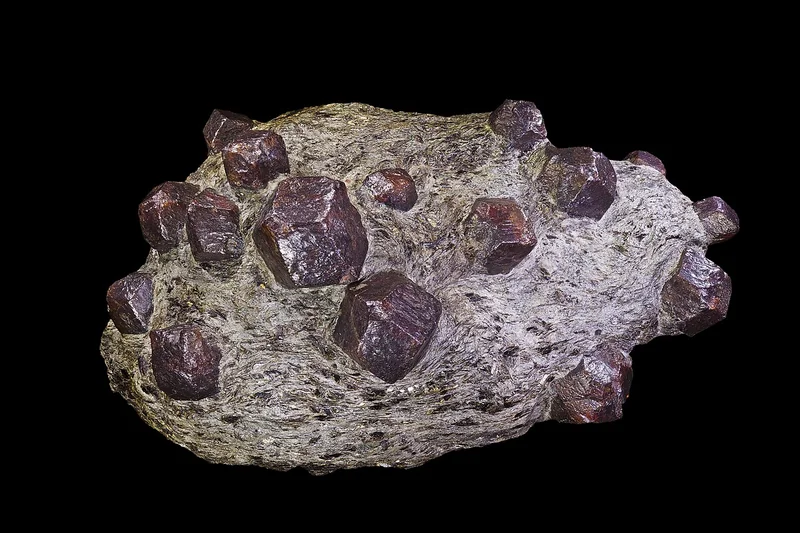
January's birthstone is garnet, most commonly represented by deep red almandine or pyrope-almandine garnet. The association of garnet with January reflects its historical abundance and deep red colour evoking blood warmth in the coldest month of the calendar. Garnet as a group encompasses many species — almandine (Fe₃Al₂Si₃O₁₂), pyrope, spessartine, grossular, andradite, and uvarovite — in colours from deep red to orange, green, and colourless. The traditional and modern January birthstone is red garnet, but the AGTA birthstone list permits any garnet colour, meaning tsavorite (green grossular) and mandarin garnet (orange spessartine) also qualify. Garnet ranks 6.5–7.5 Mohs depending on species.
Quick facts
- Item type
- Birthstone month
- Color range
- deep red, orange-red, reddish-purple, green (tsavorite), orange (spessartine)
- Birthstone month
- January (traditional)
Garnet as January's Stone
The association of garnet with January derives from the gem's historical prevalence in the market and its deep red colour, culturally associated with blood warmth, protection, and loyalty — qualities thematically suited to the coldest month in the Northern Hemisphere calendar. The birthstone calendar was not systematised until the 18th century: the Polish gem trade in 1742 and the American National Retail Jewelers Association in 1912 formalised birthstone lists that both named garnet for January. The 1912 list specifies 'garnet' without restricting species, which is why modern jewellers offer green tsavorite and orange spessartine as January birthstones alongside traditional red garnet. The Bohemian garnet tradition (clustered pyrope-almandine garnets from Czech Republic deposits) represents one of the oldest continuous garnet jewellery traditions, active since the 16th century.
Garnet Species and Varieties
The garnet group is not a single mineral but a family of related silicate minerals sharing a common crystal structure. The principal gem species are: almandine (iron aluminium silicate, deep red to reddish-purple, most common), pyrope (magnesium aluminium silicate, blood red to crimson), spessartine (manganese aluminium silicate, orange to reddish-orange), grossular (calcium aluminium silicate, including colourless, pale green tsavorite, and hessonite orange-brown), andradite (calcium iron silicate, including demantoid green and topazolite yellow), and uvarovite (calcium chromium silicate, emerald green but rarely gem-quality size). Most commercial garnets are solid solutions between end-members, particularly pyrope-almandine (Bohemian garnet, rhodolite) and spessartine-almandine. The dispersion of andradite demantoid (0.057) exceeds diamond (0.044), making it the most fiery of all garnets.
Zodiac Connection: Capricornus
January birthstones align with Capricornus (the sea goat), the zodiac constellation governing approximately December 22 to January 19. Capricornus is one of the oldest recognised constellations, appearing in Babylonian star catalogues as MUL.SUḪUR.MAŠ ('the goat fish'). The connection between garnet and Capricornus attributes to the goat sign qualities of endurance, reliability, and deep commitment — mirroring garnet's traditional symbolism of constancy and loyalty. In traditional gemstone astrology, garnet was associated with Mars and with the strengthening of blood and vital force, associations fitting for Capricorn's earthy, enduring character. Contemporary birthstone associations maintain January/garnet/Capricorn as a coherent cluster across Western astrological tradition.
Sources & further reading (2)
- gemological-institute — accessed 2026-05-08
- encyclopedia — accessed 2026-05-08
Frequently asked questions
Can January birthstones be a colour other than red?
Yes. While red garnet is the classic and traditional January birthstone, the AGTA and most modern jewellery industry standards specify 'garnet' as the stone without restricting colour. This means green tsavorite garnet (a vivid green grossular from Kenya/Tanzania, Mohs 6.5–7.5) and orange-red spessartine garnet (Mandarin garnet from Nigeria/Namibia) are equally valid January birthstones. Colour-change garnets (which shift from blue-green in daylight to reddish-purple under incandescent light) are among the rarest and most coveted garnet varieties. The traditional January association specifically invokes red garnet's deep red colour, but modern birthstone jewellery markets actively offer the full garnet colour range.
What is the difference between pyrope and almandine garnet?
Pyrope (Mg₃Al₂Si₃O₁₂) and almandine (Fe₃Al₂Si₃O₁₂) are both red garnets but differ in their magnesium (pyrope) versus iron (almandine) content. Pure pyrope is blood red to crimson; pure almandine is deep red to reddish-brown to reddish-purple. Natural gems are almost always pyrope-almandine solid solutions — the Bohemian garnets of Czech Republic are high-pyrope almandine; rhodolite garnet (a fine pink-red to purple-red variety) is a specific pyrope-almandine ratio. Pyrope tends to be slightly lighter red and more transparent; almandine tends to be darker and denser (higher iron content increases specific gravity to 3.95–4.20 for almandine versus 3.62–3.87 for pyrope). In practice, distinguishing the two in mixed natural specimens requires spectroscopy.
Is garnet durable enough for everyday jewellery?
Garnet ranges from Mohs 6.5 (some grossulars) to 7.5 (almandine, spessartine), placing it in the same hardness range as quartz and typical dust. This means garnet surfaces can be scratched by quartz dust (everyday environmental abrasive), so rings worn daily should be expected to show surface abrasion over years. Garnet has no cleavage, giving it good toughness — it does not cleave easily when struck. For earrings, pendants, and occasional-wear rings, garnet is durable enough for most uses. High-wear applications like every-day rings are better served by stones of Mohs 8 or above (spinel, sapphire, ruby). Demantoid garnet's dispersive fire makes it particularly desirable for jewellery but its Mohs 6.5 hardness requires protective settings for rings.