silicate
Jade (Nephrite & Jadeite)
Trade term covering two distinct minerals: jadeite (pyroxene) and nephrite (amphibole).
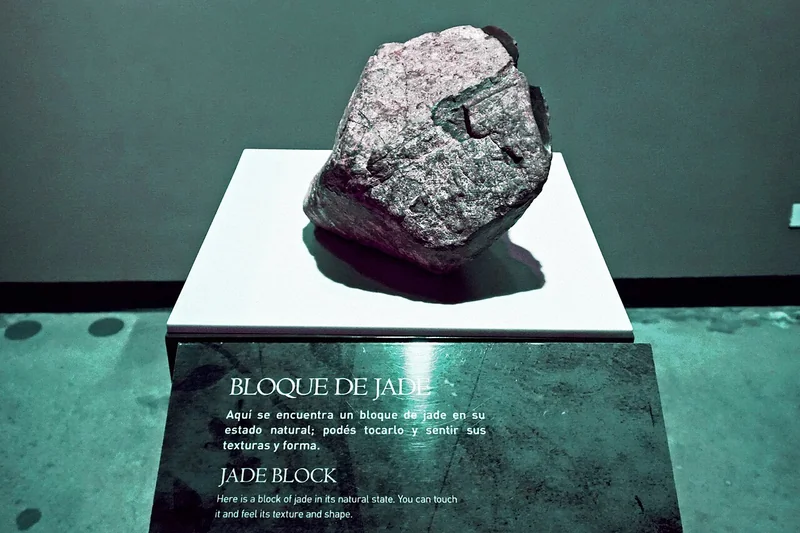
Jade is a trade term applied to two mineralogically distinct minerals: jadeite (NaAlSi2O6, a pyroxene group mineral) and nephrite (Ca2(Mg,Fe)5Si8O22(OH)2, an amphibole group mineral). Both have been used as gemstones and tools for millennia but have different chemistry, crystal structures, and geological origins. Jadeite rates 6.5–7 on Mohs, crystallises in the monoclinic system, and occurs in high-pressure metamorphic settings. Nephrite rates 6–6.5 and also crystallises in the monoclinic system via metamorphic processes. The distinction was established by French mineralogist Alexis Damour in 1863. Myanmar's Hpakan area produces the primary commercial jadeite; nephrite comes from Canada, China, New Zealand, Russia, and other sources.
Quick facts
- Item type
- Mineral
- Mineral class
- silicate
- Mohs hardness
- 6.5
- Crystal system
- monoclinic
- Chemical formula
- NaAlSi2O6 (jadeite); Ca2(Mg,Fe)5Si8O22(OH)2 (nephrite)
- Color range
- green, white, lavender, yellow, orange, grey, black
- Notable localities
- Hpakan, Kachin State, Myanmar (dominant jadeite source); Zermatt, Switzerland (historic European jadeite find); British Columbia, Canada (nephrite); Xinjiang, China (Hetian/Hotan nephrite); Southland, New Zealand (Tangiwai and bowenite nephrite)
Jadeite and Nephrite: Two Different Minerals
Jadeite (NaAlSi2O6) belongs to the pyroxene group — single-chain silicates. It forms in high-pressure, low-temperature metamorphic environments (blueschist facies), typically in subduction zones where oceanic crust is forced deep into the mantle. Myanmar's Hpakan deposit formed along the Sagaing Fault subduction zone. Jadeite has a fine interlocking granular texture of felted crystals that gives it exceptional toughness despite moderate hardness. 'Imperial jade' is the translucent, vivid green jadeite coloured by chromium impurities; other varieties include lavender (Mn), yellow, and white. Nephrite (Ca2(Mg,Fe)5Si8O22(OH)2) belongs to the actinolite-tremolite amphibole series — double-chain silicates. It forms in contact or regional metamorphism, often in serpentinite belts. Its fibrous, matted crystal texture gives it greater toughness than jadeite. Nephrite ranges from dark spinach-green (iron-rich) to creamy white (magnesium-rich).
Imperial Jade and Myanmar Jadeite
Myanmar's Hpakan-Tawmaw area in Kachin State has been the world's dominant jadeite source for at least 500 years. 'Imperial jade' designates the finest translucent to semi-transparent, vivid emerald-green jadeite coloured by chromium; it commands the highest prices in Chinese and East Asian markets. The colour intensity (chroma), translucency (water content), and freedom from mottling determine grade. The jadeite from Hpakan occurs in high-pressure/low-temperature metamorphic belts as boulders and seams within albite-phengite schist and serpentinite. Other jadeite colours from Myanmar include lavender (Mn2+), yellow-orange (iron oxide staining), and white (albite-rich). Secondary jadeite sources exist in Guatemala (Motagua Valley) and Japan (Kotaki), but neither approaches Myanmar's volume.
Nephrite Toughness and Historical Use
Nephrite's fibrous, matted microcrystalline texture makes it the toughest natural stone — tougher even than steel in impact resistance, though softer on the Mohs scale than quartz. This toughness made it the material of choice for prehistoric tool-making (adzes, clubs, weapons) in New Zealand (Maori pounamu), China (Neolithic Liangzhu culture jade axes), and across the Pacific. Hetian (Hotan) nephrite from Xinjiang, China — the 'mutton fat' white variety — has been prized in Chinese art since the Shang dynasty (c. 1600 BCE). China's imperial carving tradition used Hetian nephrite for ritual objects (bi disks, cong tubes) recorded in the Zhou dynasty ritual text Zhouli. 'Mutton fat jade' (yangzhiyu) refers to a specific grade of translucent, creamy-white Hotan nephrite without grayish tones.
Sources & further reading (3)
- gemological-institute — accessed 2026-05-08
- encyclopedia — accessed 2026-05-08
- mineral-database — accessed 2026-05-08
Frequently asked questions
What is the difference between jadeite and nephrite?
Jadeite (NaAlSi2O6) and nephrite (Ca2(Mg,Fe)5Si8O22(OH)2) are completely different minerals with different chemical compositions, crystal structures, and geological origins, though both have been used as jade for millennia. Key differences: jadeite is harder (Mohs 6.5–7 vs 6–6.5 for nephrite); jadeite has a higher specific gravity (3.3 vs 2.9–3.0 for nephrite); jadeite forms in subduction-zone metamorphic environments; nephrite in amphibolite contact metamorphism. Visually, fine jadeite can be transparent and intensely green; nephrite is typically more opaque with a waxy lustre. A refractometer and specific gravity measurement distinguish them clearly.
What makes imperial jade green?
Imperial jade's characteristic vivid green is caused by chromium (Cr3+) impurities in the jadeite crystal structure, substituting for aluminium. The same chromium mechanism produces the green of emerald and tsavorite garnet. The concentration of chromium and its distribution in the interlocking jadeite crystals determines colour intensity and uniformity. Jadeite without chromium is white (pure NaAlSi2O6); other colours come from iron (yellow), manganese (lavender), and surface oxidation staining. The colour is stable and no heat treatment is applied to enhance it in natural material.
What is 'B jade' or polymer-treated jadeite?
B jade is a trade term for jadeite that has been bleached with acid to remove brownish iron staining (a common condition called 'rusty jade'), then impregnated with polymer resin (usually epoxy or paraffin) to fill the micro-fractures created by the acid and to restore transparency and colour. The treatment creates cosmetically attractive stones from lower-quality material. B jade is distinguished from untreated (A jade) by laboratory examination: Raman spectroscopy detects polymer; infrared spectroscopy reveals impregnation. A jade is untreated natural jadeite; C jade is dyed. In Chinese trade, the A/B/C classification is a disclosure standard. B and C jade are less durable than A jade because the impregnation can yellow or deteriorate over time.