silicate
Imperial Topaz
Orange to orange-pink topaz variety; Ouro Preto, Brazil; most commercially valued topaz colour.
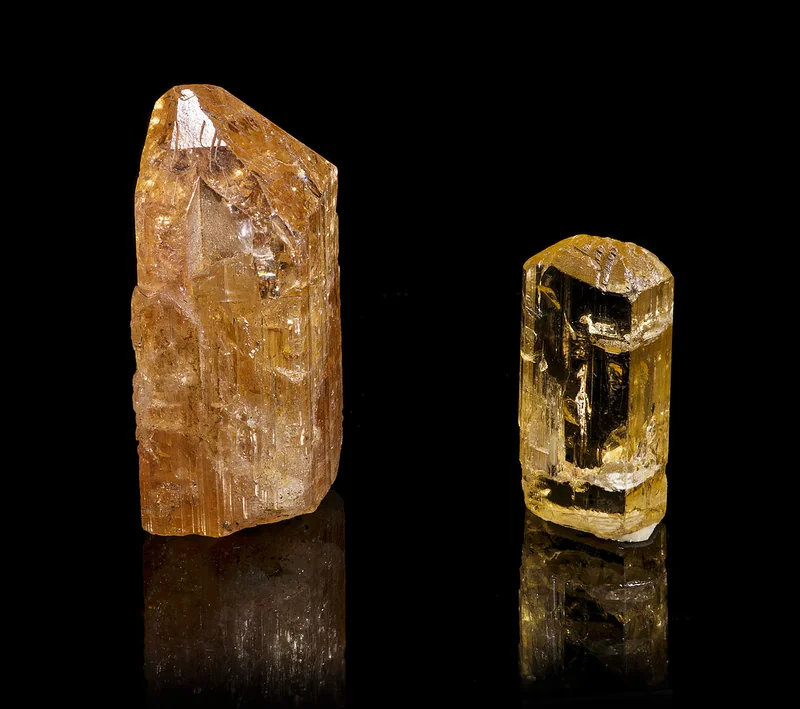
Imperial topaz is a trade designation for the most commercially prized colour of topaz — a rich orange to orange-pink to reddish-orange, associated primarily with the Capao and Dom Bosco mines near Ouro Preto, Minas Gerais, Brazil. The name has no standardised mineralogical definition; 'precious topaz' is sometimes used as a synonym. The colour results from trace iron impurities combined with minor chromium in some specimens. Brazil's Ouro Preto area has been the dominant source of imperial topaz for centuries; the district was mined by the Portuguese from the 17th century onward. Imperial topaz is Al2SiO4(F,OH)2, crystallises in the orthorhombic system, and rates 8 on the Mohs scale.
Quick facts
- Item type
- Variety
- Mineral class
- silicate
- Mohs hardness
- 8
- Crystal system
- orthorhombic
- Chemical formula
- Al2SiO4(F,OH)2
- Color range
- orange, orange-pink, orange-red, golden-orange
- Notable localities
- Capao mine, near Ouro Preto, Minas Gerais, Brazil (primary); Dom Bosco mine, near Ouro Preto, Minas Gerais, Brazil; Ural Mountains, Russia (orange-pink topaz, historic)
Colour Origin and Ouro Preto Geology
Imperial topaz forms in the quartz-topaz greisen and pegmatitic veins associated with highly evolved granitic plutons around Ouro Preto. The orange to pink-orange colour results from iron (Fe3+) impurities occupying interstitial positions in the crystal structure, combined in some specimens with small amounts of chromium. The fluorine content of Brazilian topaz (Al2SiO4(F,OH)2) varies, affecting both colour stability and refractive index slightly. Many imperial topaz stones from Ouro Preto have been subject to mild heat treatment — typically 200–350 °C — which removes brown tones and enhances the pink-orange component by selective bleaching of certain iron colour centres. Natural colour (untreated) imperial topaz commands higher prices. The Capao mine has operated continuously for over 200 years.
The 'Imperial' Trade Designation
'Imperial topaz' entered gem trade usage in the 19th century, likely reflecting the stone's popularity in Brazilian imperial court jewellery under Pedro II (1825–1891). The Portuguese colonial gem trade at Ouro Preto contributed to European exposure to the orange topaz. Some sources attribute the 'imperial' name to Russian court jewellery of the Tsarist period, where orange-pink topaz from the Ural Mountains was prized. Neither attribution is definitively documented. The designation is used today by gem dealers and the Brazilian gem industry to mark Ouro Preto material in the characteristic orange-to-pink range. It is not standardised by any international body (GIA, CIBJO) with formal colour boundaries.
Distinction from Other Orange Gems
Imperial topaz competes in the orange-to-orange-pink colour space with several other gem minerals: hessonite garnet (orange-brown grossular), spessartine garnet (orange-red to orange), padparadscha sapphire (orange-pink), and citrine (orange-yellow). Key distinctions: topaz has characteristic perfect basal cleavage (diagnostic under magnification), specific gravity of 3.5 (heavier than garnet at ~3.7 for spessartine, but hessonite is ~3.5), and refractive index of 1.61–1.63 (distinguishable by refractometer). Hardness is 8, which is harder than citrine (7) and hessonite (7–7.5). Spessartine garnet has no cleavage (cubic structure), a key distinguishing feature from topaz.
Sources & further reading (3)
- gemological-institute — accessed 2026-05-08
- encyclopedia — accessed 2026-05-08
- mineral-database — accessed 2026-05-08
Frequently asked questions
Is all orange topaz 'imperial topaz'?
No. The designation 'imperial topaz' is used primarily in the trade to indicate orange to orange-pink topaz from the Ouro Preto region of Brazil. Orange topaz from Pakistan, Nigeria, or other localities may have comparable colour but is typically not marketed as 'imperial' in the highest-premium sense. Additionally, there is no standardised colour boundary: some dealers apply 'imperial' to any vivid orange topaz regardless of origin; others restrict it to Ouro Preto material or to stones with the specific pinkish-orange (rather than pure orange) hue associated with Capao mine production.
Can imperial topaz colour fade?
Some imperial topaz — particularly heat-treated material where certain colour centres have been modified — can fade upon prolonged exposure to strong sunlight (UV). The orange-pink colour produced by heat treatment at lower temperatures may be less stable than deeply saturated natural colour. Natural, untreated Ouro Preto topaz with colour from stable iron impurities is generally considered light-fast. The extent of fading risk depends on the specific colour mechanism in the individual stone. Responsible sellers of treated stones should note the potential for UV-related colour change, and prolonged display in direct sunlight should be avoided for treated material.
What is the largest known imperial topaz?
The American Golden Topaz, exhibited at the Smithsonian National Museum of Natural History, is the largest faceted topaz in the world at 22,892.5 ct (approximately 4.6 kg). It is a yellow to golden-orange colour, cut with 172 facets from a single Brazilian crystal weighing over 12 kg. While it is not strictly orange-pink 'imperial' colour by narrow trade standards, it is from the Ouro Preto region. Famous orange-pink imperial topaz pieces include stones in the Portuguese and Spanish crown collections and various historical European jewellery pieces.