silicate
Garnet
Silicate mineral group with six major species; cubic system, Mohs 6.5–7.5.
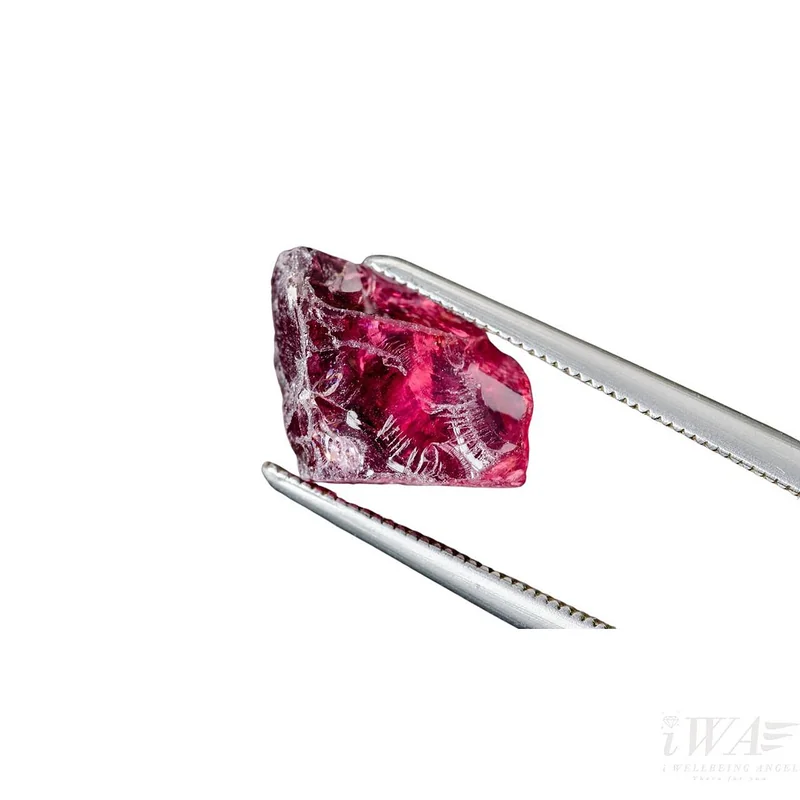
Garnet is not a single mineral but a group of closely related silicate minerals sharing the general formula X3Y2(SiO4)3, where X is typically Ca, Mg, Fe2+, or Mn, and Y is typically Al, Fe3+, or Cr. The six main gem species are almandine (Fe3Al2Si3O12), pyrope (Mg3Al2Si3O12), spessartine (Mn3Al2Si3O12), grossular (Ca3Al2Si3O12), andradite (Ca3Fe2Si3O12), and uvarovite (Ca3Cr2Si3O12). Most garnet crystallises in the cubic (isometric) system with no cleavage. Hardness varies from 6.5 (grossular) to 7.5 (almandine-pyrope). Garnet occurs in a wide colour range — red, orange, yellow, green, purple, colourless — with red almandine being the most familiar variety.
Quick facts
- Item type
- Mineral
- Mineral class
- silicate
- Mohs hardness
- 7
- Crystal system
- cubic
- Chemical formula
- X3Y2(SiO4)3
- Color range
- red, orange, yellow, green, purple, colorless, black
- Notable localities
- Bohemia, Czech Republic (historic Bohemian pyrope); Umba Valley and Songea, Tanzania (mixed-species); Sri Lanka (hessonite grossular; spessartine); Namibia (demantoid andradite); India (almandine in schists and migmatites)
The Garnet Group: Six Species
Garnet encompasses six main species: (1) Almandine (Fe3Al2Si3O12) — the most common, deep red to reddish-purple, found worldwide in metamorphic rocks; (2) Pyrope (Mg3Al2Si3O12) — blood-red, occurs in peridotite and kimberlite, includes the famous Bohemian garnet; (3) Spessartine (Mn3Al2Si3O12) — orange to red-orange, notably from Namibia, Brazil, and Sri Lanka; (4) Grossular (Ca3Al2Si3O12) — colourless to yellow, orange, green; tsavorite is green grossular; hessonite is orange-brown; (5) Andradite (Ca3Fe2Si3O12) — yellow-green to black; demantoid is the prized green variety with high dispersion; (6) Uvarovite (Ca3Cr2Si3O12) — bright green, usually too small to facet. Most commercial garnets are solid solutions between two or more species, such as pyrope-almandine ('rhodolite') or pyrope-spessartine ('malaya').
Geological Occurrence
Garnet occurs in nearly every metamorphic and many igneous rock types. Almandine is a common index mineral in mica schists and gneisses. Pyrope forms at high pressures in peridotite and eclogite and is a characteristic indicator mineral in kimberlite (diamond-bearing pipes), where it occurs as rounded 'G9/G10' pyrope grains. Grossular and andradite form in calc-silicate rocks (skarns) where igneous fluids react with limestone. Demantoid andradite forms in serpentinite. Spessartine occurs in granitic pegmatites. The wide range of chemical compositions means garnet can serve as a geothermobarometer in metamorphic petrology — the composition records the pressure and temperature conditions at the time of crystallisation.
Colour Range and Notable Varieties
Garnet's wide colour range reflects the diversity of the group. Red colours come from almandine (Fe3+/Fe2+ charge transfer) and pyrope (Fe3+ in a Mg-dominant lattice). Orange is produced by spessartine (Mn2+). Green comes from tsavorite (V3+ in grossular), demantoid (Fe3+ in andradite), and uvarovite (Cr3+). The alexandrite-like colour-change garnets (purple-blue in daylight, red-purple in incandescent light) are spessartine-pyrope solid solutions from East Africa and Madagascar. The colour change results from a narrow transmission window between Cr3+ absorption bands that shifts in perceived hue depending on the light spectrum. These are among the most interesting optical phenomena in the garnet group.
Sources & further reading (3)
- gemological-institute — accessed 2026-05-08
- encyclopedia — accessed 2026-05-08
- mineral-database — accessed 2026-05-08
Frequently asked questions
Is garnet always red?
No. While red is the most familiar colour because almandine and pyrope are the most common gem garnets, the group spans nearly the full colour spectrum. Tsavorite grossular is vivid green; demantoid andradite is green with high fire; spessartine ranges from orange to red-orange; hessonite grossular is orange-brown to yellowish; colour-change garnets shift from purple-blue to red under different light sources. Only blue pure garnet in daylight is exceedingly rare, though some East African pyrope-spessartines appear blue-green in certain lighting.
What is tsavorite garnet?
Tsavorite is the vivid green variety of grossular garnet (Ca3Al2Si3O12) coloured by vanadium and/or chromium impurities. It was discovered in 1967 in the Tsavo region of Kenya by geologist Campbell Bridges and later in Tanzania. Tsavorite rates 7–7.5 on Mohs, has no cleavage (cubic structure), and achieves a vivid green colour competitive with fine emerald. Unlike emerald, tsavorite is typically free of inclusions, has higher refractive index, and does not require oil/resin treatment. The deposits occur in metamorphic calc-silicate rocks (grossular skarns) associated with Mozambique Belt metamorphism.
Why does garnet have no cleavage?
Most garnet species crystallise in the cubic isometric system, which has high symmetry. Cleavage in minerals occurs along planes where bonding is weakest. In cubic garnets, the bond density is relatively uniform in all directions within the SiO4 tetrahedra and the X-site polyhedra, and no single crystallographic plane is significantly weaker than others. The result is no true cleavage; garnet breaks with a conchoidal to irregular fracture. This makes garnet more resistant to accidental cleavage than minerals like topaz or calcite, contributing to its durability for gem use and as an abrasive in garnet sandpaper.