silicate
Fire Opal
Transparent to translucent orange-red opal; primarily from Mexico; may lack play-of-colour.
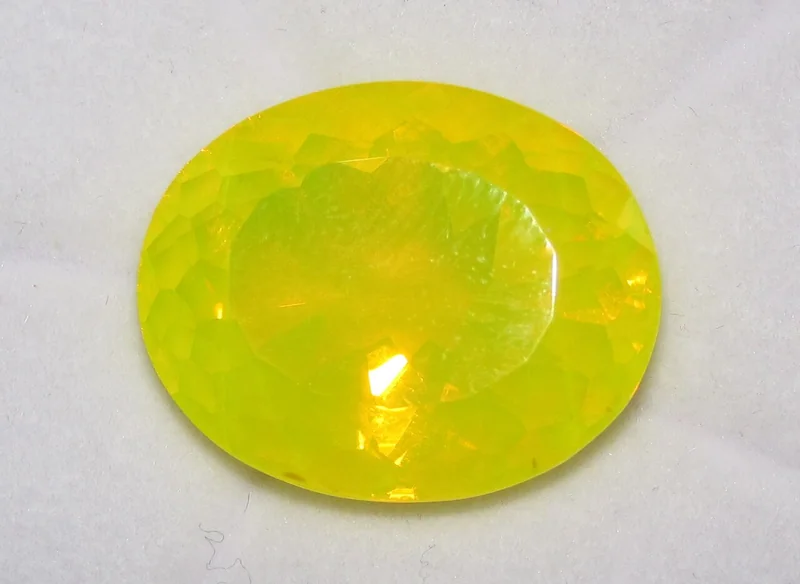
Fire opal is a variety of precious opal characterised by its vivid orange to orange-red to red body colour, with translucent to transparent clarity. Unlike most precious opal, fire opal typically lacks or shows only faint play-of-colour, deriving its value from its inherent body colour and transparency rather than spectral diffraction. The colour comes from iron oxide incorporated in the amorphous silica structure. Mexico's Queretaro state is the primary world source; fire opal also occurs in Honduras, Guatemala, Ethiopia, and Brazil. The Queretaro deposit occurs in rhyolitic volcanic tuff and produces gems large enough for faceting. In Mexico fire opal is known as 'opalo de fuego'.
Quick facts
- Item type
- Variety
- Mineral class
- silicate
- Mohs hardness
- 6
- Crystal system
- amorphous
- Chemical formula
- SiO2·nH2O
- Color range
- orange, orange-red, red, yellow-orange
- Notable localities
- Queretaro state, Mexico (primary; 'opalo de fuego'); Jalisco, Nayarit, and Guerrero, Mexico; Honduras (minor); Ethiopia (Wollo Province, some fire opal); Brazil (minor)
Orange Colour and Iron Oxide
Fire opal's vivid orange-to-red body colour comes from trace amounts of iron oxide (Fe2O3 or iron hydroxides) incorporated in the amorphous hydrated silica structure during formation. The iron content produces a broad absorption band that transmits orange and red wavelengths. Unlike the play-of-colour of precious opal (which requires an ordered sphere array), fire opal's colour is from a chemical colourant, not optical diffraction. Fire opal forms from silica-rich hydrothermal fluids or volcanic water in extrusive volcanic rock, particularly rhyolitic tuff. Mexico's Queretaro fire opals occur at elevations of 1800–2000 m in ignimbrite and rhyolite volcanic sequences of Miocene age (approximately 6–15 million years old).
Faceting and Optical Properties
High-clarity fire opal from Mexico can be faceted to display the transparency and body colour to advantage. Step cuts, oval brilliants, and cushion cuts are common. Due to opal's low hardness (5.5–6.5) and sensitivity to dehydration, fire opal requires protective settings (bezels preferred) and care to avoid thermal shock and prolonged exposure to dry conditions. Most fire opal is cut as cabochons, which display any play-of-colour present and show the colour depth well. Transparent faceted Mexican fire opal with vivid orange colour and no visible inclusions is the most commercially sought form. Fire opal with play-of-colour is called 'precious fire opal' and is particularly valued for combining warm body colour with spectral display.
Mexican Fire Opal Tradition
Fire opal has been mined in Mexico since pre-Columbian times; Aztec artefacts containing fire opal have been recovered from archaeological sites. The Aztec name for fire opal is recorded as 'quetzalitzlipyollitli' in historical Nahuatl texts. Spanish colonists continued mining it and it was traded to Europe, where it appeared in Baroque jewellery. The Queretaro state mines — particularly the area around Tequisiapan and San Juan del Rio — remain the most productive commercial source. Contemporary Mexican fire opal occurs in seams and nodules within ignimbrite formations and is extracted by relatively small-scale artisanal mining operations. Queretaro opal tends to have higher transparency than Ethiopian or Brazilian fire opal of comparable colour.
Sources & further reading (3)
- gemological-institute — accessed 2026-05-08
- encyclopedia — accessed 2026-05-08
- mineral-database — accessed 2026-05-08
Frequently asked questions
Does fire opal show play-of-colour?
Fire opal typically shows little or no play-of-colour, which distinguishes it from most precious opal. Its value comes from the inherent orange-to-red body colour and transparency, not from spectral diffraction. Some fire opals — called 'precious fire opal' — do show play-of-colour in addition to the warm body colour; these are the most sought-after form. The presence or absence of play-of-colour depends on whether the specific stone contains a sufficiently ordered silica sphere array (play-of-colour present) or lacks it (body colour only).
Why is Mexican fire opal particularly transparent compared to other opal?
The transparency of Queretaro fire opal results from the volcanic rhyolitic tuff environment in which it forms. The silica-rich volcanic water fills cavities in ignimbrite slowly, allowing relatively pure, low-porosity silica to deposit with fewer inclusions and less random structural disorder than opal forming in sedimentary settings. The result is a more glassy, transparent material. In contrast, most Australian precious opal forms in clay-bearing sedimentary environments where organic matter and clay minerals are more abundant, leading to more opaque body tones.
How does fire opal differ from other coloured opals?
Fire opal is defined by its orange-to-red body colour and transparency-to-translucency — not by play-of-colour. 'Precious opal' refers to any opal (including white, crystal, black, or fire opal) that shows play-of-colour. 'Common opal' (potch) lacks play-of-colour and also lacks fire opal's vivid warm colour. Fire opal is distinct from black opal (dark body, play-of-colour), white opal (pale body, play-of-colour), and crystal opal (colourless body, play-of-colour). The combination of warm colour and potential for both transparency and play-of-colour makes fire opal a distinct and recognisable opal type.