February Birthstone
Amethyst — violet quartz of wisdom and sobriety; once valued as highly as ruby or sapphire.
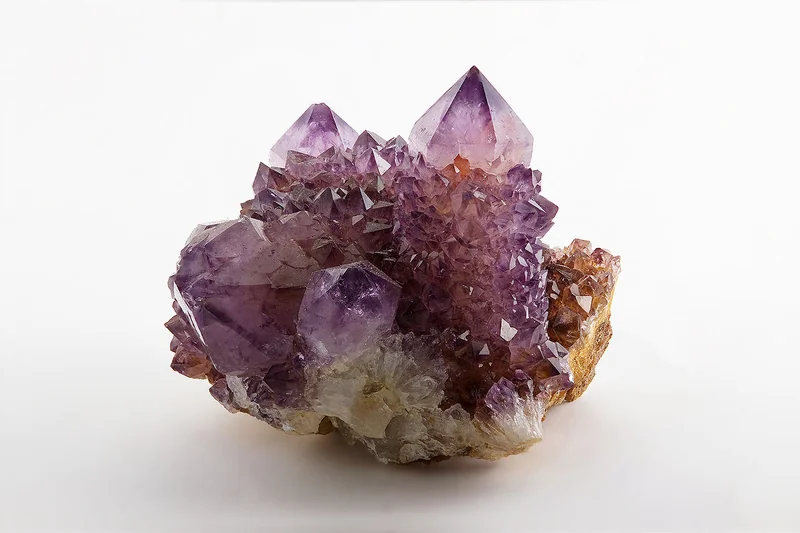
February's birthstone is amethyst, the violet to purple variety of quartz (SiO₂) coloured by iron impurities and irradiation. Amethyst has been treasured as a gemstone for thousands of years — ancient Egyptian, Greek, and Roman jewellery extensively used amethyst, and the gem was considered among the most precious of stones until large Brazilian deposits were discovered in the 19th century, dramatically reducing its rarity and price. Amethyst rates 7 on Mohs and forms as hexagonal prismatic crystals typically in geode cavities in volcanic basalt. Major sources today are Brazil (particularly Rio Grande do Sul), Uruguay, Zambia, and Madagascar. Amethyst's name derives from Greek 'amethystos' (not drunk), reflecting the ancient belief that the stone prevented intoxication.
Quick facts
- Item type
- Birthstone month
- Color range
- pale lilac, medium purple, deep violet, reddish-purple
- Birthstone month
- February (traditional)
Amethyst's Colour and Chemistry
Amethyst's purple colour results from the combination of Fe³⁺ ions substituting for Si⁴⁺ in the quartz structure and irradiation by natural gamma rays during crystal growth. The iron creates colour centres (charge-transfer complexes) that absorb yellow-green wavelengths, transmitting violet. The colour is not stable at high temperatures — heating amethyst above approximately 470°C turns it yellow-orange (citrine) or green (green amethyst/prasiolite), a transformation used commercially to produce lower-cost yellow and green quartz. The colour distribution in natural amethyst crystals is often uneven — colour concentrations appear at growth zones and at the terminations (tips) of crystals — so rough is oriented and cut to show the most even colour face-up. Uruguay amethyst tends toward deeper, more saturated purple; Brazilian amethyst varies widely from pale lavender to deep purple; Zambian amethyst is often the deepest purple with slight red flashes.
Historical Significance and Rarity Shift
Amethyst was among the most valued gems of the ancient world. Greek and Roman texts describe it alongside diamond, sapphire, and emerald. The ancient Greeks believed amethyst prevented drunkenness — drinking vessels were carved from amethyst, and wearing the stone was supposed to keep the wearer clear-headed. Medieval European bishops wore amethyst rings as symbols of spiritual authority (the colour purple denoted papal and episcopal rank). The stone appeared in Crown Jewels of multiple European monarchies. This valuation prevailed until the early 19th century when massive geode deposits in Rio Grande do Sul, Brazil, flooded the market with affordable amethyst. Post-discovery, amethyst dropped from precious to semiprecious status — though fine deep-coloured specimens from Zambia and Uruguay retain high value.
Zodiac Connection: Aquarius
February birthstones align with Aquarius (the water bearer), governing approximately January 20 to February 18. Aquarius is associated in classical astrology with intellect, humanitarian vision, and unconventional thinking. Amethyst's traditional associations with clarity of mind, spiritual insight, and the prevention of clouded judgment align thematically with Aquarius's cerebral character. The water bearer's connection to the flow of thought and the pursuit of wisdom resonates with amethyst's ancient Greek name — amethystos, meaning 'not drunk' — implying a clear, unintoxicated mind. In Western gem tradition, amethyst has long been linked to the episcopal and scholarly classes, and its purple colour carries associations with elevated thinking that parallel Aquarius's intellectual orientation.
Sources & further reading (2)
- gemological-institute — accessed 2026-05-08
- encyclopedia — accessed 2026-05-08
Frequently asked questions
Why is amethyst considered a semiprecious stone when it used to be precious?
The distinction between 'precious' and 'semiprecious' gemstones is informal and market-driven, not a scientific classification. Amethyst was reclassified informally from precious to semiprecious when Brazilian deposits discovered in the 19th century made it abundantly available and affordable. Before these discoveries, European amethyst sources (Siberia, Sri Lanka, India) were limited, and fine specimens were genuinely rare and expensive. With availability, price dropped and cultural valuation followed. GIA and modern gemological institutes do not officially use 'precious vs. semiprecious' terminology because it implies a fixed hierarchy that does not reflect current market realities — a fine Zambian amethyst may command more per carat than a poor-quality ruby. The division is a historical artefact of 19th-century European gem trade practice.
Can amethyst change colour with heat or light?
Yes. Amethyst is sensitive to heat and prolonged UV exposure. Heating above approximately 470°C converts the iron colour centres from the Fe³⁺ configuration producing purple to configurations producing yellow (ametrine/citrine) or green (prasiolite). This is intentional in commercial production: heat-treated amethyst sold as citrine is common and legal when disclosed, though natural citrine (which is rare) is preferable. UV exposure over long periods can fade amethyst colour — very dark specimens from certain localities are particularly vulnerable. For practical jewellery use, normal indoor lighting is not a concern, but prolonged direct sunlight fading is possible over years. Storage away from intense light is recommended for valuable specimens.
What is ametrine and how does it relate to amethyst?
Ametrine is a quartz variety that shows both amethyst purple and citrine yellow in the same crystal, with a distinct colour boundary between the two zones. It occurs naturally in one significant commercial source: the Anahi mine in Bolivia. The two colours exist in the same crystal because different growth zones formed under different temperature and pressure conditions that affected the stability of the Fe colour centres differently. In ametrine, the amethyst zone maintains the Fe³⁺ configuration producing purple; the citrine zone has iron in a different valence state producing yellow-orange. Because the two colour zones are sharp, ametrine is typically cut to show both zones in the face-up view — often with a diagonal partition between purple and yellow. Bolivia's Anahi mine is the primary commercial source of natural ametrine; virtually all commercially available ametrine originates from it.