silicate
Emerald
Green beryl coloured by chromium or vanadium impurities, Mohs 7.5–8.
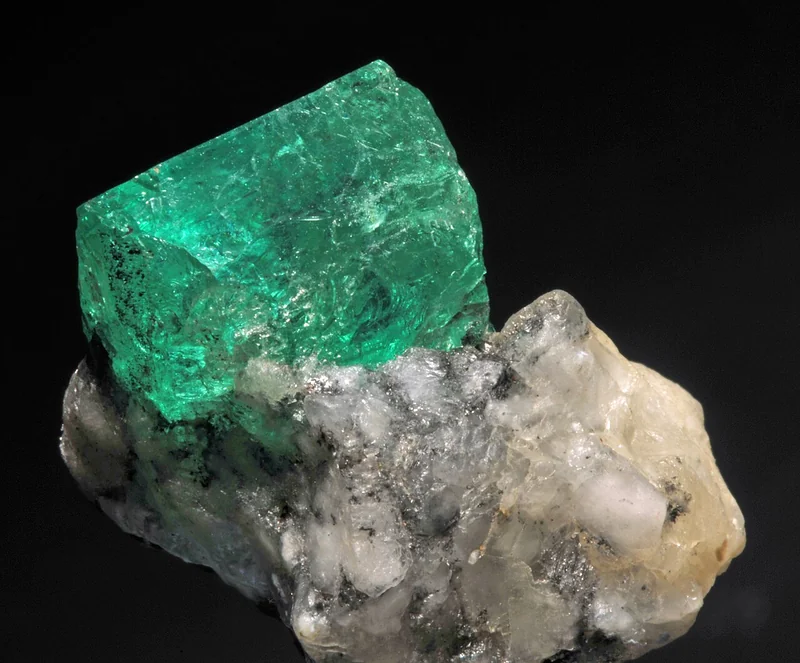
Emerald is the vivid green variety of the mineral beryl (Be3Al2Si6O18), coloured by trace amounts of chromium (Cr3+) or vanadium (V3+) substituting for aluminium in the crystal lattice. Beryl crystallises in the hexagonal system and rates 7.5–8 on the Mohs scale. Emerald is characterised by a distinctive inclusion pattern called 'jardin' (French for garden) — a mossy network of fluid inclusions, healed fractures, and crystals that is considered part of the gem's identity and used to confirm natural origin. Colombia's Muzo and Chivor mines have historically produced the most highly regarded stones, valued for their warm, slightly yellowish-green colour.
Quick facts
- Item type
- Mineral
- Mineral class
- silicate
- Mohs hardness
- 7.75
- Crystal system
- hexagonal
- Chemical formula
- Be3Al2Si6O18
- Color range
- green, yellowish-green, bluish-green
- Notable localities
- Muzo, Boyaca, Colombia (intense warm green); Chivor, Boyaca, Colombia (slightly bluish green); Itabira (Crato), Minas Gerais, Brazil; Sandawana, Zimbabwe (intense small stones); Zambia (Kafubu/Kagem, major current producer)
Mineralogy and the Jardin
Beryl (Be3Al2Si6O18) forms hexagonal prisms with a characteristic ring-silicate structure based on six-membered rings of SiO4 tetrahedra. In emerald, Cr3+ or V3+ (ionic radius similar to Al3+) substitute into the octahedral Al sites, absorbing red and blue-violet wavelengths and transmitting green. Colombian stones owe their colour primarily to chromium; Brazilian and Zambian stones frequently show vanadium as the dominant colourant. GIA defines emerald as beryl coloured by chromium or vanadium with sufficient saturation to be called green. 'Jardin' refers to the characteristic inclusion landscape — three-phase fluid inclusions (liquid, gas, solid), healed fractures (fingerprints), and crystal inclusions of pyrite, calcite, and actinolite — that distinguishes natural emerald from synthetic and that functions as a natural fingerprint.
Colombian Emerald Geology
Colombian emeralds occur in sedimentary black shales of the Eastern Cordillera, formed by hydrothermal brines that percolated through organic-rich Cretaceous marine shales. The chromium derives from the shales themselves rather than from igneous intrusions — an unusual geological setting that distinguishes Colombia from nearly all other world sources. Muzo (western zone) produces warmer, slightly yellowish-green stones with higher chromium. Chivor (eastern zone) tends to produce cooler, slightly bluish-green stones. Both mines have been worked since pre-Columbian times by the Muzo and Chibcha peoples. Zambia's Kafubu district deposits occur in amphibolite-schist metamorphic rocks, producing stones with higher iron content and a deeper, slightly cooler green.
Treatments and Synthetic Emerald
Oil or resin filling of surface-reaching fractures is nearly universal in emerald due to the prevalence of the jardin. The degree of filling — from none to significant — is reported on GIA laboratory certificates. Cedar oil (refractive index close to emerald at 1.58–1.59) and Opticon resin are common filling media. Untreated (no filler) natural emeralds of fine colour command premium prices. Synthetic emeralds have been produced commercially since the 1930s (Chatham, Carroll Chatham; Gilson, Pierre Gilson; Biron; Tairus). They are grown by flux-melt or hydrothermal methods and have identical composition but different inclusion types detectable by laboratory examination.
Sources & further reading (3)
- gemological-institute — accessed 2026-05-08
- encyclopedia — accessed 2026-05-08
- mineral-database — accessed 2026-05-08
Frequently asked questions
What causes the green colour in emerald?
Emerald's green colour is caused by trace amounts of chromium (Cr3+) or vanadium (V3+) substituting for aluminium ions in the beryl crystal lattice. These ions absorb red wavelengths (around 630–700 nm) and blue-violet wavelengths (around 400–450 nm), transmitting green. The exact hue depends on the relative concentrations of each colourant: chromium-dominant stones (Colombia) tend toward a warm, slightly yellowish green; vanadium-dominant stones (Brazil) tend toward a more yellowish green.
What is the 'jardin' of an emerald?
Jardin (French: garden) is the industry term for the characteristic inclusion landscape inside a natural emerald, which resembles moss or vegetation under magnification. It consists of three-phase fluid inclusions (containing liquid, gas, and solid phases), healed fractures with fingerprint-like patterns, and crystal inclusions such as pyrite cubes or calcite rhombohedra. The jardin is generally accepted as a defining feature of natural emerald, distinguishing it from synthetic or imitation stones, and is referenced in laboratory reports as confirmation of natural origin.
How does Colombian emerald differ from Zambian emerald?
Colombian emeralds form in sedimentary black shales via hydrothermal brines; the chromium colourant comes from the shale environment, resulting in low iron content and a warm, slightly yellowish to pure green. Colombian stones are also noted for high chromium-driven fluorescence (weak red under UV). Zambian emeralds form in metamorphic amphibolite schists; they typically contain more iron, which suppresses fluorescence and shifts the colour toward a cooler, slightly bluish or grayish green. Both sources produce a range of qualities; top stones from either can be exceptional. Laboratory origin determination uses trace element ratios and inclusion types.