native-element
Diamond
Carbon mineral rated 10 on the Mohs scale — the hardest known natural substance.
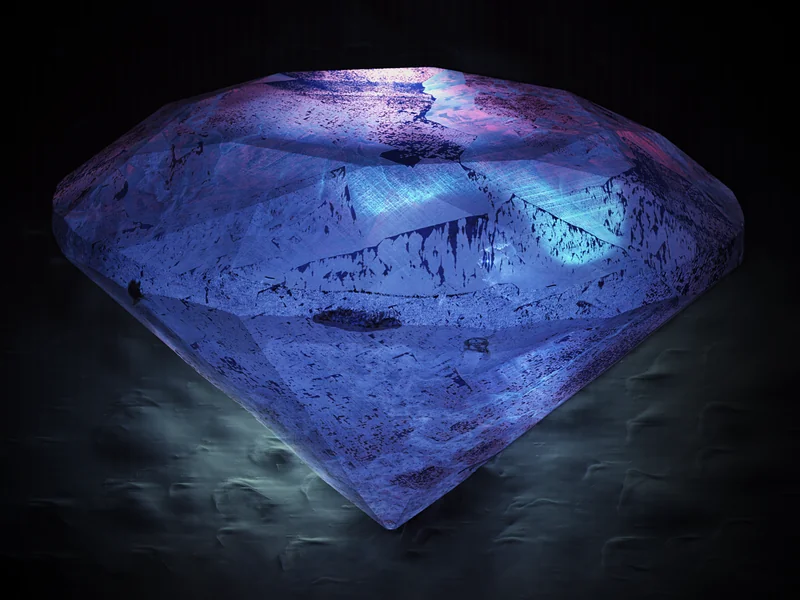
Diamond is the crystalline allotrope of carbon and the hardest natural mineral, scoring 10 on the Mohs hardness scale. Its carbon atoms are arranged in a face-centred cubic lattice (diamond cubic structure) held together by sp3 covalent bonds, producing exceptional hardness, high refractive index (2.417), and strong dispersion. Diamonds form at depths of 150–200 km in the mantle under pressures of 45–60 kilobars and temperatures of 900–1300 °C, then reach the surface through kimberlite and lamproite volcanic pipes. The four Cs of gem grading — cut, colour, clarity, and carat weight — were standardised by the Gemological Institute of America in the mid-20th century.
Quick facts
- Item type
- Mineral
- Mineral class
- native-element
- Mohs hardness
- 10
- Crystal system
- cubic
- Chemical formula
- C
- Color range
- colorless, yellow, brown, pink, blue, green, black
- Notable localities
- Kimberley, South Africa (historic kimberlite pipes); Jwaneng, Botswana (world's largest by value); Argyle, Western Australia (fancy pink diamonds); Mir pipe, Yakutia, Russia; Mwadui, Tanzania (world's largest kimberlite)
Crystal Structure and Physical Properties
Diamond belongs to the isometric crystal system with space group Fd3m. Each carbon atom forms four equivalent sigma bonds with neighbouring carbon atoms in a tetrahedral arrangement, giving the structure its exceptional rigidity. The bond length is 1.54 Å and bond angle 109.5°. Diamond has a density of 3.51 g/cm³ and no cleavage planes in the usual sense, though it does have perfect octahedral cleavage along {111} planes used by gem cutters. Its thermal conductivity (900–2300 W/m·K) is the highest of any natural material. The refractive index of 2.417 and dispersion (fire) of 0.044 produce the characteristic brilliance of faceted gems. Diamond is polymorphous with graphite; under surface conditions graphite is the stable form, but the diamond-to-graphite conversion is kinetically inhibited at room temperature.
Geological Origin and Mining
Diamonds crystallise in the lithospheric mantle at depths of approximately 150–200 km. They ascend to the surface rapidly — over hours to days — entrained in ultramafic magmas that form kimberlite and lamproite pipes. Most commercial diamond mining targets primary kimberlite (pipe mines) or secondary alluvial and marine placer deposits where erosion has concentrated diamonds. The Kimberley pipes in South Africa were the first major primary source discovered (1869–1871). Botswana's Jwaneng and Orapa mines currently produce the greatest value of gem-quality stones. Alluvial diamonds occur notably in Angola, DR Congo, and along the Namibian coastline.
Gem Grading: The Four Cs
The GIA standardised a four-variable grading system in the 1950s: Cut (proportions and symmetry of the faceted stone); Colour (graded D–Z, with D being colourless and Z a light yellow or brown); Clarity (inclusion count and position graded FL through I3); and Carat weight (metric unit where 1 carat = 0.2 g). Diamonds grading D–F in colour and FL–VVS in clarity are classed as exceptional quality. Fancy colour diamonds (pink, blue, green, orange) are graded on a separate scale and owe their colour to structural defects or trace impurities: blue from boron substitution, pink from plastic deformation, green from natural irradiation.
Sources & further reading (3)
- gemological-institute — accessed 2026-05-08
- encyclopedia — accessed 2026-05-08
- mineral-database — accessed 2026-05-08
Frequently asked questions
Why is diamond the hardest natural mineral?
Diamond's hardness derives from its crystal structure: each carbon atom forms four strong covalent bonds in a tetrahedral arrangement throughout the lattice, leaving no slip planes. In graphite, carbon atoms form weaker layered sheets that slide easily. The result is that diamond resists scratching by any other natural material. On the Mohs scale it is rated 10, though hardness is anisotropic — diamond is slightly harder on the {111} octahedral faces than on the {100} cube faces.
What causes fancy colour in diamonds?
Colourless diamonds are pure carbon. Colour arises from structural defects or trace impurities: nitrogen aggregates (the most common defect, present in most diamonds) cause yellow or brown; isolated nitrogen causes yellow; boron causes blue; plastic deformation of the crystal lattice causes pink and red; natural gamma or neutron irradiation followed by annealing causes green, yellow-green, or blue-green. Fancy colour diamonds are graded separately by the GIA on a scale from Faint to Fancy Vivid.
What is the difference between a natural diamond and a lab-grown diamond?
Both natural and laboratory-grown diamonds have identical chemical composition (carbon) and crystal structure. Natural diamonds formed in the mantle billions of years ago. Lab-grown diamonds are produced by either high-pressure high-temperature (HPHT) synthesis or chemical vapour deposition (CVD) in weeks to months. They are chemically and physically indistinguishable by standard gemological tests; specialist instruments detect trace inclusion and growth pattern differences. The GIA and other labs report lab-grown diamonds separately from natural diamonds.