silicate
Demantoid Garnet
Green andradite garnet with the highest dispersion of any gem mineral; Ural Mountains, Russia.
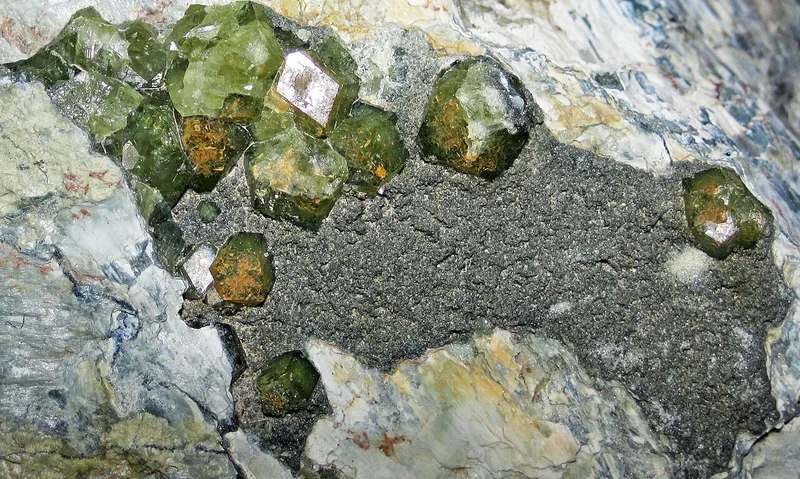
Demantoid is the green variety of andradite garnet (Ca3Fe2Si3O12), coloured by chromium (Cr3+) and iron (Fe3+). It has the highest dispersion of any naturally occurring gem mineral (0.057), exceeding diamond (0.044), which gives it exceptional fire. Rates 6.5–7 on Mohs. Demantoid was discovered in Russia's Ural Mountains in 1853 near Nizhny Tagil and became popular in late 19th-century European jewellery, particularly in pieces by Faberge. The name means 'diamond-like' in Dutch, referring to its brilliant lustre. Ural demantoid is distinguished by characteristic horsetail inclusions of chrysotile fibers, used as a positive indicator of Russian origin. Namibia is the other significant commercial source, producing material without horsetail inclusions.
Quick facts
- Item type
- Variety
- Mineral class
- silicate
- Mohs hardness
- 6.75
- Crystal system
- cubic
- Chemical formula
- Ca3Fe2Si3O12
- Color range
- green, yellowish-green, olive-green
- Notable localities
- Ural Mountains, Russia (Nizhny Tagil area; horsetail inclusions); Green Dragon mine, Namibia (modern commercial source); Madagascar (minor)
Dispersion: Why Demantoid Has More Fire than Diamond
Dispersion — the difference in refractive index between violet and red wavelengths — determines how much white light is separated into its spectral colours (fire) when passing through a gem. Diamond's dispersion of 0.044 is high, producing its characteristic rainbow fire. Demantoid's dispersion is 0.057 — approximately 30% higher than diamond — giving it the greatest fire of any natural gem mineral. The high dispersion arises from the steep refractive index gradient across the visible spectrum in andradite's crystal structure. Despite the lower refractive index (1.89 versus diamond's 2.42), demantoid's higher dispersion means individual facets can produce more vivid spectral colour. The Chevalier cut (a modified brilliant) and other low-reflection cuts are often used to maximise demantoid's dispersion.
Horsetail Inclusions: Ural Signature
Russian demantoid from the Ural Mountains commonly contains characteristic curved, fan-shaped inclusions of byssolite fibers (a variety of chrysotile asbestiform actinolite), known in the trade as 'horsetail' inclusions because they resemble the feathery tail of a horse. These inclusions form within the andradite crystal during growth as serpentine group fibers in the host rock are incorporated. The horsetail inclusion is considered a positive quality indicator in Russian demantoid — unlike most inclusions in other gems, which reduce value, horsetails confirm Russian origin and are accepted and even desired by collectors. Namibian demantoid typically lacks horsetail inclusions; origin determination uses trace element chemistry and inclusion study.
Faberge and Tsarist-Era Popularity
Demantoid was discovered in 1853 in the Ural Mountains near Nizhny Tagil and rapidly became fashionable in Russian and European jewellery during the Belle Epoque (1880–1910). Peter Carl Faberge used demantoid extensively in his Imperial Easter Eggs and jewellery commissioned by the Russian court; demantoid appears as leaves on gold enamel flower arrangements, as setting stones, and in border designs. The gem appeared prominently in Edwardian jewellery across Europe. Production declined after the 1917 Revolution; Russian deposits were largely abandoned until the 1990s when renewed interest prompted reopening. Contemporary Ural production is very limited; commercial supply comes primarily from Namibia and secondary sources in Iran and Madagascar.
Sources & further reading (3)
- gemological-institute — accessed 2026-05-08
- encyclopedia — accessed 2026-05-08
- mineral-database — accessed 2026-05-08
Frequently asked questions
Why are horsetail inclusions valued in demantoid?
Horsetail inclusions — fibrous byssolite/actinolite inclusions in Russian demantoid — are valued for three reasons: they confirm Russian/Ural origin, which commands a premium; they are uniquely beautiful under magnification; and they are considered part of the gem's natural character rather than a defect. In fine Russian demantoid, a well-formed horsetail inclusion visible under 10x magnification is considered an asset by collectors. This contrasts with the general gem principle that inclusions reduce value; in Russian demantoid specifically, the horsetail presence increases marketability and price relative to comparable Namibian stones without inclusions.
How does demantoid compare to tsavorite garnet?
Both demantoid and tsavorite are green garnets but from different species: demantoid is andradite (Ca3Fe2Si3O12); tsavorite is grossular (Ca3Al2Si3O12). Key differences: demantoid has higher dispersion (0.057 vs tsavorite 0.028), giving more fire; tsavorite tends to a cleaner, more vivid pure green; tsavorite is harder (7–7.5 vs demantoid 6.5–7); tsavorite is generally available in larger sizes commercially; demantoid is rarer in fine quality. Both are high-quality green gems; the choice depends on whether fire (demantoid) or colour saturation (tsavorite) is preferred.
Can demantoid be heat-treated to improve colour?
Heat treatment is not standard practice for demantoid. Unlike sapphire or ruby, demantoid's colour does not benefit from conventional heat treatment protocols; heating risks changing the iron oxidation state in andradite, potentially modifying colour unpredictably. The horsetail inclusions in Russian material — a valued indicator of origin — would also be affected by high-temperature treatment. Most demantoid on the market is untreated natural material. Laboratory reports from GIA, Gübelin, and SSEF confirm treatment status and origin.