silicate
Citrine
Yellow to orange quartz variety coloured by ferric iron; Mohs 7, trigonal system.
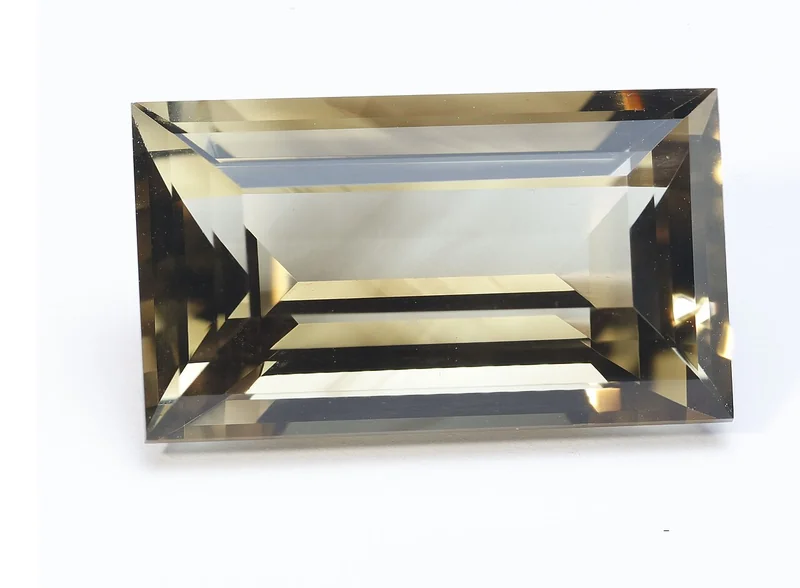
Citrine is the yellow to orange-brown variety of quartz (SiO2), coloured by Fe3+ colour centres in the crystal lattice. Quartz crystallises in the trigonal system and rates 7 on the Mohs scale. Natural citrine ranges from pale yellow to dark orange and is relatively uncommon compared to amethyst. The majority of commercial citrine is produced by heat-treating amethyst or smoky quartz at approximately 470–560 °C, which converts purple Fe4+ colour centres to yellow-orange Fe3+ centres. The name derives from the Old French 'citrin' (lemon). Major supply comes from Brazil (Rio Grande do Sul and Bahia) and Bolivia (Anahi mine, which also produces ametrine). Citrine is sometimes confused with yellow topaz or yellow sapphire but can be distinguished by its lower specific gravity.
Quick facts
- Item type
- Mineral
- Mineral class
- silicate
- Mohs hardness
- 7
- Crystal system
- trigonal
- Chemical formula
- SiO2
- Color range
- yellow, orange-yellow, golden-orange, brownish-orange
- Notable localities
- Rio Grande do Sul, Brazil (heated amethyst production); Bahia, Brazil (natural citrine pockets); Anahi mine, Bolivia (natural citrine and ametrine); Salamanca, Spain (historic pale yellow); Ural Mountains, Russia (natural golden citrine)
Colour Mechanism and Heat Treatment
Citrine's yellow-to-orange colour arises from Fe3+ colour centres. In natural citrine, trace Fe3+ ions stabilised in specific lattice defect positions absorb blue-violet wavelengths (~450 nm), producing the yellow transmission colour. When amethyst or smoky quartz is heated to 470–560 °C, the Fe4+ (amethyst) or electron-centre (smoky) colour centres are destroyed and Fe3+ centres become dominant, yielding yellow-to-orange. The transformation is permanent and stable. The 'Madeira' citrine designation (after Madeira wine) refers to a rich orange-red colour, almost always from heated amethyst. A paler yellow natural citrine from Brazil is sometimes called 'lemon quartz' in the trade. Laboratory distinction between natural and heat-treated citrine requires spectroscopic examination.
Geographic Sources
Brazil is the dominant world supplier of citrine, both natural and heat-treated. The Ametista do Sul municipality in Rio Grande do Sul produces large quantities of heated amethyst sold as citrine. Bahia state produces some natural citrine from hydrothermal vein pockets. Bolivia's Anahi mine produces naturally bicolour ametrine (amethyst-citrine) crystals and also plain citrine. Spain's Salamanca area historically produced pale yellow citrine. The Ural Mountains of Russia are a historic source of naturally golden citrine, now producing in small quantities. Madagascar and Zambia produce citrine in smaller volumes from metamorphic settings.
Distinction from Yellow Topaz and Yellow Sapphire
Citrine, yellow topaz, and yellow sapphire are all transparent yellow gems that have historically been confused in trade descriptions. They differ substantially in physical properties: specific gravity (citrine 2.65, topaz 3.49–3.57, sapphire 4.00); Mohs hardness (citrine 7, topaz 8, sapphire 9); refractive index (citrine 1.544–1.553, topaz 1.609–1.631, sapphire 1.762–1.770). A standard gemological test with a refractometer and heft test separates all three easily. Historically, many gems traded as 'topaz' before the 19th century were citrine; the Spanish Inquisition-era 'topaz' gems in various European crown jewels are now identified as citrine or chrysoberyl.
Sources & further reading (3)
- gemological-institute — accessed 2026-05-08
- encyclopedia — accessed 2026-05-08
- mineral-database — accessed 2026-05-08
Frequently asked questions
Is most commercial citrine heat-treated amethyst?
Yes. The majority of citrine sold commercially has been produced by heating amethyst or smoky quartz. The treatment converts purple or grey colour centres to yellow-orange Fe3+ centres at temperatures around 470–560 °C. The result is indistinguishable from natural citrine by eye; spectroscopic techniques can sometimes detect differences. The treatment is not considered a disclosure-requiring alteration in most trade contexts because the mineral species (quartz) and its properties are unchanged. Natural citrine exists but is rarer and tends to be lighter in colour.
What is 'Madeira' citrine?
Madeira citrine is a trade name for citrine with a deep, rich orange to reddish-orange colour reminiscent of Madeira wine from Portugal. The name does not refer to a geographic origin. Madeira-colour citrine is almost invariably produced by heat-treating deeply coloured amethyst from Brazil (Rio Grande do Sul). Natural citrine rarely reaches the depth of saturation described as Madeira. The name is used by gem dealers and jewellers as a colour descriptor; it has no standardised mineralogical or trade definition.
Can citrine be confused with yellow topaz?
Yes, historically this confusion was common. Both citrine and yellow topaz can appear identical to the naked eye. Key differences for gemologists: topaz has a specific gravity of about 3.5 (notably heavier than citrine at 2.65), a higher refractive index (1.61–1.63 vs citrine 1.54–1.55), and perfect basal cleavage. A refractometer reading immediately distinguishes them, and heft (relative weight) is often perceptible by an experienced handler. Before modern gemology, the two were routinely traded interchangeably under the name 'topaz'.