oxide
Chrysoberyl
Beryllium aluminate; Mohs 8.5, orthorhombic, includes alexandrite and cat's eye varieties.
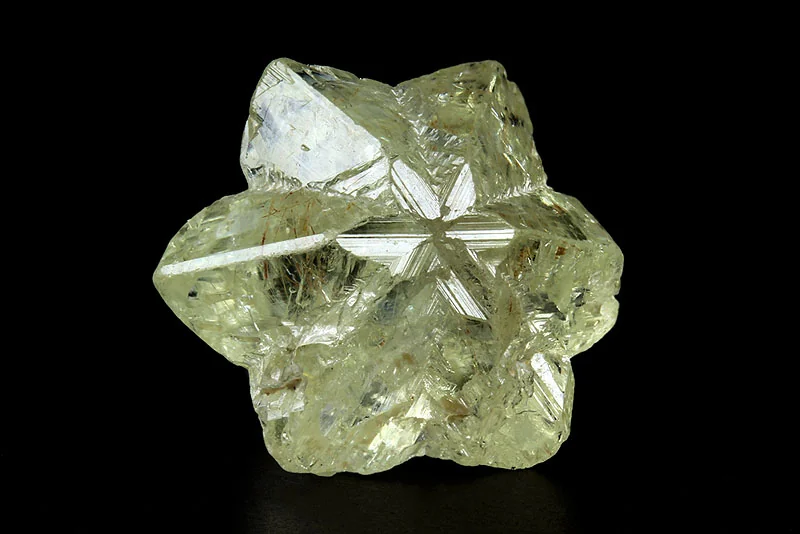
Chrysoberyl is a beryllium aluminate mineral, BeAl2O4, crystallising in the orthorhombic system and rating 8.5 on the Mohs scale — the third-hardest natural mineral after diamond (10) and corundum (9). In its common form it is transparent to translucent yellow to yellowish-green to brown, coloured by trace Fe3+. It has two remarkable gem varieties: alexandrite (Cr3+-bearing, showing a strong colour change from green-blue in daylight to red in incandescent light) and cat's eye chrysoberyl (exhibiting chatoyancy). Brazil's Minas Gerais state is the primary source; Sri Lanka and Russia's Ural Mountains are historic localities. Alexandrite, discovered in Russia's Ural Mountains in 1830 and named for future Tsar Alexander II, is among the rarest and most valued coloured gemstones.
Quick facts
- Item type
- Mineral
- Mineral class
- oxide
- Mohs hardness
- 8.5
- Crystal system
- orthorhombic
- Chemical formula
- BeAl2O4
- Color range
- yellow, yellow-green, brown, green, red-green (alexandrite)
- Notable localities
- Itabira and Hematita, Minas Gerais, Brazil (alexandrite and cat's eye); Ural Mountains, Russia (original alexandrite locality, 1830); Ratnapura district, Sri Lanka (cat's eye chrysoberyl, alexandrite); Zimbabwe (Masvingo; alexandrite); India (Andhra Pradesh; cat's eye chrysoberyl)
Crystal Chemistry and Hardness
Chrysoberyl (BeAl2O4) belongs to the orthosilicate-related oxide group; despite the 'beryl' in its name it is unrelated to the beryl (Be3Al2Si6O18) group used for emerald and aquamarine. The structure consists of a close-packed oxygen framework with Be2+ in tetrahedral sites and Al3+ in octahedral sites. No silicon is present. Chrysoberyl ranks 8.5 on Mohs, making it harder than topaz (8) and spinel (8) but softer than corundum (9). It is extremely tough due to the strong Be-O and Al-O bond network. Plain chrysoberyl is coloured by Fe3+ producing yellow to brownish-yellow; Cr3+ substitution for Al3+ produces alexandrite's dual colour effect.
Alexandrite: Colour-Change Mechanism
Alexandrite is the chromium-bearing variety of chrysoberyl, with Cr3+ substituting for some Al3+ in the octahedral sites. The Cr3+ absorption spectrum in chrysoberyl creates a narrow transmission window in the green (around 560 nm) and red (above 680 nm). In daylight (which is blue-green-rich), the eye perceives mainly the green transmission and the stone appears green to blue-green. Under incandescent light (which is red-orange-rich), the eye perceives mainly the red transmission and the stone appears red to purple-red. The alexandrite effect (colour change) depends on the precise position of the Cr3+ absorption bands: slightly different Cr coordination geometry than in ruby shifts the balance differently. This is described by the 'alexandrite effect' in mineralogy.
Cat's Eye Chrysoberyl (Cymophane)
Cat's eye chrysoberyl (trade name: cymophane) exhibits chatoyancy — a single bright band of reflected light ('cat's eye') that moves as the stone is rotated, visible when cut as a cabochon. The effect arises from parallel inclusions of rutile, silk, or hollow tubes oriented perpendicular to the c-axis; reflected light from these inclusions concentrates into a bright line perpendicular to the inclusions. The finest cat's eye stones show a 'milk and honey' effect: one half of the stone appears milky white and the other honey-gold, switching as the light direction changes. Sri Lanka (Ratnapura) is the pre-eminent source of fine cat's eye chrysoberyl. The term 'cat's eye' in the gem trade, without qualification, conventionally refers to chrysoberyl; other cat's eye stones must be specified (e.g., 'cat's eye tourmaline').
Sources & further reading (3)
- gemological-institute — accessed 2026-05-08
- encyclopedia — accessed 2026-05-08
- mineral-database — accessed 2026-05-08
Frequently asked questions
What causes alexandrite's colour change?
Alexandrite's colour change is caused by chromium (Cr3+) ions in the crystal structure and the specific shape of the Cr3+ absorption spectrum in chrysoberyl. Cr3+ in alexandrite absorbs most of the visible spectrum except for two narrow transmission windows: one in green (~560 nm) and one in deep red (>680 nm). Under daylight or fluorescent light, which is rich in green and blue wavelengths, the eye responds most strongly to the green transmission: the stone appears green to blue-green. Under incandescent candlelight or tungsten light, which is rich in red wavelengths, the eye responds most strongly to the red transmission: the stone appears red to purplish-red. The exact colour in each light type varies between individual stones depending on Cr3+ concentration and host-crystal chemistry.
Is alexandrite the rarest gem?
Alexandrite is among the rarest commercially available gem minerals. The original Ural Mountain deposit near Ekaterinburg was largely exhausted by the late 19th century; subsequently discovered deposits in Brazil, Zimbabwe, and Sri Lanka produce much smaller quantities than the Russian source did. Fine-quality alexandrite — strong colour change, good transparency, attractive size — is genuinely scarce relative to demand. Other minerals are rarer in an absolute sense (painite, taaffeite), but alexandrite is notably rare relative to its prominence in the gem trade and collector market.
How is 'cat's eye' in chrysoberyl different from cat's eye in other gems?
Cat's eye (chatoyancy) occurs in many minerals when parallel fibrous or tubular inclusions reflect light into a band. In the gem trade, 'cat's eye' without a mineral qualifier conventionally means chrysoberyl cat's eye. Other minerals exhibiting chatoyancy must specify the mineral: 'cat's eye tourmaline', 'cat's eye aquamarine', 'cat's eye quartz'. Chrysoberyl's cat's eye is the most prized for the sharpness of the eye band, the quality of the milk-and-honey effect, and the transparency of the host material. The Sri Lankan cymophane is the benchmark against which other cat's eye stones are compared.