Cabochon
Smooth domed gem cut without facets; oldest cutting style; suited for opaque and phenomena gems.
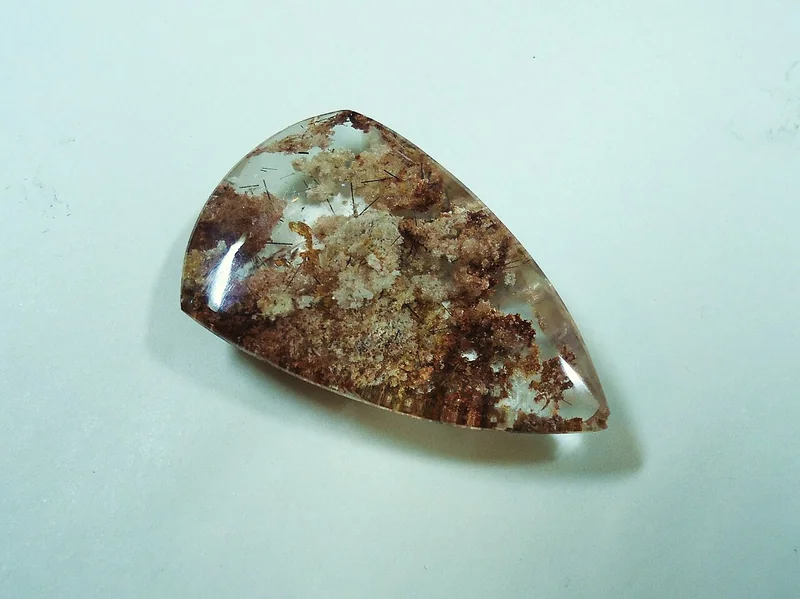
A cabochon is a gemstone that has been shaped and polished to produce a smooth, convex domed top and a flat or slightly concave base, without any facets. The word derives from the Middle French 'caboche' (head). Cabochon cutting is the oldest gem finishing technique — prehistoric use of polished stones, and early gem use throughout the ancient world, predominantly employed this form. It remains the appropriate cut for gems exhibiting optical phenomena (asterism, chatoyancy, adularescence, play-of-colour) maximised by a smooth curved surface rather than facets. Opaque and translucent gems such as opal, turquoise, jade, lapis lazuli, moonstone, and star corundum are typically cut as cabochons. Cabochon proportions vary by outline (round, oval, cushion) and dome height.
Quick facts
- Item type
- Cut
Geometry and Optical Phenomena
A standard cabochon has a flat base and a convex dome top. The dome's height relative to its girdle diameter is the key proportional variable: a high dome (dome height 1/2 or more of diameter) produces strong optical phenomena effects but may appear dark from excess depth; a low dome (shallow) covers more of the gem's face but may reduce the sharpness of phenomena effects. Round cabochons are most common; ovals are standard for many gems. The smooth curved surface is essential for displaying optical phenomena: asterism (star effect) requires the dome to focus reflected light from oriented needle inclusions into rays; chatoyancy (cat's eye) requires the dome to concentrate reflected light from parallel fibers into a band; play-of-colour in opal is most visible as an uninterrupted surface rather than fragmented by facet edges. Adularescence in moonstone (the floating, shimmering glow from labradorescence layers) is similarly best shown as a smooth dome.
Historical Precedence
Cabochon cutting predates faceting by thousands of years. Polished pebble gems from the Harappan civilisation (c. 3000–1500 BCE) are documented. Ancient Egyptian, Mesopotamian, Greek, Roman, and Byzantine jewellery predominantly used cabochon-cut gems — garnets, emeralds, sapphires, and rubies in settings from the Bronze Age through the medieval period were almost invariably cabochon. Faceting of gems in a geometric pattern was not common until the 14th–15th century CE in Europe, when improved tools and grinding wheels allowed controlled facet placement. Medieval and Byzantine jewellery is characterised by large, smooth, polished cabochons of coloured gems (en cabochon style) in cloisons or collet settings.
Modern Cabochon Applications
Today, cabochon cutting is standard for gems with optical phenomena or insufficient transparency for faceting: opal (play-of-colour), cat's eye chrysoberyl (chatoyancy), star ruby and star sapphire (asterism), moonstone and labradorite (adularescence, labradorescence), turquoise, malachite, jade, coral, amber, and lapis lazuli (opaque to translucent). Translucent to transparent gems such as amethyst, garnet, or sapphire can also be cut cabochon when the gem is too included for faceting, when the cutter wishes to maximise weight yield from a piece of rough, or as an aesthetic choice. The 'double cabochon' (domed both top and bottom) is used for gems where high transparency benefits from curves on both sides, such as fine moonstone.
Sources & further reading (2)
- gemological-institute — accessed 2026-05-08
- encyclopedia — accessed 2026-05-08
Frequently asked questions
Why can't a star sapphire be faceted?
The asterism (six-rayed star) in star sapphire requires the stone to be cut as a cabochon with the c-axis of the crystal running from base to dome top. The three sets of oriented rutile needle inclusions must lie perpendicular to the viewing direction for the star to appear. Faceting would break the smooth curved surface into multiple flat planes, each reflecting only a portion of the included needles; instead of a continuous moving star, you would see disjointed reflections from each facet. Additionally, faceting would require removing much of the material containing the oriented inclusions, potentially eliminating the phenomenon. Heat treatment (which improves sapphire colour and clarity) dissolves the silk inclusions that cause asterism, further confirming that star corundum must be cut cabochon and left untreated.
How is the quality of a cabochon evaluated?
Quality criteria for cabochons depend on the gem material but generally include: dome symmetry (smooth, even profile without flat spots or bumps); base finish (flat and even); outline symmetry (round, oval, or other outline should be symmetrical); clarity and colour of the material; and the strength and quality of any optical phenomenon present. For star gems, the sharpness, symmetry, and position (centred) of the star are primary. For cat's eye, the sharpness and centredness of the eye band matter most. For opal, the brightness, pattern, and colour range of play-of-colour are assessed. For opaque gems (turquoise, jade, lapis), colour uniformity, polish quality, and pattern are evaluated.
Can a transparent gem be cut as a cabochon?
Yes. While transparent gems are typically faceted to maximise light return and brilliance, they can be cut cabochon for various reasons: to preserve an optical phenomenon (asterism, chatoyancy); to preserve maximum weight from a piece of rough; to display colour depth in a smooth, soft way; or for aesthetic preference. 'Carbuncle' — the term used for high-quality red cabochon gems (primarily garnet and ruby) in medieval jewellery — refers to transparent to translucent gems cut in dome form. Fine-quality transparent ruby, sapphire, and emerald can be cut cabochon if the cutter or buyer prefers the rounded, smooth appearance over facets.