Brilliant Cut
57-58 facet round cut maximising light return; proportions standardised by Marcel Tolkowsky (1919).
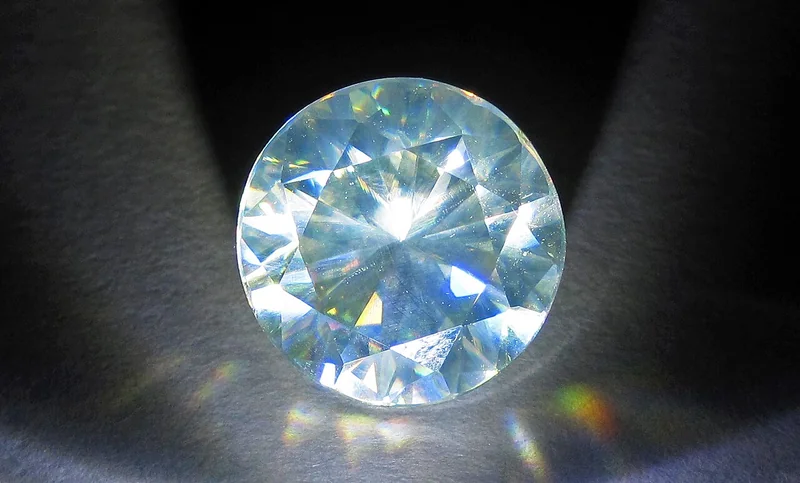
The brilliant cut is a faceting arrangement of 57 or 58 facets on a round or near-round gemstone, designed to maximise light return through the table and produce maximum brilliance and fire. The standard round brilliant consists of 33 facets on the crown (upper half) and 24 or 25 on the pavilion (lower half). Theoretical proportions for diamond were published by Marcel Tolkowsky in 1919 ('Diamond Design: A Study of the Reflection and Refraction of Light in Diamond'). The cut dominates the modern diamond market (approximately 75% of diamonds sold), but is also applied to sapphire, ruby, and other coloured gems. The modern triple-excellent (triple-X) diamond — GIA grades of Excellent for cut, polish, and symmetry — represents the applied pinnacle of round brilliant geometry.
Quick facts
- Item type
- Cut
Geometry: Crown, Girdle, Pavilion
The round brilliant is divided into three zones: the crown (upper), girdle (widest equatorial rim), and pavilion (lower). The crown has 33 facets: 1 octagonal table, 8 bezel facets, 8 star facets, and 16 upper girdle facets. The pavilion has 24 or 25 facets: 8 pavilion main facets, 16 lower girdle facets, and optionally 1 culet (small flat bottom facet). Tolkowsky's 1919 analysis specified optimal crown angle of 34.5° and pavilion angle of 40.75° for diamond (refractive index 2.417) to achieve total internal reflection of light entering through the crown. Modern GIA cut grading (introduced 2005) uses a complex algorithm incorporating 38 factors including table percentage, crown angle, pavilion angle, girdle thickness, and culet size to assign grades of Excellent, Very Good, Good, Fair, and Poor.
History: From Mazarin to Tolkowsky
The development of the brilliant cut spans 300 years. Early forms appeared in the 17th century: the 'double rose' and later the 'Mazarin cut' (attributed to Cardinal Mazarin, c. 1640) had 34 facets. The 'Peruzzi cut' (c. 1700, attributed to Vincenzo Peruzzi) increased facet count to 58. By the early 19th century, the 'old mine cut' (a high crown, small table, large culet) was common; the 'old European cut' (round profile, high crown, smaller table) followed. Steam-powered bruting machines (1870s) allowed cutting round outlines precisely. Tolkowsky's 1919 mathematical analysis provided the theoretical basis for modern proportions. The shift to electric-powered precision tools and laser cutting in the 20th century produced the 'modern round brilliant' with precisely calculated proportions.
Applied to Coloured Gems
While the round brilliant was developed for diamond, it is widely applied to coloured gemstones — ruby, sapphire, emerald, and others. However, the optimal angles differ because coloured gems have different refractive indices than diamond (e.g., sapphire 1.762–1.770; emerald 1.565–1.602). Cutters adjust crown and pavilion angles for each gem material to achieve total internal reflection for that specific RI. For coloured gems, brilliance is also balanced against colour: a deeper pavilion can concentrate colour (useful for light-coloured stones) but at the cost of some brilliance. GIA and other labs do not issue standard cut grades for coloured gems (unlike for diamonds) because colour optimisation varies by stone.
Sources & further reading (2)
- gemological-institute — accessed 2026-05-08
- encyclopedia — accessed 2026-05-08
Frequently asked questions
Why does the round brilliant cut have exactly 57 or 58 facets?
The 57-facet standard has no facets at the culet (bottom point); the 58-facet version adds a small flat octagonal culet facet. The facet count results from the geometric logic of the cut: 8-fold radial symmetry (8 main crown facets, 8 main pavilion facets) with additional smaller facets (star, upper girdle, lower girdle) filling the geometric spaces between them. This specific arrangement, developed iteratively over the 17th–19th centuries, was shown by Tolkowsky to maximise light return for diamond. Other facet counts (90-facet Royal Asscher, 82-facet hearts and arrows) modify the arrangement while retaining the underlying round brilliant principle.
What is the 'hearts and arrows' pattern in round brilliants?
When a round brilliant is cut with exceptional symmetry and precise angles, viewing through the table under a special reflection scope reveals 8 arrowheads (from above) and 8 hearts (from below), produced by the symmetric reflection of light from the 8 pavilion mains off the girdle facets. This 'hearts and arrows' pattern indicates high precision in cutting symmetry. Not all GIA Excellent-graded diamonds show hearts and arrows; the pattern requires a stricter symmetry standard than GIA's grading criteria. Japanese gemologists developed the H&A scope in the 1980s; the effect is primarily aesthetic and does not necessarily correspond to superior optical performance.
How does the round brilliant differ from the old mine cut?
The old mine cut (prevalent from roughly 1700 to 1900) is the precursor of the modern brilliant. It has a round-to-cushion outline (not perfectly round), a high crown, small table, very large culet, and 58 facets similar to the modern brilliant. The proportions were cut by eye and hand tools rather than precise calculations. Old mine cuts appear softer, warmer, and more sparkly in candlelight (for which they were designed) but return less light in fluorescent or LED lighting compared to modern brilliants. 'Old European cuts' (c. 1890–1930) have a more circular outline and medium-large culet. Antique cuts are valued by collectors for their distinct optical character.