silicate
Black Opal
Precious opal with dark body colour (N1-N4) maximising play-of-colour contrast; Lightning Ridge primary.
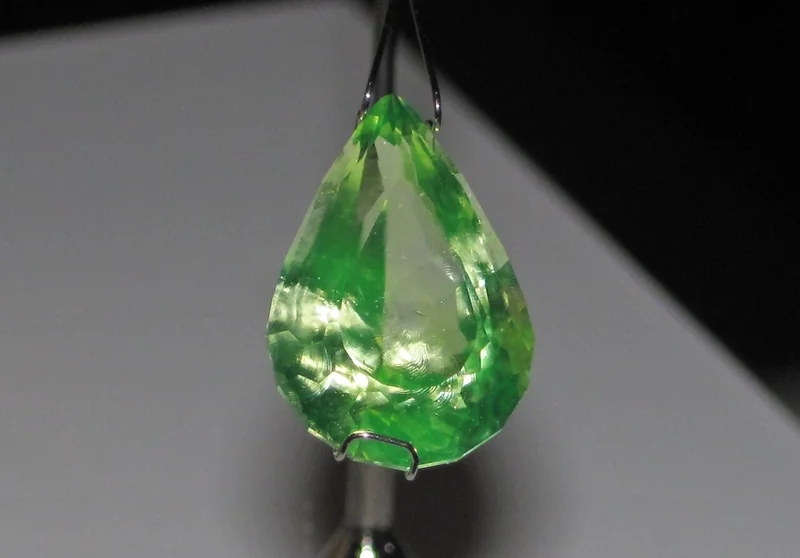
Black opal is the variety of precious opal with a dark body tone (rated N1 to N4 on the Gem Trade Lab body-tone scale), which creates a high-contrast dark background against which the spectral play-of-colour appears most vivid. The dark colour comes from traces of organic carbon and iron oxide distributed through the silica structure. Lightning Ridge in New South Wales, Australia, is the world's primary source; the Lightning Ridge opal field produces the finest black opals, including the Royal One (306 ct), Black Prince (273 ct), and Flame Queen. Black opal commands the highest per-carat prices among opal varieties. Precious opal's play-of-colour arises from diffraction of light by regularly stacked amorphous silica spheres (SiO2·nH2O).
Quick facts
- Item type
- Variety
- Mineral class
- silicate
- Mohs hardness
- 6
- Crystal system
- amorphous
- Chemical formula
- SiO2·nH2O
- Color range
- black, dark grey, dark blue-black
- Notable localities
- Lightning Ridge, New South Wales, Australia (world primary source); Mintabie, South Australia (semi-black and black opal); Andamooka, South Australia (some dark opal)
Body Tone and Play-of-Colour Enhancement
Black opal's body tone is rated N1 (jet black) to N4 (dark) on a scale from N1 (darkest) to N9 (white), as used by the Gemmological Association of Australia and international labs. The darker the body tone, the greater the contrast between the dark background and the spectral play-of-colour. In white or light opal, play-of-colour appears against a milky white background, reducing contrast. In black opal, the same play-of-colour pattern appears to glow more intensely because each spectral colour is isolated against darkness — analogous to fireworks appearing more brilliant against a night sky than a daylit sky. The dark colouration in Lightning Ridge black opal comes from dispersed carbon-bearing material and ironite (iron oxide) incorporated during formation in sedimentary nodules.
Lightning Ridge Geology
Lightning Ridge is located in north-western New South Wales, in a region underlain by Lower Cretaceous marine and freshwater sediments (Griman Creek Formation). Precious opal formed when silica-rich groundwater percolated through sandstone layers and filled voids, cracks, and cavities in clay-rich nodules and fossil shells. The specific combination of silica concentration, pH, temperature gradients, and organic-carbon-bearing host sediments created the conditions for black opal formation. Mining at Lightning Ridge is primarily by shaft sinking (vertical shafts to the opal-bearing horizon at approximately 5–15 m depth) and horizontal drive tunnelling. The main opal-bearing horizon is called the 'opal dirt'. The Lightning Ridge field has been mined commercially since the early 20th century.
Grading and Famous Stones
Black opal grading assesses body tone (N1 darkest preferred), brightness of play-of-colour (A = brightest), pattern (including 'harlequin' — the rarest, consisting of uniform broad mosaic squares), colour range (broad spectral coverage more valued), and freedom from faults. Pattern terms in the Australian opal trade include 'harlequin', 'rolling flash', 'flagstone', 'ribbon', and 'chinese writing'. The Royal One (306 ct, discovered 2015), Black Prince (273 ct), and Flame Queen (253 ct) are among the most famous Lightning Ridge black opals. The Fire of Australia (998 ct rough, 2392 ct uncut) is the largest black opal ever found. Museum specimens are held at the Australian Museum, Sydney, and the Smithsonian National Museum of Natural History.
Sources & further reading (3)
- gemological-institute — accessed 2026-05-08
- encyclopedia — accessed 2026-05-08
- mineral-database — accessed 2026-05-08
Frequently asked questions
Why is black opal more valuable than white opal?
Black opal typically commands higher prices than white or light opal of equivalent play-of-colour quality because the dark body tone dramatically increases the visibility and contrast of the spectral colours. The same diffraction pattern that appears relatively subdued against a white background appears intensely brilliant against black. Fine black opal with a harlequin or broad flashing pattern of multiple saturated colours against a N1–N2 body tone is among the most visually striking gemstones. Rarity also contributes: Lightning Ridge black opal with high brightness and fine pattern is genuinely uncommon even within the Lightning Ridge production.
What is the 'harlequin' pattern in opal?
Harlequin is the rarest and most prized play-of-colour pattern in precious opal. It consists of broad, roughly equal-sized, square or rectangular patches of spectral colour arranged in a mosaic pattern — resembling the diamond-patterned costume of the Commedia dell'arte harlequin character. True harlequin requires the colour patches to be broad (not pin-fire or small), contiguous, separated by distinct boundaries, and covering most of the stone's face with approximately equal distribution of colours. Very few black opals display a complete, symmetrical harlequin pattern; most 'harlequin' stones in the trade show an approximation. The pattern designation is a quality factor, not a strict criterion.
Can black opal be treated to enhance body tone?
Yes. 'Smoke treatment' involves wrapping opal in paper, heating it in a closed container to deposit carbon soot into the pores, temporarily darkening the body tone. Smoke treatment is impermanent and considered a disclosure-requiring treatment. Carbon-impregnated opals ('smoked opals') are less valuable than naturally dark black opals. Natural black opal receives its dark tone during geological formation from organic carbon and iron oxide incorporated in the silica matrix. Laboratory testing (primarily examination of pore fill and carbon distribution under magnification and spectroscopy) can detect smoke treatment.