silicate
Aquamarine
Blue-green beryl coloured by ferrous iron impurities, Mohs 7.5–8.
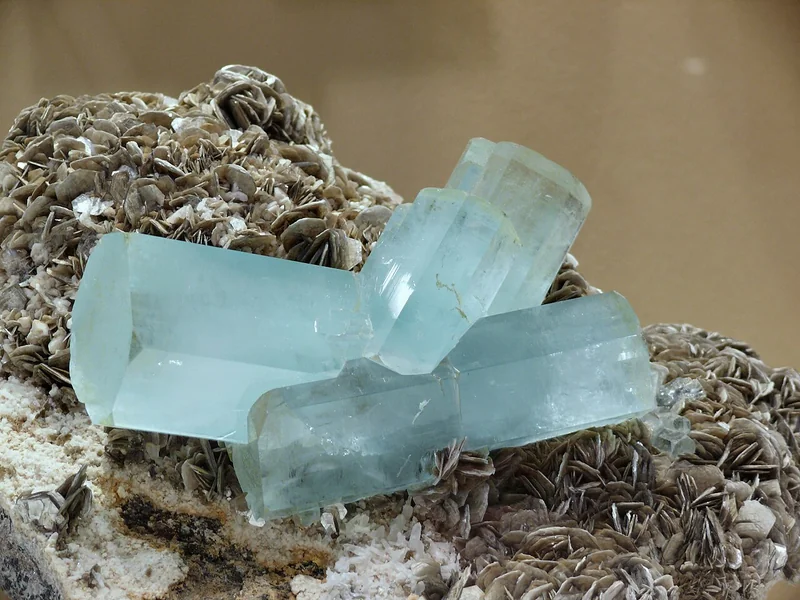
Aquamarine is the blue to blue-green variety of the mineral beryl (Be3Al2Si6O18), coloured by ferrous iron (Fe2+) in the crystal channels of the hexagonal structure. Beryl rates 7.5–8 on the Mohs scale. Aquamarine derives its name from the Latin 'aqua marina' (seawater) for its characteristic blue-green colour. Brazil's Minas Gerais state is the world's primary source, producing crystals that can weigh several kilograms; the Dom Pedro aquamarine (10,363 ct rough, carved by Bernd Munsteiner) is the largest faceted aquamarine in the world. Lighter blue stones can be heat-treated to reduce the greenish component and improve colour purity.
Quick facts
- Item type
- Mineral
- Mineral class
- silicate
- Mohs hardness
- 7.75
- Crystal system
- hexagonal
- Chemical formula
- Be3Al2Si6O18
- Color range
- blue, blue-green, greenish-blue
- Notable localities
- Marambaia and Santa Maria de Itabira, Minas Gerais, Brazil; Shigar Valley, Pakistan (fine blue crystals); Mimoso do Sul, Espirito Santo, Brazil; Gilgit-Baltistan, Pakistan; Antanifotsy, Madagascar
Colour and Mineralogy
Beryl's crystal structure contains open hexagonal channels parallel to the c-axis that can host a variety of ions and molecules. In aquamarine, Fe2+ ions in these channels produce a blue colour by absorbing wavelengths around 700 nm. A greenish component — present in many natural stones — arises from Fe3+ ions also in the lattice, which absorb blue wavelengths. Heating stones to approximately 400 °C reduces Fe3+ to Fe2+, eliminating the yellow-green component and improving blue purity. This treatment is standard in the trade and widely accepted. The resulting 'Santa Maria' colour (named after the Santa Maria de Itabira mine) refers to a particularly saturated, pure blue. Aquamarine is dichroic: colourless in one crystal direction and blue in another.
Brazilian Sources and Crystal Habit
Brazil's Minas Gerais state produces the majority of world aquamarine supply from pegmatite deposits — coarse-grained igneous intrusions where slow crystallisation allows large crystals to form. Crystals from Minas Gerais regularly exceed 1 kg; the largest known crystal weighed over 110 kg (found at Marambaia, 1910). Pakistan's Shigar Valley (Gilgit-Baltistan) produces intensely blue crystals with excellent clarity from alpine-type pegmatites at high altitude. Madagascar and Mozambique produce aquamarine in metamorphic settings. Aquamarine is typically found in prismatic hexagonal crystals, sometimes with striated surfaces parallel to the c-axis.
Gem Grading and Heat Treatment
Aquamarine is graded on colour, clarity, and cut. The most desirable colour is a vivid, pure blue without greenish overtones; in the trade this is often called 'Santa Maria' after the Brazilian mine or 'Santa Maria Africana' for similar colour stones from Mozambique. Clarity is generally high relative to other coloured stones because aquamarine has relatively few inclusions; liquid inclusions producing a 'rain' effect are the most common. Heat treatment to reduce iron-related yellow component is nearly universal and not considered a disclosure-worthy treatment in the trade. Natural untreated stones of fine blue colour do not command a premium in the way that untreated ruby or sapphire do.
Sources & further reading (3)
- gemological-institute — accessed 2026-05-08
- encyclopedia — accessed 2026-05-08
- mineral-database — accessed 2026-05-08
Frequently asked questions
Why does aquamarine turn bluer when heated?
Many natural aquamarine crystals contain both Fe2+ (which produces blue) and Fe3+ (which contributes a yellow-green component). Heating to approximately 400 °C in an oxidising atmosphere does not change the iron content, but converts Fe3+ to Fe2+ within the crystal lattice. This eliminates the yellow-green absorption, leaving a purer blue. The process is stable and permanent. Since the treatment is so standard, it is not typically disclosed in trade descriptions, unlike more invasive treatments applied to ruby or emerald.
What distinguishes aquamarine from blue topaz?
Aquamarine (beryl, Be3Al2Si6O18) and blue topaz (Al2SiO4(F,OH)2) are different mineral species with different chemistry and crystal structures. Distinguishing features: specific gravity (aquamarine 2.68–2.74; topaz 3.49–3.57 — topaz is noticeably heavier); refractive index (aquamarine 1.56–1.60; topaz 1.61–1.63); Mohs hardness (both approximately 7.5–8); and crystal system (aquamarine hexagonal; topaz orthorhombic). A gemologist can distinguish them readily with a refractometer and heft test.
What is the Dom Pedro aquamarine?
The Dom Pedro aquamarine is the world's largest faceted aquamarine, cut from a rough crystal found in Minas Gerais, Brazil. The rough weighed approximately 27 kg; the finished sculpture is 35 cm tall and weighs 10,363 ct. German gemstone carver Bernd Munsteiner cut it into a pointed obelisk form with concave facets (a signature Munsteiner technique) to maximise light refraction. It was donated to the Smithsonian National Museum of Natural History in 2012, where it is displayed in the Janet Annenberg Hooker Hall of Geology, Gems, and Minerals.