April Birthstone
Diamond — hardest natural substance; brilliance and eternity for the spring month.
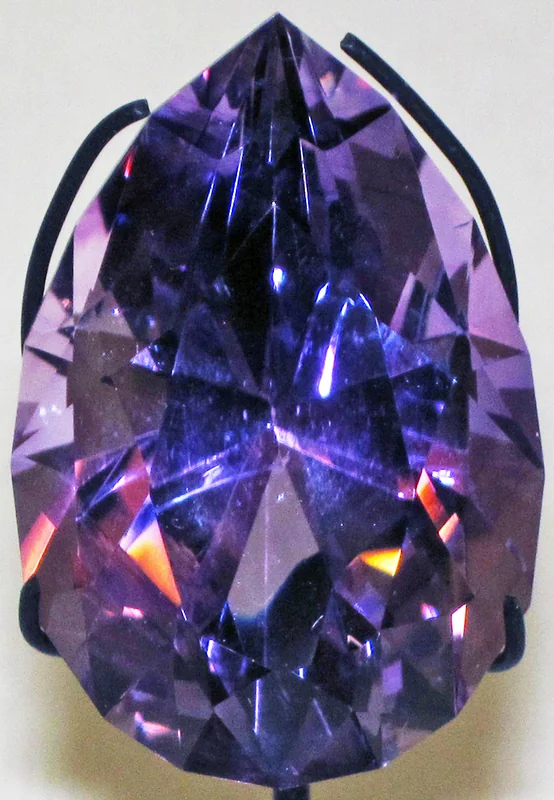
April's birthstone is diamond, the carbon allotrope that is the hardest natural substance (Mohs 10) and the most thermally conductive material at room temperature. Diamond forms 150–200 km deep in Earth's mantle under extreme pressure and temperature, then reaches the surface via explosive volcanic eruptions in kimberlite and lamproite pipes. The brilliant cut — designed specifically to maximise diamond's light return through its high refractive index (2.417) and dispersion — has made the round brilliant diamond the most commercially successful gemstone in history. Major producing countries include Russia (ALROSA), Botswana (Debswana), Canada, and Australia. Laboratory-grown diamonds, chemically identical to natural diamonds, entered the commercial market significantly in the 2010s.
Quick facts
- Item type
- Birthstone month
- Color range
- colourless (D-F grade), near-colourless (G-J), yellow, brown, rare blue, rare pink, rare red
- Birthstone month
- April (traditional)
Diamond as April's Stone
Diamond's association with April appears in multiple historical birthstone lists, including the Breastplate of Aaron (interpreted by scholars as diamond in the original Hebrew 'yahalom') and later in the standardised 1912 ANJA list. April occupies the middle of spring in the Northern Hemisphere — a time of clarity, renewal, and emergence — attributes mirrored in diamond's transparent, enduring brilliance. The diamond engagement ring convention, cemented globally by De Beers from the 1940s onward, overlaps with April associations: an April birthday associated with permanence, love, and the purest gem. Diamond is also associated in Vedic astrology with Venus and is the traditional gem for Venus, love, and marriage — further reinforcing its association with spring's energy of new beginnings.
The 4Cs and Diamond Grading
GIA's 4Cs grading system — Cut, Colour, Clarity, and Carat weight — developed in the mid-20th century, provides standardised language for diamond quality. Cut grades assess light return efficiency (Excellent–Poor for round brilliants); Colour grades scale from D (colourless) through Z (light yellow), with D-F colourless and G-J near-colourless considered premium for white diamonds; Clarity grades assess inclusions and surface blemishes on an 11-grade scale from FL (Flawless) to I3 (heavily included); Carat is the standard weight unit for gems (1 carat = 0.2 grams). Beyond the GIA D-Z colour scale, 'fancy coloured diamonds' — including blue (Hope Diamond, Moussaieff Red's colour type), pink, red, green, orange, and yellow — are graded separately with their own colour intensity and distribution grades and are typically rarer and more valuable than equivalent-sized colourless diamonds.
Zodiac Connection: Aries
April birthstones align with Aries (the ram), governing approximately March 21 to April 19. Aries is the first sign of the zodiac, associated with initiative, courage, directness, and energy — the sign of new beginnings, as the zodiac year begins with Aries at the spring equinox. Diamond's hardness, uncompromising clarity, and status as the 'first among gems' (most valued, most tested, most enduring) align naturally with Aries' character as first and strongest. In traditional gem astrology, diamond was associated with Mars (Aries' ruling planet) — the planet of energy, action, and the warrior spirit. The correspondence of the hardest gem with the most forceful sign creates a memorable and coherent pairing across multiple astrological traditions.
Sources & further reading (2)
- gemological-institute — accessed 2026-05-08
- encyclopedia — accessed 2026-05-08
Frequently asked questions
Are laboratory-grown diamonds real diamonds?
Yes. Laboratory-grown (also called lab-created, synthetic, or cultured) diamonds are physically, chemically, and optically identical to natural diamonds — both are pure carbon in the cubic crystal structure. There is no gemological difference detectable without specialised equipment: same hardness (10 Mohs), same optical properties (RI 2.417, dispersion 0.044), same thermal conductivity. The distinction is origin: natural diamonds formed billions of years ago under the Earth's mantle; lab-grown diamonds are produced in weeks or months by HPHT (high pressure, high temperature) or CVD (chemical vapour deposition) processes. GIA grades lab-grown diamonds with the same 4Cs as natural diamonds but issues separate reports identifying them as laboratory-grown. Lab-grown diamonds retail at 50–80% discounts compared to natural diamonds of equivalent quality. They are not 'fake' diamonds — they are real diamonds grown above ground.
What makes diamond the hardest natural substance?
Diamond's extreme hardness (Mohs 10, the maximum) results from its crystal structure: all four valence electrons of each carbon atom form strong covalent bonds with four neighbouring carbon atoms in a three-dimensional tetrahedral lattice (diamond cubic structure). This creates an isotropic network of the strongest chemical bonds known (C-C covalent bonds at 154 pm bond length). Every carbon atom is equivalently bonded to four others in a maximally dense, symmetric arrangement, leaving no weak planes. Diamond's hardness is not uniform in all directions (it is slightly harder perpendicular to the {111} octahedral face than along it, which is why diamond can be cleaved along {111} planes despite its hardness — hardness measures resistance to scratching, not cleavage). This directional variation in hardness is exploited in cutting: diamond is polished against diamond using orientation that exploits the softer direction.
How does diamond produce 'fire' (spectral colours)?
Diamond's fire is produced by its high dispersion — the variation in refractive index with wavelength. Diamond's RI is 2.465 for violet light and 2.407 for red light, a spread of 0.058 (the official dispersion value 0.044 measures the B-G interval). When white light enters the diamond and reflects internally, each wavelength is refracted at a slightly different angle, separating colours like a prism. The separated spectral colours emerge from different facets at different angles, producing flashes of red, orange, yellow, green, blue, and violet. Diamond has the highest dispersion of any colourless gem — about three times that of sapphire (0.018). The brilliant cut's geometry is designed to maximise these spectral flashes: steep crown angles let refracted light exit at angles visible to the viewer rather than passing straight back out the table.