silicate
Amethyst
Purple quartz variety coloured by iron impurities and irradiation; Mohs 7.
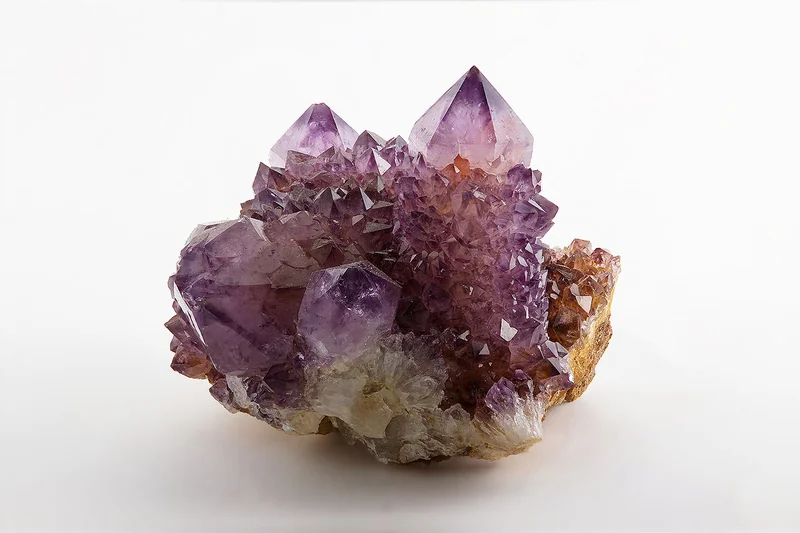
Amethyst is the purple variety of quartz (SiO2), coloured by iron impurities combined with natural gamma irradiation. Fe4+ colour centres in the quartz lattice absorb yellow-green light (~470 nm), producing purple. Quartz crystallises in the trigonal system and rates 7 on the Mohs scale. Amethyst occurs in geodes — hollow volcanic rocks lined with crystals — and in hydrothermal veins. Brazil's Rio Grande do Sul state and Uruguay's Artigas department supply the majority of world production, primarily from basalt geodes. The colour can range from pale lilac to deep violet; deeply coloured material from Zambia and Madagascar is particularly noted. Heating amethyst to approximately 470 °C converts it to yellow-orange citrine.
Quick facts
- Item type
- Mineral
- Mineral class
- silicate
- Mohs hardness
- 7
- Crystal system
- trigonal
- Chemical formula
- SiO2
- Color range
- purple, violet, lilac, pinkish-purple
- Notable localities
- Rio Grande do Sul, Brazil (large geode production); Artigas, Uruguay (deep purple cathedral geodes); Zambia (Kalomo; deep reddish-purple stones); Maissau, Austria (historic European source); Thunder Bay, Ontario, Canada (hematite inclusions give red sheen)
Colour Origin and Stability
Amethyst's purple colour arises from Fe4+ colour centres created when Fe3+ ions in the quartz lattice are irradiated by natural gamma radiation from surrounding rocks. The Fe4+ centre (sometimes written as [FeO4]0) absorbs a broad band around 520 nm, leaving transmitted light in the purple-violet range. Irradiating colourless quartz containing Fe3+ artificially produces the same colour centres, confirming the mechanism. The colour is stable under normal conditions but fades irreversibly if heated above approximately 300–470 °C (depending on origin), which is exploited to produce citrine and prasiolite. Prolonged exposure to strong sunlight can also cause gradual fading in some specimens. The colour in amethyst is often unevenly distributed in zones parallel to crystal growth faces.
Occurrence in Geodes
The majority of amethyst supply comes from basaltic geodes in the Parana Basin of southern Brazil and Uruguay. These hollow spherical to ovoid cavities in basalt flows were originally gas bubbles; hydrothermal silica-rich fluids subsequently deposited quartz on the cavity walls. In Brazil (Rio Grande do Sul) geodes range from centimetres to several metres in diameter and are mined by open-cut and tunnel methods from Mesozoic-age basalt flows. The characteristic cathedral geodes sold as display specimens come primarily from Uruguay's Artigas area, noted for deep, reddish-purple colour. Zambian amethyst from the Kalomo and Mapatizya areas occurs in metamorphic schists and often shows a deeper, more saturated purple than Brazilian material.
Heating to Citrine and Prasiolite
Heating amethyst between 470 °C and 560 °C destroys the Fe4+ colour centre by reducing Fe4+ back to Fe3+; the resulting stone is yellow to orange-yellow (citrine). Most commercial citrine is heat-treated amethyst rather than natural citrine. Heating between 400 and 500 °C in the presence of certain trace impurities can produce prasiolite (green amethyst), a pale green quartz variety. Heating above 600 °C generally produces a milky or white quartz. The transformation is irreversible at the colour-centre level; the mineral remains quartz (SiO2) throughout. The conversion temperature varies with trace element chemistry, explaining the range of cited temperatures in the literature.
Sources & further reading (3)
- gemological-institute — accessed 2026-05-08
- encyclopedia — accessed 2026-05-08
- mineral-database — accessed 2026-05-08
Frequently asked questions
Why does amethyst fade in sunlight?
Amethyst's colour depends on Fe4+ colour centres that are sensitive to photons as well as heat. Prolonged exposure to intense UV radiation (as in direct sunlight) can break down the colour centres, causing gradual fading. The rate of fading depends on the intensity of irradiation, the specific colour chemistry of the stone, and temperature. Most amethyst fading from sunlight is a slow process over years of exposure; normal indoor light does not cause observable fading. Storing amethyst specimens away from direct sunlight is standard practice for preserving display colour.
What is ametrine?
Ametrine is a bicolour quartz that displays both purple amethyst zones and yellow-orange citrine zones in the same crystal. It occurs naturally at the Anahi mine in Bolivia, where a single geological deposit produces crystals with both colour types in distinct sectors. The different colours reflect different temperatures in different sectors of the growing crystal: higher-temperature zones lack the Fe4+ centres and appear citrine; lower-temperature zones preserve them and appear amethyst. Natural ametrine is primarily sourced from Bolivia; synthetic ametrine is also produced.
Is all commercial citrine heat-treated amethyst?
A large proportion of commercial citrine is produced by heating amethyst. Natural citrine occurs but is less common than natural amethyst; most natural citrine is pale or medium yellow. The rich orange-yellow 'Madeira' citrine colour is almost always the result of heat-treating amethyst or smoky quartz. Heat-treated citrine is not considered an undisclosed treatment because the process is a standard industry practice analogous to heat treatment in sapphire; however, responsible dealers will note whether material is natural or heat-treated citrine.