silicate
Almandine Garnet
Most common garnet species; deep red to reddish-purple iron aluminium silicate; Mohs 7–7.5.
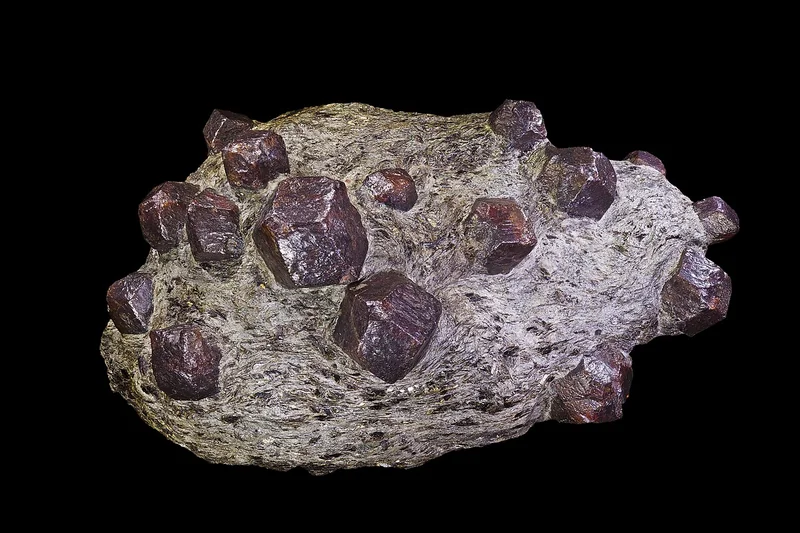
Almandine (Fe3Al2Si3O12) is the most abundant and widely distributed species in the garnet group. It produces deep red to reddish-purple to reddish-brown colours from Fe2+/Fe3+ charge transfer absorption in the octahedral Al site. Almandine crystallises in the cubic system and rates 7–7.5 on Mohs. It occurs in metamorphic rocks (mica schists, gneisses) worldwide and forms a continuous solid solution with pyrope (Mg end-member) and spessartine (Mn end-member). The name is thought to derive from the town of Alabanda in ancient Caria (modern Turkey), a historic gem trading centre mentioned by Pliny the Elder. Major sources include India, Sri Lanka, Brazil, Mozambique, and the Bohemian Massif of the Czech Republic.
Quick facts
- Item type
- Variety
- Mineral class
- silicate
- Mohs hardness
- 7.25
- Crystal system
- cubic
- Chemical formula
- Fe3Al2Si3O12
- Color range
- deep red, reddish-purple, reddish-brown, orange-red
- Notable localities
- Rajasthan and Andhra Pradesh, India (major commercial producer); Ratnapura, Sri Lanka (gem gravels); Minas Gerais, Brazil; Bohemian Massif, Czech Republic (historic Bohemian garnet pyrope-almandine); Mozambique, Tanzania (various metamorphic settings)
Crystal Chemistry and Colour
Almandine's deep red to reddish-purple colour arises from Fe2+ and Fe3+ ions in the octahedral Al3+ sites of the garnet structure. An intervalence charge transfer between adjacent Fe2+ and Fe3+ ions absorbs blue-green wavelengths around 480–530 nm, producing the red-purple residual transmission. Higher iron content increases absorption, making stones darker and potentially opaque in thicker sections. Very large almandine crystals are often too dark to show good colour unless cut thin. Almandine has a specific gravity of approximately 3.95–4.20, higher than most gem minerals, making faceted stones noticeably heavy. The cubic crystal system gives almandine no cleavage, contributing to its toughness.
Geographic Distribution and Geology
Almandine is one of the most geologically common gem minerals, occurring as porphyroblasts (large crystals grown within a fine-grained matrix) in mica schists, gneisses, and migmatites worldwide. India's Rajasthan state produces millions of carats of commercial almandine annually, primarily small (1–5 mm) rounded crystals recovered from weathered schist. Sri Lanka's alluvial illam gem gravels yield larger, better-quality stones. Brazil's Minas Gerais produces almandine in pegmatite-adjacent metamorphic settings. The Bohemian Massif of the Czech Republic is historically significant for its low-domed ('Bohemian') garnet jewellery tradition, using small high-pyrope almandines in clustered settings; the garnet industry around Trebnitz (Trebenice) has operated since the 16th century.
Almandine in Abrasives and Industrial Use
Beyond gem use, almandine garnet is one of the most widely used industrial abrasives in the world. Crushed garnet is used in garnet sandpaper and abrasive blasting. Because garnet is harder than most materials being abraded (quartz, feldspars), chemically inert, and fractures to sharp edges, it produces an efficient, non-toxic abrasive. India exports large quantities of crushed almandine garnet for sandpaper manufacture. Garnet waterjet cutting — where high-pressure water mixed with garnet abrasive cuts metals, composites, and stone — uses primarily almandine from India and Australia. The abrasive and gem markets draw from the same geological deposits but different quality grades.
Sources & further reading (3)
- gemological-institute — accessed 2026-05-08
- encyclopedia — accessed 2026-05-08
- mineral-database — accessed 2026-05-08
Frequently asked questions
Why does almandine appear almost black in some specimens?
The deep red colour of almandine results from strong iron absorption that extends into the orange wavelengths. In very iron-rich crystals and in thicker sections, the absorption becomes so strong that almost no visible light is transmitted, making the stone appear very dark to near-black by eye. This is why almandine is often cut with a concave pavilion (hollow back) or a thin girdle to reduce the depth of stone the light must travel through, allowing colour to show. Stones of 2–5 mm diameter with good iron chemistry can show vivid deep red; larger stones from the same deposit may appear too dark without careful cutting.
What is 'Bohemian garnet' jewellery?
Bohemian garnet jewellery is a traditional style from the Bohemian region of the Czech Republic (historically the Kingdom of Bohemia), characterised by clusters of small, densely set, low-domed pyrope-almandine garnets in a flat or slightly domed mosaic design. The garnets used are predominantly pyrope to pyrope-almandine in composition, recovered from alluvial deposits and weathered peridotite in the Trebenic area. The tradition dates to at least the 16th century and reached its peak commercial importance in the 18th–19th centuries. The Bohemian garnet trade association (Granat, based in Trebenice) continues to produce traditional cluster pieces.
Is almandine garnet the same as 'garnet' on a birthstone list?
Yes. January's traditional and modern birthstone is 'garnet', and in practice this most commonly refers to red almandine or pyrope-almandine garnet. The January association probably reflects the historical prevalence and affordability of red almandine in the gem trade. However, any garnet species can technically be considered a January birthstone; the AGTA (American Gem Trade Association) birthstone list specifies 'garnet' without limiting it to a particular species, meaning tsavorite (green grossular) or spessartine (orange) garnet also qualify. The traditional association is specifically with red garnet.