Canis lupus familiaris
Xoloitzcuintli
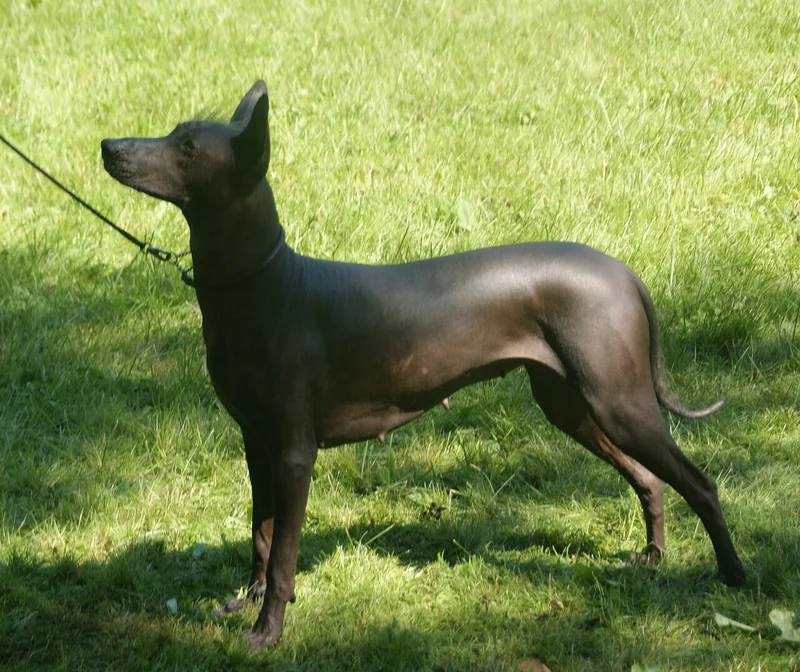 Featured photoxoloitzcuintli.jpg
The Xoloitzcuintli, also called the Mexican Hairless Dog or Xolo, is one of the oldest dog breeds in the world, with a history spanning at least 3,000 years in Mesoamerica. Named for the Aztec deity Xolotl and the Nahuatl word 'itzcuintli' (dog), the breed was considered sacred by the Aztec, Toltec, and other Mesoamerican cultures, who believed Xolos guided the souls of the dead to the underworld. Both hairless and coated varieties exist, in three sizes (toy, miniature, and standard). The AKC recognised the breed in 2011 and placed it in the Non-Sporting Group.
Quick facts
- AKC group
- Non-Sporting
- Origin country
- Mexico
- Origin period
- Ancient, documented from c. 1000 BCE
- Coat type
- Short
- Coat colors
- Black, Grey, Slate, Bronze, Red, Liver, Dark Brown
- Average lifespan
- 13-18 years
- Recognition
- AKC 2011 · FCI 1956 · UKC 1993 · Group 5 — Spitz and Primitive Types (Section 6: Primitive type)
Origin
The Xoloitzcuintli is one of humanity's oldest documented dog companions. Archaeological evidence from Aztec, Colima, Toltec, and Maya sites — including ceramic figurines, burial urns, and wall paintings — places hairless dogs of this type throughout Mesoamerica from approximately 1000 BCE. The Nahuatl name combines 'Xolotl' — the Aztec god of lightning and the guide of souls through the underworld — with 'itzcuintli', meaning dog. The Aztec believed the Xolo had healing powers; its warm skin was used as a living compress for arthritic and rheumatic conditions.
Recognition
The FCI recognised the Xoloitzcuintli in 1956 (FCI No. 234) with Mexico as patron country, classifying it in Group 5 (Spitz and Primitive types). The Federación Canófila Mexicana maintains the breed standard in Mexico, where the Xolo is the national dog. The AKC admitted the breed to the Miscellaneous Class in 2007 and granted full Non-Sporting Group recognition in 2011. The Mexican government declared the breed a national treasure in the 20th century.
Standard
The FCI and AKC standards recognise three sizes: toy (25–36 cm), miniature (36–48 cm), and standard (48–60 cm). Two coat types are recognised: hairless (predominantly hairless with possible short hair on the head, feet, and tail tip) and coated (short, flat, smooth coat over the whole body). Accepted colours include black, grey, slate, bronze, red, liver, and dark brown, uniform or spotted; the skin may be lighter or darker in hairless individuals. The breed should be elegant and moderately boned.
Sources & further reading (3)
- kennel-club-registry — accessed 2026-05-07
- encyclopedia — accessed 2026-05-07
- fci-standard — accessed 2026-05-07
Frequently asked questions
What AKC group does the Xoloitzcuintli belong to?
The AKC places the Xoloitzcuintli in the Non-Sporting Group. This group serves as a catch-all for breeds that do not fit neatly into the purpose-defined groups (Sporting, Hound, Working, Terrier, Toy, Herding). The Xolo's ancient companion and sacred-dog function, combined with its unusual size range and the existence of both hairless and coated varieties, led to its placement in the Non-Sporting Group.
What does 'Xoloitzcuintli' mean?
Xoloitzcuintli is a Nahuatl (Aztec language) compound: 'Xolotl' refers to the Aztec deity of lightning, death, and the underworld — the divine guide who led souls through Mictlan — and 'itzcuintli' means dog. The name therefore translates approximately as 'dog of Xolotl' or 'Xolotl's dog'. The popular nickname 'Xolo' is a shortened form.
When was the Xoloitzcuintli recognised by the AKC?
The AKC granted full recognition to the Xoloitzcuintli in 2011, placing it in the Non-Sporting Group. The breed had been in the AKC Miscellaneous Class since 2007. The FCI had recognised the breed since 1956 (FCI No. 234) with Mexico as patron country, and the UKC since 1993.