Canis lupus familiaris
Bulldog
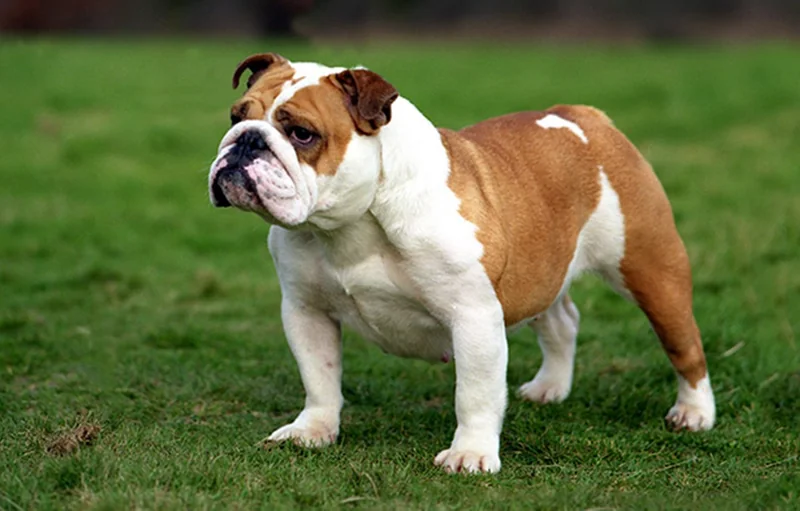 Featured photobulldog.jpg
The Bulldog is a medieval English bull-baiting dog refined post-1835 into the modern compact companion. The Bulldog descends from the medieval English baiting dogs used for the blood-sport of bull-baiting from the 13th century onward.
Quick facts
- AKC group
- Non-Sporting
- Origin country
- England
- Origin period
- 13th century (modern type formalized 1860s)
- Coat type
- Short
- Coat colors
- Red, Fawn, White, Brindle, Pied — any combination of these
- Average lifespan
- 8-10 years
- Recognition
- AKC 1886 · FCI 1955 · UKC 1934 · Group 2 — Pinscher and Schnauzer-Molossoid breeds-Swiss Mountain and Cattle Dogs (Section 2.1: Molossoid breeds, Mastiff type)
Origin
Bull-baiting — pitting dogs against a tethered bull — was a popular blood-sport across medieval England from at least the 13th century, and a distinct heavy-jawed mastiff type was bred for the work. The earliest unambiguous use of the name 'Bulldog' is in a 1631 letter. After the Cruelty to Animals Act of 1835 outlawed bull-baiting, the breed was at risk of extinction; from the 1860s onward, breeders associated with the Bulldog Club (founded 1875) refined the pit-fighting type into a more compact, less aggressive companion dog with the modern stocky build, undershot jaw, and pushed-in nose. The first written breed standard was published in 1875, the AKC registered the breed in 1886, and the modern type stabilized by the 1890s.
Recognition
The American Kennel Club admitted the breed in 1886, the United Kennel Club followed in 1934, and the Federation Cynologique Internationale published the international standard (FCI No. 149) in 1955. The FCI assigns the breed to Group 2 — Pinscher and Schnauzer-Molossoid breeds-Swiss Mountain and Cattle Dogs (Section 2.1: Molossoid breeds, Mastiff type).
Standard
The AKC and FCI standards describe a medium-sized, smooth-coated, thick-set dog, rather low in stature, broad, powerful, and compact. The defining features are the massive, short-faced head with a heavily wrinkled and pushed-in muzzle, the undershot jaw, and the wide-set forelegs creating the breed's characteristic rolling gait. The straight, short, fine, close, smooth, and glossy coat lies close to the body. Recognized colours and patterns are red, fawn, white, brindle, and any combination of these (pied). The breed stands 33-40 cm at the withers and weighs 22-25 kg.
Sources & further reading (3)
- kennel-club-registry — accessed 2026-05-04
- encyclopedia — accessed 2026-05-04
- fci-standard — accessed 2026-05-04
Frequently asked questions
What is the Bulldog's AKC group?
The American Kennel Club places the Bulldog in the Non-Sporting Group. The Non-Sporting Group is the AKC's residual category for breeds whose modern role does not fit the older Sporting / Hound / Working / Terrier / Toy / Herding rubrics; the Bulldog, Dalmatian, and Poodle sit here. The breed's foundation working role was as a medieval English bull-baiting dog refined post-1835 into the modern compact companion.
When was the Bulldog officially recognized?
The American Kennel Club admitted the breed in 1886; the United Kennel Club followed in 1934; the Federation Cynologique Internationale published the international standard (FCI No. 149) in 1955.
What is the average lifespan of a Bulldog?
Kennel-club longevity surveys place the Bulldog's average lifespan in the 8-10 years range. The figure here represents the spread reported by the major parent-club studies and the Kennel Club (UK) purebred-dog health surveys.