Canis lupus familiaris
Bichon Frise
 Featured photobichon-frise.jpg
The Bichon Frise is a Mediterranean curly-coated white Bichon — Tenerife to French and Spanish courts. The Bichon Frise descends from the Mediterranean Bichon-type lap-dogs (along with the Maltese, the Bolognese, the Coton de Tulear, and the Havanese), with documented presence in Tenerife (Canary Islands) from the 14th century, from where Spanish and Italian sailors brought them to Continental Europe.
Quick facts
- AKC group
- Non-Sporting
- Origin country
- Mediterranean (refined in France / Belgium)
- Origin period
- 14th century (modern type formalized 1933)
- Coat type
- Curly
- Coat colors
- Pure White (with permitted shading of buff, cream, or apricot around the ears or on the body)
- Average lifespan
- 14-15 years
- Recognition
- AKC 1972 · FCI 1959 · UKC 1972 · Group 9 — Companion and Toy Dogs (Section 1: Bichons and related breeds)
Origin
The Bichon Frise descends from the Mediterranean Bichon-type lap-dogs (a family also including the Maltese, Bolognese, Coton de Tulear, and Havanese), with documented presence in Tenerife (the largest of the Canary Islands) from the 14th century — hence the older breed name 'Tenerife Bichon'. From the Canaries the breed spread back to Continental Europe with Spanish and Italian sailors and became a favourite of the French royal court, particularly under Henri III (reigned 1574-1589) and Napoleon III (reigned 1852-1870). The breed nearly died out at the start of the 20th century; the modern type was formalized in 1933 by the Société Centrale Canine, which renamed the Tenerife Bichon as 'Bichon Frise' (French for 'curly Bichon'). The AKC admitted the breed in 1972.
Recognition
The American Kennel Club admitted the breed in 1972, the United Kennel Club followed in 1972, and the Federation Cynologique Internationale published the international standard (FCI No. 215) in 1959. The FCI assigns the breed to Group 9 — Companion and Toy Dogs (Section 1: Bichons and related breeds).
Standard
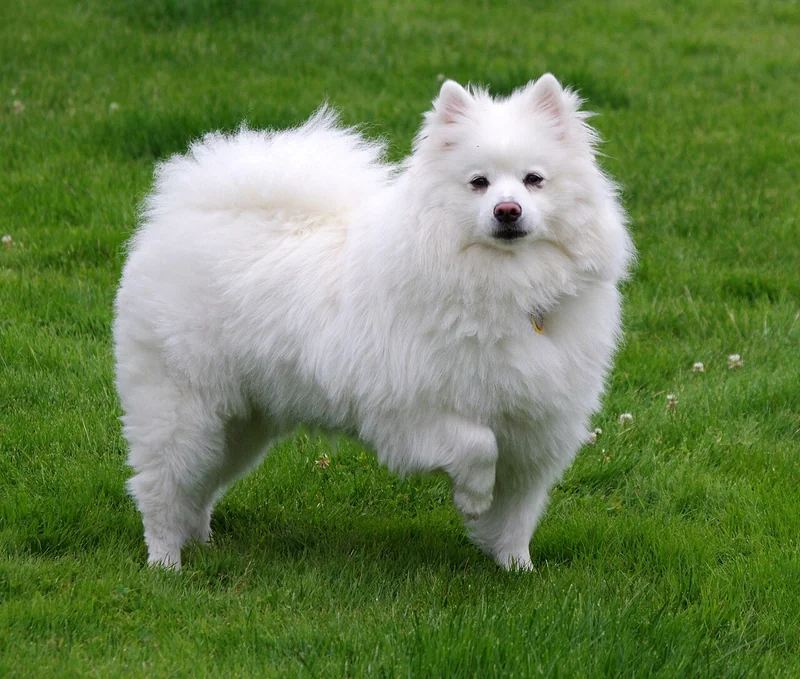
The AKC and FCI standards describe a small, sturdy, white powder-puff of a dog whose merry disposition is evidenced by its plumed tail carried jauntily over the back and the inquisitive expression. The defining feature is the soft, dense, curly, double coat in pure white (with permitted shading of buff, cream, or apricot around the ears or on the body) — a soft, dense undercoat with a coarser, curly outer coat. The breed stands 23-30 cm at the withers and weighs 3-6 kg.
Sources & further reading (3)
- kennel-club-registry — accessed 2026-04-30
- encyclopedia — accessed 2026-04-30
- fci-standard — accessed 2026-04-30
Frequently asked questions
What is the Bichon Frise's AKC group?
The American Kennel Club places the Bichon Frise in the Non-Sporting Group. The Non-Sporting Group is the AKC's residual category for breeds whose modern role does not fit the older Sporting / Hound / Working / Terrier / Toy / Herding rubrics; the Bulldog, Dalmatian, and Poodle sit here. The breed's foundation working role was as a Mediterranean curly-coated white Bichon — Tenerife to French and Spanish courts.
When was the Bichon Frise officially recognized?
The American Kennel Club admitted the breed in 1972; the United Kennel Club followed in 1972; the Federation Cynologique Internationale published the international standard (FCI No. 215) in 1959.
What is the average lifespan of a Bichon Frise?
Kennel-club longevity surveys place the Bichon Frise's average lifespan in the 14-15 years range. The figure here represents the spread reported by the major parent-club studies and the Kennel Club (UK) purebred-dog health surveys.