Canis lupus familiaris
Tibetan Terrier
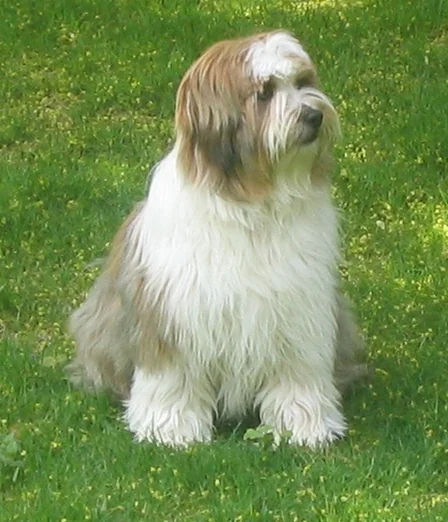 Featured phototibetan-terrier.jpg
The Tibetan Terrier is a ancient Tibetan-plateau Drokpa-herder and monastery 'holy dog'. The Tibetan Terrier (despite the name, not a true terrier — the breed is the largest of the four Tibetan breeds and was used as a herding and companion dog rather than for going to ground) was kept for at least 2,000 years by the nomadic Drokpa people of the Tibetan plateau and at the monasteries of Tibet, where the dogs were considered 'holy dogs' and were never sold but only given as gifts.
Quick facts
- AKC group
- Non-Sporting
- Origin country
- Tibet
- Origin period
- Antiquity (formalized 1930s)
- Coat type
- Long
- Coat colors
- Any colour or combination — white, gold, cream, smoke, black, parti-colour, tricolour, brindle
- Average lifespan
- 12-15 years
- Recognition
- AKC 1973 · FCI 1957 · UKC 1948 · Group 9 — Companion and Toy Dogs (Section 5: Tibetan breeds)
Origin
The Tibetan Terrier (despite the name, not a true terrier — the breed has no terrier-style 'going to ground' history; the name was applied by 19th-century European visitors who thought the dog resembled British terriers in size and rough coat) is the largest of the four Tibetan breeds (alongside the Lhasa Apso, Tibetan Spaniel, and Shih Tzu). The breed was kept for at least 2,000 years by the nomadic Drokpa herding people of the Tibetan plateau as a working herding dog and at the lamaseries of Tibet as a companion and watchdog. The dogs were considered 'holy dogs' and were never sold but only given as gifts of friendship and good fortune; their geographic isolation in Tibet preserved the breed's purity. The modern Western breed descends from a single dog (Bunti) imported to India by Dr Agnes Greig (a British physician working in India) in 1922, plus a small number of subsequent imports. The AKC admitted the breed in 1973.
Recognition
The American Kennel Club admitted the breed in 1973, the United Kennel Club followed in 1948, and the Federation Cynologique Internationale published the international standard (FCI No. 209) in 1957. The FCI assigns the breed to Group 9 — Companion and Toy Dogs (Section 5: Tibetan breeds).
Standard
The AKC and FCI standards describe a powerful, medium-sized, square-built dog of strong bone, with the appearance of being completely covered with a long, flowing double coat. The defining feature is the unusual large, flat, round, hare-shaped foot — a snowshoe adaptation to the Tibetan-plateau snow that the breed traditionally worked through. The double coat is profuse, fine, neither silky nor woolly, long and parted naturally down the back. Any colour and any combination of colours is acceptable. The breed stands 36-43 cm at the withers and weighs 8-14 kg.
Sources & further reading (3)
- kennel-club-registry — accessed 2026-04-30
- encyclopedia — accessed 2026-04-30
- fci-standard — accessed 2026-04-30
Frequently asked questions
What is the Tibetan Terrier's AKC group?
The American Kennel Club places the Tibetan Terrier in the Non-Sporting Group. The Non-Sporting Group is the AKC's residual category for breeds whose modern role does not fit the older Sporting / Hound / Working / Terrier / Toy / Herding rubrics; the Bulldog, Dalmatian, and Poodle sit here. The breed's foundation working role was as a ancient Tibetan-plateau Drokpa-herder and monastery 'holy dog'.
When was the Tibetan Terrier officially recognized?
The American Kennel Club admitted the breed in 1973; the United Kennel Club followed in 1948; the Federation Cynologique Internationale published the international standard (FCI No. 209) in 1957.
What is the average lifespan of a Tibetan Terrier?
Kennel-club longevity surveys place the Tibetan Terrier's average lifespan in the 12-15 years range. The figure here represents the spread reported by the major parent-club studies and the Kennel Club (UK) purebred-dog health surveys.