Canis lupus familiaris
Lhasa Apso
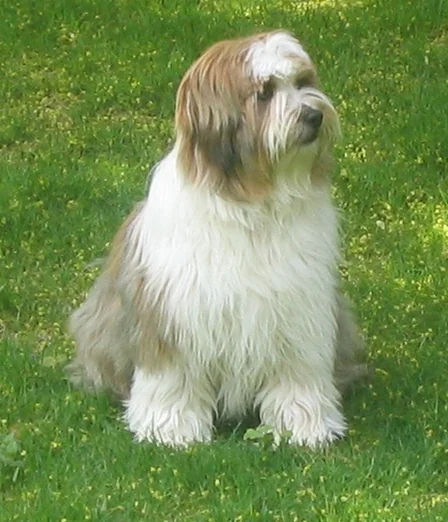
 Featured photolhasa-apso.jpg
The Lhasa Apso is a ancient Tibetan monastery sentinel — the 'Bark Lion Sentinel Dog' of Lhasa. The Lhasa Apso (named for the Tibetan capital Lhasa and the Tibetan word apso, meaning 'long-haired' or 'goat-like') was kept for at least 1,000 years as the indoor sentinel dog of Tibetan monasteries and the homes of the Tibetan nobility, where the dogs would alert to intruders by barking — the role gives the breed its Tibetan name Apso Seng Kye ('Bark Lion Sentinel Dog').
Quick facts
- AKC group
- Non-Sporting
- Origin country
- Tibet
- Origin period
- Antiquity (formalized 1930s)
- Coat type
- Long
- Coat colors
- Any colour acceptable — gold, sable, white, black, parti-colour, with various pattern combinations
- Average lifespan
- 12-15 years
- Recognition
- AKC 1935 · FCI 1960 · UKC 1948 · Group 9 — Companion and Toy Dogs (Section 5: Tibetan breeds)
Origin
The Lhasa Apso (named for the Tibetan capital Lhasa and the Tibetan word apso, meaning 'long-haired' or 'goat-like') was kept for at least 1,000 years in Tibet as the indoor sentinel dog of Tibetan monasteries and the homes of the Tibetan nobility. The dogs alerted to intruders by barking — the role that gives the breed its Tibetan name Apso Seng Kye ('Bark Lion Sentinel Dog'). The dogs were considered sacred; export from Tibet was strictly controlled and Lhasa Apsos were given only as official gifts. The modern Western breed descends from a small number of dogs gifted by the 13th Dalai Lama (Thubten Gyatso, 1876-1933) to American visitors C. Suydam Cutting and his wife Helen Cutting Wilmerding between 1933 and 1937. The AKC admitted the breed in 1935 (initially classed with the Tibetan Terrier; the two were separated by the AKC in 1959).
Recognition
The American Kennel Club admitted the breed in 1935, the United Kennel Club followed in 1948, and the Federation Cynologique Internationale published the international standard (FCI No. 227) in 1960. The FCI assigns the breed to Group 9 — Companion and Toy Dogs (Section 5: Tibetan breeds).
Standard
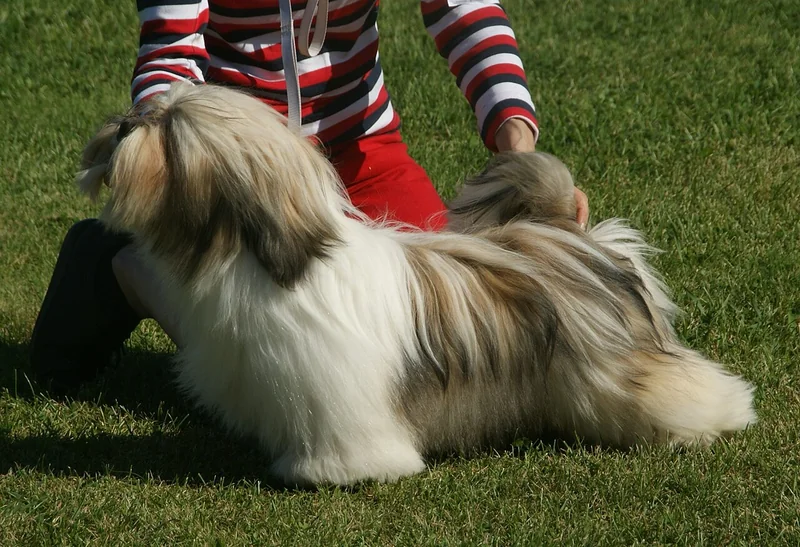
The AKC and FCI standards describe a small, hardy, well-balanced, sturdy dog of profuse coat. The defining feature is the long, heavy, straight, hard, dense outer coat over a moderate undercoat — the coat falls heavily down each side of the body and over the head, partially covering the eyes, with a long beard and moustache on the muzzle. Any colour is acceptable, with gold, sable, parti-colour, and white the most common patterns. The breed stands 25-28 cm at the withers and weighs 6-7 kg.
Sources & further reading (3)
- kennel-club-registry — accessed 2026-04-30
- encyclopedia — accessed 2026-04-30
- fci-standard — accessed 2026-04-30
Frequently asked questions
What is the Lhasa Apso's AKC group?
The American Kennel Club places the Lhasa Apso in the Non-Sporting Group. The Non-Sporting Group is the AKC's residual category for breeds whose modern role does not fit the older Sporting / Hound / Working / Terrier / Toy / Herding rubrics; the Bulldog, Dalmatian, and Poodle sit here. The breed's foundation working role was as a ancient Tibetan monastery sentinel — the 'Bark Lion Sentinel Dog' of Lhasa.
When was the Lhasa Apso officially recognized?
The American Kennel Club admitted the breed in 1935; the United Kennel Club followed in 1948; the Federation Cynologique Internationale published the international standard (FCI No. 227) in 1960.
What is the average lifespan of a Lhasa Apso?
Kennel-club longevity surveys place the Lhasa Apso's average lifespan in the 12-15 years range. The figure here represents the spread reported by the major parent-club studies and the Kennel Club (UK) purebred-dog health surveys.