Canis lupus familiaris
Scottish Deerhound
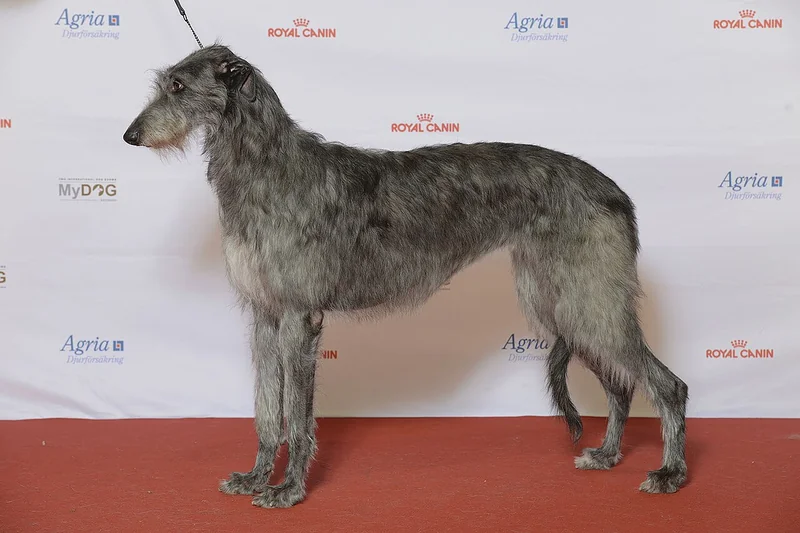 Featured photoscottish-deerhound.jpg
The Scottish Deerhound is one of the tallest dog breeds in the world and one of the oldest sighthound breeds in Britain, with a history stretching back beyond written record. Known as the 'Royal Dog of Scotland', the breed was associated with Scottish clan chieftains and highland nobility from at least the 16th century, when regulations decreed that only those of the rank of earl or higher could own one. Its rough, wiry coat, great size, and coursing speed were developed specifically for pursuing the red deer of the Scottish Highlands. The AKC recognised the breed in 1886.
Quick facts
- AKC group
- Hound
- Origin country
- Scotland
- Origin period
- Medieval
- Coat type
- Wirehaired
- Coat colors
- Blue Grey, Dark Grey, Grey Brindle, Yellow, Sandy
- Average lifespan
- 8-11 years
- Recognition
- AKC 1886 · FCI 1954 · UKC 1940 · Group 10 — Sighthounds (Section 2: Rough-haired Sighthounds)
Origin
Large, rough-coated sighthounds resembling the modern Scottish Deerhound were documented in Scotland by Roman writers during the 1st century CE and feature in early Scottish and Irish literature. The breed became the exclusive preserve of Scottish highland nobility during the medieval period — 16th-century Scottish law prohibited commoners from owning one — which simultaneously elevated the breed's status and imperiled its population. The Deerhound's purpose was to course the large red deer of the highland glens, a quarry requiring great size, speed, and stamina from the dog.
Recognition
The introduction of rifle hunting for deer in the 19th century dramatically reduced demand for coursing hounds. Archibald and Duncan McNeill of Colonsay began a systematic revival of the breed from the 1820s, documenting pedigrees and promoting the Deerhound at the early dog shows following The Kennel Club's formation in 1873. The KC recognised the breed that same year; the AKC followed in 1886, placing the Deerhound in the Hound Group. The FCI standard (FCI No. 164) was established in 1954.
Standard
The AKC and FCI standards describe a very large, tall, wiry-coated sighthound of greyhound character — great speed, combined with the strength and endurance to pull down a full-grown red deer. The coat is rough and hard, about 7–10 cm long on the body and the neck, with a slight fringe on the belly and inside of the legs. Blue-grey is the preferred colour; dark grey, grey brindle, yellow, sandy red, and red fawn with black points are all acceptable. Males stand at least 76 cm; females at least 71 cm.
Sources & further reading (3)
- kennel-club-registry — accessed 2026-05-07
- encyclopedia — accessed 2026-05-07
- fci-standard — accessed 2026-05-07
Frequently asked questions
What AKC group does the Scottish Deerhound belong to?
The AKC places the Scottish Deerhound in the Hound Group as a sighthound. The breed pursues game primarily by sight and speed — in the Deerhound's case, red deer across open Scottish highland terrain. It is one of the tallest breeds in the AKC Hound Group and is closely related to the Irish Wolfhound, which is slightly taller.
Why was the Scottish Deerhound called the Royal Dog of Scotland?
The Deerhound's size, elegance, and hunting ability made it so prized by Scottish nobility that 16th-century law restricted ownership to persons of the rank of earl or above. A condemned noble could reportedly obtain a pardon by offering a Scottish Deerhound in exchange. This association with royalty and highland clan chiefs earned it the title 'Royal Dog of Scotland'. Sir Walter Scott, who owned Deerhounds, famously called the breed 'the most perfect creature of Heaven'.
How does the Scottish Deerhound compare to the Irish Wolfhound?
The Scottish Deerhound and Irish Wolfhound are closely related large rough-coated sighthounds with parallel histories on either side of the Irish Sea. The Irish Wolfhound is generally taller (minimum 79 cm for males vs. 76 cm for Deerhounds) and heavier (minimum 54 kg vs. 40–50 kg). The Deerhound is finer boned and considered slightly more elegant; the Wolfhound has a more massive, powerful build. Both breeds were used to course large prey — deer and wolves, respectively — by highland nobility.