Canis lupus familiaris
Basenji
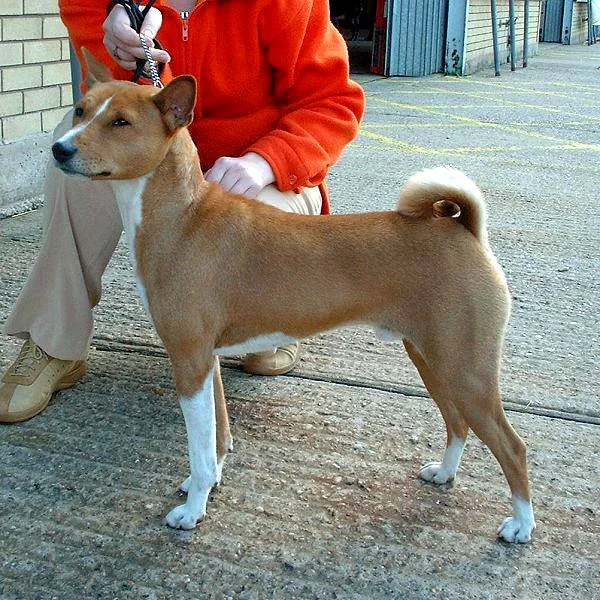 Featured photobasenji.jpg
The Basenji is a small, short-haired hunting dog originating in Central Africa, where it has been used for millennia by forest people of the Congo Basin to flush small game into nets. It is best known for its inability to produce a typical bark — instead it vocalises with a distinctive yodel-like sound called a barroo — and for its cat-like habits of self-grooming and meticulous cleanliness. Representations closely resembling the modern Basenji appear on ancient Egyptian artefacts, suggesting a very long history of domestication. The AKC recognised the Basenji in 1944.
Quick facts
- AKC group
- Hound
- Origin country
- Democratic Republic of the Congo
- Origin period
- Ancient
- Coat type
- Short
- Coat colors
- Chestnut Red and White, Black and White, Tricolor, Brindle and White
- Average lifespan
- 13-14 years
- Recognition
- AKC 1944 · FCI 1964 · UKC 1948 · Group 5 — Spitz and Primitive Types (Section 6: Primitive type)
Origin
The Basenji developed in the tropical forests and savannahs of Central Africa, where the Azande, Mangbetu, and related peoples used it for generations to flush small game — particularly forest duikers, cane rats, and francolin — into nets. European explorers first encountered the breed in the Congo Basin in the late 19th century; the Reverend C. M. Browne described the breed in 1895 and brought specimens to England, though they died before establishing a breeding program. Dogs matching the Basenji's description appear in Egyptian pyramid drawings from approximately 2600 BCE, pointing to a very ancient domestication history.
Recognition
Olivia Burn's successful 1936 importation of Basenjis to Britain established the foundation of the Western breeding population. The Basenji Club of Great Britain was founded in 1937. The AKC recognised the breed in 1944, placing it in the Hound Group. The FCI recognised the Basenji in 1964 (FCI No. 43), placing it in Group 5, Section 6 (Primitive type), reflecting its ancient, pre-European-contact status as a dog type shaped almost entirely by natural and indigenous selective pressure.
Standard
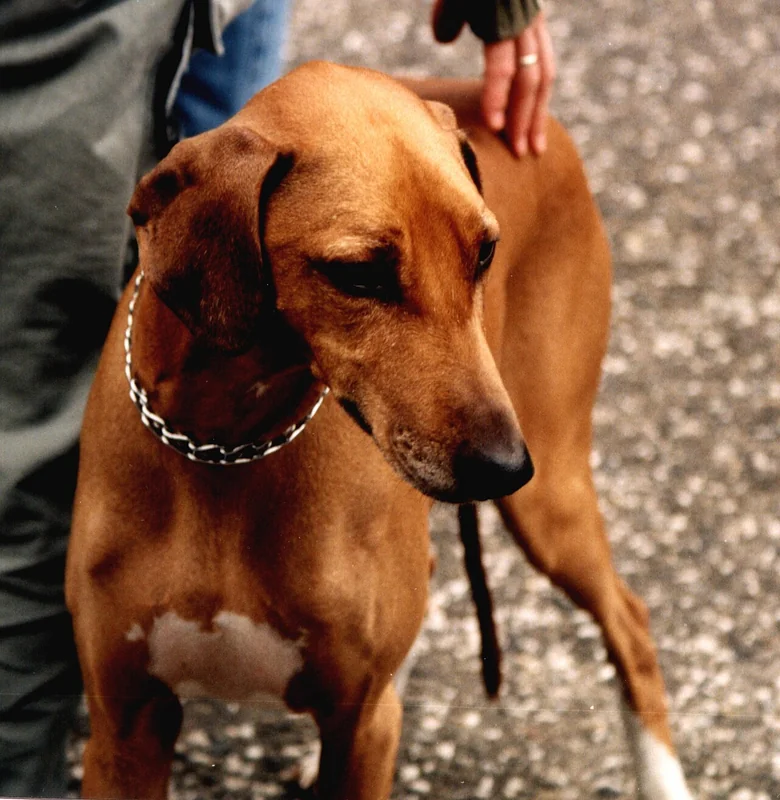
The AKC standard describes a lightly built, finely boned, aristocratic-looking dog of medium size. The head is flat and well-chiseled with a fine, tapering muzzle, and the forehead carries wrinkles when the dog is alert. The tightly curled tail carried over to one side is a breed hallmark. The coat is short, sleek, and close. Recognised colours are chestnut red and white, black and white, tricolor (black, chestnut, and white), and brindle and white; white feet, chest, and tail tip are required in all colours. Males stand 43 cm; females 40 cm.
Sources & further reading (3)
- kennel-club-registry — accessed 2026-05-07
- encyclopedia — accessed 2026-05-07
- fci-standard — accessed 2026-05-07
Frequently asked questions
Why can't the Basenji bark?
The Basenji cannot produce the typical dog bark because its larynx is shaped differently from most domestic dog breeds — the laryngeal anatomy does not allow the repeated bark cycle. Instead, Basenjis vocalise with a characteristic sound often described as a yodel, chortle, or 'barroo', produced on both inhalation and exhalation. They are also capable of growling, howling, and other vocalizations; the 'barkless' description refers specifically to the inability to produce the repetitive barking of most domestic breeds.
What AKC group is the Basenji in?
The AKC places the Basenji in the Hound Group. The breed is classified as a primitive hunting hound that uses both sight and scent in the hunt. The FCI, however, places it in Group 5 (Spitz and Primitive types), reflecting its ancient status as a breed type shaped by thousands of years of natural selection in Central Africa rather than by modern breed-club standards.
When was the Basenji recognised by the AKC?
The AKC recognised the Basenji in 1944. The breed had been successfully established in Britain from 1936 when Olivia Burn imported the first healthy breeding specimens, and the Basenji Club of Great Britain was founded in 1937. The FCI followed with recognition in 1964 (FCI No. 43).