Canis lupus familiaris
Nova Scotia Duck Tolling Retriever
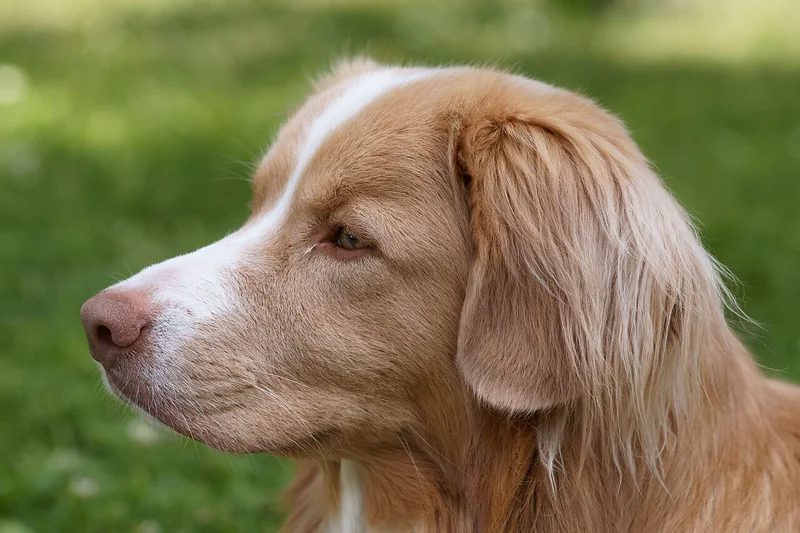 Featured photonova-scotia-duck-tolling-retriever.jpg
The Nova Scotia Duck Tolling Retriever, commonly called the Toller, is the smallest of the AKC retriever breeds and Canada's only dog breed to achieve AKC recognition. Developed in Yarmouth County, Nova Scotia, in the early 19th century, the breed employs a unique hunting technique called tolling — frolicking and retrieving sticks at the water's edge to arouse the curiosity of ducks and lure them within gunshot range. The breed's fox-red to golden-red coat and white flash markings are hallmarks of the standard. The AKC admitted the Toller in 2003.
Quick facts
- AKC group
- Sporting
- Origin country
- Canada
- Origin period
- Early 19th century
- Coat type
- Double
- Coat colors
- Golden Red, Red, Orange Red
- Average lifespan
- 12-14 years
- Recognition
- AKC 2003 · FCI 1995 · UKC 1996 · Group 8 — Retrievers, Flushing Dogs, Water Dogs (Section 1: Retrievers)
Origin
The Toller's origin lies in Yarmouth County, Nova Scotia, where Acadian settlers and Mi'kmaq people had observed that red foxes could lure curious ducks shoreward by playing along the water's edge. Hunters replicated this technique by using small, fox-red dogs to toll waterfowl within gunshot range while remaining hidden in a blind. The dog's working role combined tolling at the water's edge with retrieving the shot birds. Its compact size allowed it to work in the small boats favoured on Nova Scotia's rivers and tidal inlets.
Recognition
The Canadian Kennel Club recognised the breed in 1945 under the name Nova Scotia Duck Tolling Retriever — a name that accurately captures the unique tolling technique. The breed was declared the provincial dog of Nova Scotia in 1995. The FCI granted recognition in 1995 (FCI No. 312) and assigned the breed to Group 8. The AKC entered the breed in its Miscellaneous Class in 2001 and granted full Sporting Group recognition in 2003, making it the most recently recognised retriever in the AKC.
Standard
The AKC standard describes a medium-sized, compact, well-muscled dog, slightly longer than tall, with a strong, clean-cut head and a slightly wedge-shaped muzzle. The double coat is water-repellent, medium length, with a softer dense undercoat; the outer coat may be straight or slightly wavy. Colour ranges from golden red to a lighter copper or orange-red, with white flash markings on the forehead, below the neck, on the paws, and on the tip of the tail. Males stand 48–51 cm; females 45–48 cm.
Sources & further reading (3)
- kennel-club-registry — accessed 2026-05-07
- encyclopedia — accessed 2026-05-07
- fci-standard — accessed 2026-05-07
Frequently asked questions
What is the Nova Scotia Duck Tolling Retriever's unique hunting technique?
The Toller uses a hunting method called tolling — the dog plays along the shoreline, fetching sticks and running back and forth near the water. This activity arouses the natural curiosity of ducks, which swim closer to investigate. Once the ducks are within range, the hunter reveals themselves to flush the birds. After the shot, the Toller retrieves the downed waterfowl in the traditional retriever manner.
When was the Toller recognised by the AKC?
The AKC granted the Nova Scotia Duck Tolling Retriever full recognition in 2003, placing it in the Sporting Group. It entered the AKC Miscellaneous Class in 2001. The Canadian Kennel Club had recognised the breed much earlier, in 1945, and the FCI followed in 1995. The Toller is the most recently recognised retriever breed in the AKC.
Why is the Toller's coat red or orange?
The fox-red to golden-red coat is directly linked to the breed's tolling function: its color closely mimics that of a red fox, the natural animal whose shoreline play originally attracted ducks. Selective breeding reinforced this coloration as a functional trait. The AKC standard specifies that the body coat must range from golden red to a darker copper or orange red, with lighter feathering permissible.