Canis lupus familiaris
Chesapeake Bay Retriever
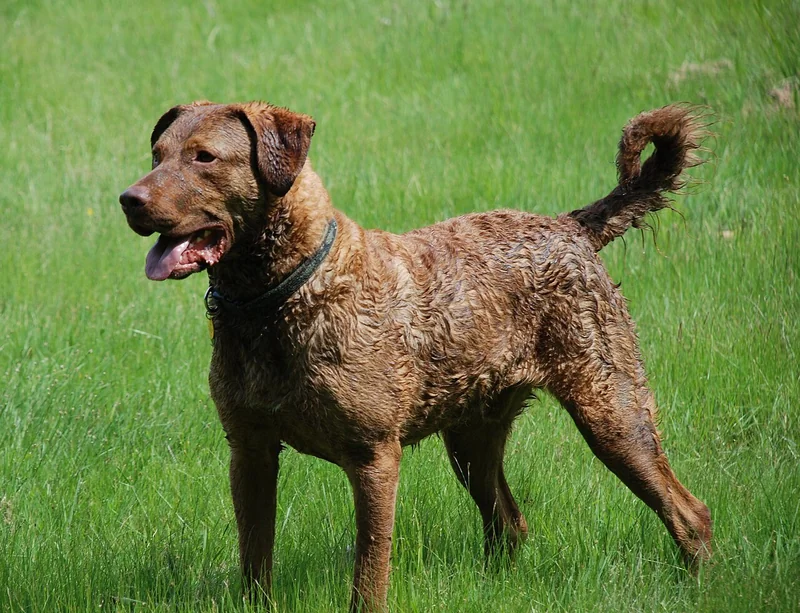 Featured photochesapeake-bay-retriever.jpg
The Chesapeake Bay Retriever is a American Chesapeake Bay duck-retrieving water dog descended from the 1807 Sailor + Canton pair. The Chesapeake Bay Retriever traces to two Newfoundland-type pups, Sailor and Canton, rescued from a shipwrecked English brig off the Maryland coast of Chesapeake Bay in 1807.
Quick facts
- AKC group
- Sporting
- Origin country
- United States (Chesapeake Bay)
- Origin period
- Early 19th century
- Coat type
- Medium
- Coat colors
- Brown, Sedge, Deadgrass
- Average lifespan
- 10-13 years
- Recognition
- AKC 1878 · FCI 1954 · UKC 1948 · Group 8 — Retrievers, Flushing Dogs, Water Dogs (Section 1: Retrievers)
Origin
In 1807, an English brig (Canton) sailing from Newfoundland to Poole, England, was wrecked off the Maryland coast of Chesapeake Bay. Two pups of the now-extinct St John's water dog type, named Sailor and Canton after the brig, were rescued and given to local landowners. Their descendants were crossed with local hounds, the now-extinct English Water Spaniel, the Curly-Coated Retriever, and the Flat-Coated Retriever to produce a duck-retrieving dog adapted to the icy Chesapeake bay water. The breed was fixed by the 1880s; the AKC registered the Chesapeake Bay Retriever in 1878, making it the first American-bred AKC sporting breed.
Recognition
The American Kennel Club admitted the breed in 1878, the United Kennel Club followed in 1948, and the Federation Cynologique Internationale published the international standard (FCI No. 263) in 1954. The FCI assigns the breed to Group 8 — Retrievers, Flushing Dogs, Water Dogs (Section 1: Retrievers).
Standard
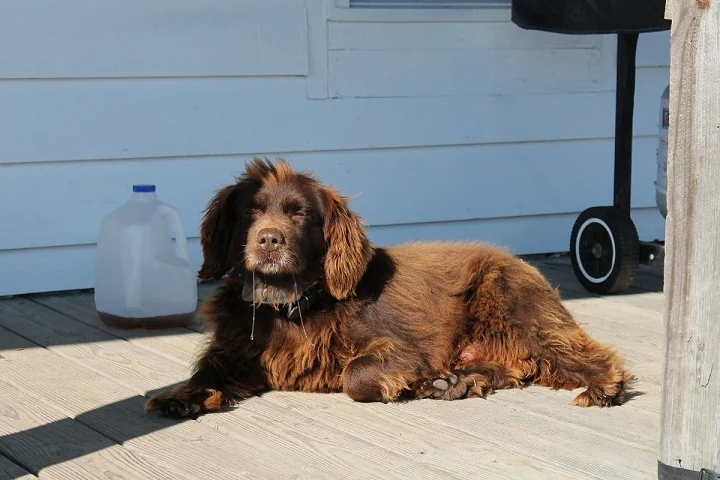
The AKC and FCI standards describe a dog of bright and cheerful nature, intelligent, courageous, willing, and alert. The defining feature is the distinctive double coat: a thick, short, harsh outer coat with a dense, fine, woolly undercoat that is so oily as to be water-resistant. Recognized colours are restricted to the colours of the breed's working environment: brown (any shade), sedge (a yellowish red), and deadgrass (a faded tan, the colour of the marsh grasses where the dog hunts). Males stand 58-66 cm at the withers, females 53-61 cm.
Sources & further reading (3)
- kennel-club-registry — accessed 2026-04-30
- encyclopedia — accessed 2026-04-30
- fci-standard — accessed 2026-04-30
Frequently asked questions
What is the Chesapeake Bay Retriever's AKC group?
The American Kennel Club places the Chesapeake Bay Retriever in the Sporting Group. The Sporting Group gathers pointers, setters, retrievers, and spaniels — breeds developed to assist hunters in locating, flushing, or retrieving game birds. The breed's foundation working role was as a American Chesapeake Bay duck-retrieving water dog descended from the 1807 Sailor + Canton pair.
When was the Chesapeake Bay Retriever officially recognized?
The American Kennel Club admitted the breed in 1878; the United Kennel Club followed in 1948; the Federation Cynologique Internationale published the international standard (FCI No. 263) in 1954.
What is the average lifespan of a Chesapeake Bay Retriever?
Kennel-club longevity surveys place the Chesapeake Bay Retriever's average lifespan in the 10-13 years range. The figure here represents the spread reported by the major parent-club studies and the Kennel Club (UK) purebred-dog health surveys.