Canis lupus familiaris
Norwegian Buhund
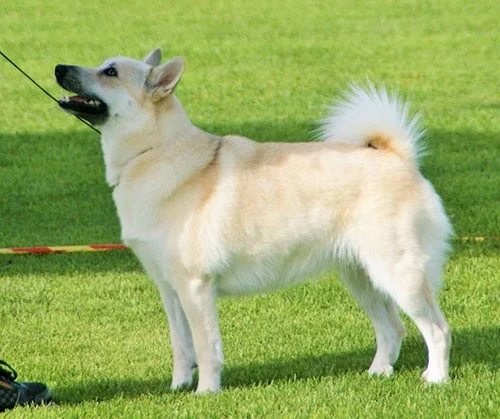 Featured photonorwegian-buhund.jpg
The Norwegian Buhund is a compact, lively Scandinavian spitz herding breed with a history stretching to the Viking Age. Dogs closely resembling the modern Buhund were found buried in the Gokstad Viking ship burial mound dated to approximately 900 CE, providing direct evidence of the breed's antiquity. Used for centuries to herd sheep and guard Norse farms and homesteads, the Buhund was officially bred and recognised in Norway from the 1920s onward. The AKC admitted it in 2009. Males stand 43–47 cm and females 41–45 cm.
Quick facts
- AKC group
- Herding
- Origin country
- Norway
- Origin period
- Ancient, documented from c. 900 CE
- Coat type
- Double
- Coat colors
- Wheaten, Red, Black
- Average lifespan
- 12-15 years
- Recognition
- AKC 2009 · FCI 1954 · UKC 1996 · Group 5 — Spitz and Primitive Types (Section 3: Nordic Watchdogs and Herders)
Origin
The Norwegian Buhund is among the oldest Scandinavian dog breeds. The discovery of dog remains in the Gokstad Viking ship burial mound (c. 900 CE) — excavated at Sandefjord, Norway, in 1880 — provided direct archaeological evidence: the six dogs buried with the chieftain closely resembled the modern Buhund in skeletal structure. For over a millennium, the Buhund was an indispensable farm dog in Norway, herding sheep and reindeer, guarding farmsteads (bu) against predators, and accompanying hunters and fishermen.
Recognition
The breed was brought to the attention of the Norwegian kennel community by John Saeland, who began standardisation work in the 1920s. A regional breed show for Buhunds was held at Jaeren, Norway, in 1920. The Norwegian Kennel Club recognised the breed, and the Norsk Buhundklubb was established in 1939. The FCI (FCI No. 237) recognised the breed in 1954 with Norway as patron country. The AKC admitted the Norwegian Buhund to the Herding Group in 2009.
Standard
The FCI and AKC standards describe a medium-small, lightly built, square-bodied spitz with a wedge-shaped head, erect ears, and a tightly curled tail carried over the back. The double coat is rich and hard in the outer layer with a woolly, thick undercoat; the coat is particularly abundant around the neck, on the chest, and on the backs of the thighs. Accepted colours are wheaten (pale cream to bright yellow), red (dark red is less preferred), and black (with or without white markings). Males stand 43–47 cm; females 41–45 cm.
Sources & further reading (3)
- kennel-club-registry — accessed 2026-05-07
- encyclopedia — accessed 2026-05-07
- fci-standard — accessed 2026-05-07
Frequently asked questions
What AKC group does the Norwegian Buhund belong to?
The AKC places the Norwegian Buhund in the Herding Group. The breed has been used for centuries to herd sheep and goats on Norwegian mountain farms and is still used in this role in Norway today. The FCI classifies it in Group 5 (Spitz and Primitive types), Section 3 (Nordic Watchdogs and Herders), alongside the Icelandic Sheepdog and other Scandinavian herding spitz breeds.
What is the connection between the Norwegian Buhund and Viking history?
Dog remains found in the Gokstad Viking ship burial mound in Norway — dated to approximately 900 CE and excavated in 1880 — closely match the skeletal structure of the modern Norwegian Buhund. The burial included six dogs alongside the chieftain's body, suggesting the Buhund-type dog was a prized companion of Viking-age Norwegian farmers and warriors. This archaeological evidence makes the Buhund one of the few modern breeds with direct physical evidence extending to the Viking Age.
When was the Norwegian Buhund recognised by the AKC?
The AKC recognised the Norwegian Buhund in 2009, placing it in the Herding Group. The FCI had recognised the breed since 1954 (FCI No. 237) with Norway as patron country. The Norsk Buhundklubb was founded in 1939, and breed standardisation in Norway had begun in the 1920s under John Saeland.