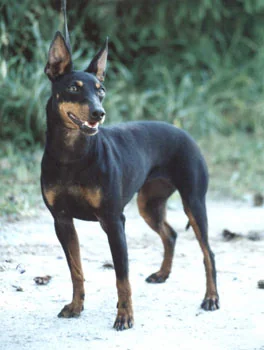
The Manchester Terrier is a mid-19th-century Manchester cotton-mill ratter — Black-and-Tan Terrier × Whippet cross. The Manchester Terrier was developed in mid-19th-century Manchester, England, by 'Damper' John Hulme, who crossed the now-extinct English Black-and-Tan Terrier with the Whippet to produce a refined working ratter capable of dispatching the rats of the Manchester cotton mills and the warren rabbits of the surrounding farmland.
Quick facts
- AKC group
- Terrier
- Origin country
- England (Manchester)
- Origin period
- Mid-19th century
- Coat type
- Short
- Coat colors
- Black and Tan only — coal black with rich mahogany-tan markings above each eye, on the muzzle, throat, chest, legs, and below the tail
- Average lifespan
- 14-16 years
- Recognition
- AKC 1887 · FCI 1956 · UKC 1948 · Group 3 — Terriers (Section 1: Large and medium-sized Terriers)
Origin
The Manchester Terrier was developed in mid-19th-century Manchester, England, by 'Damper' John Hulme of Crumpsall — a famous rat-pit gambler — who crossed the now-extinct English Black-and-Tan Terrier with the Whippet to produce a refined working ratter capable of dispatching the rats of the Manchester cotton mills and the warren rabbits of the surrounding farmland. The breed was extensively bred down to a toy size in the late 19th century, producing the Toy Manchester Terrier (registered as a separate breed by the AKC in 1886, then merged back as a sub-variety of the Manchester Terrier in 1959). The Manchester Terrier was the foundation breed of several modern terriers (including the Doberman Pinscher) and the AKC registered the breed in 1887.
Recognition
The American Kennel Club admitted the breed in 1887, the United Kennel Club followed in 1948, and the Federation Cynologique Internationale published the international standard (FCI No. 71) in 1956. The FCI assigns the breed to Group 3 — Terriers (Section 1: Large and medium-sized Terriers).
Standard
The AKC and FCI standards describe a small, sleek, sinewy, smartly-built terrier of moderate substance, with a slightly-arched back, deep chest, and elegant outline — the Whippet ancestry visible in the build. Two size varieties are recognized: Standard (5-10 kg, 38-41 cm) and Toy (2-5 kg, 25-30 cm). The short, hard, dense, glossy coat is recognized in only one colour pattern: coal black with rich mahogany-tan markings above each eye, on the muzzle, throat, chest, legs, and below the tail.
Sources & further reading (3)
- kennel-club-registry — accessed 2026-04-30
- encyclopedia — accessed 2026-04-30
- fci-standard — accessed 2026-04-30
Frequently asked questions
What is the Manchester Terrier's AKC group?
The American Kennel Club places the Manchester Terrier in the Terrier Group. The Terrier Group gathers breeds developed to hunt and dispatch vermin or to go to ground after fox and badger; the name derives from the Latin terra ('earth'). The breed's foundation working role was as a mid-19th-century Manchester cotton-mill ratter — Black-and-Tan Terrier × Whippet cross.
When was the Manchester Terrier officially recognized?
The American Kennel Club admitted the breed in 1887; the United Kennel Club followed in 1948; the Federation Cynologique Internationale published the international standard (FCI No. 71) in 1956.
What is the average lifespan of a Manchester Terrier?
Kennel-club longevity surveys place the Manchester Terrier's average lifespan in the 14-16 years range. The figure here represents the spread reported by the major parent-club studies and the Kennel Club (UK) purebred-dog health surveys.