Canis lupus familiaris
Ibizan Hound
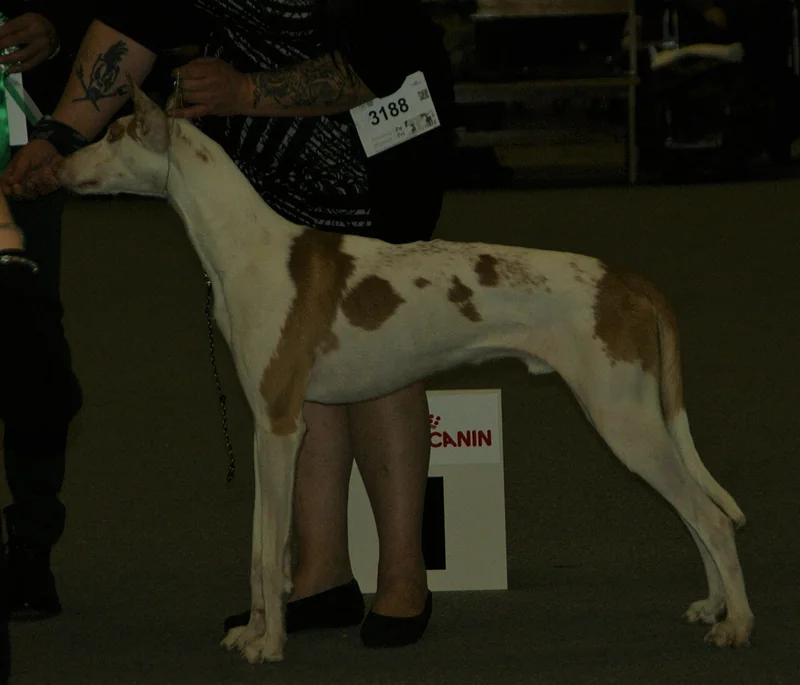 Featured photoibizan-hound.jpg
The Ibizan Hound is a tall, elegant sighthound native to the Balearic Islands of Spain — principally Ibiza and Formentera — where it has hunted rabbit for centuries using an unusual combination of sight, scent, and hearing. Its distinctive large, upright amber-colored ears and amber or caramel eyes give it an expression reminiscent of the Egyptian god Anubis, a resemblance reinforced by ancient Egyptian artefacts depicting similar dogs. The breed comes in both smooth and wirehaired varieties. The AKC admitted the Ibizan Hound in 1979. Males stand 60–72 cm and weigh 20–29 kg.
Quick facts
- AKC group
- Hound
- Origin country
- Spain
- Origin period
- Ancient, documented from c. 3400 BCE
- Coat type
- Short
- Coat colors
- White, Red, White and Red
- Average lifespan
- 11-14 years
- Recognition
- AKC 1979 · FCI 1954 · UKC 1996 · Group 5 — Spitz and Primitive Types (Section 7: Primitive type — Hunting Dogs)
Origin
Ancient Egyptian tomb paintings and artefacts from as far back as 3400 BCE depict tall, large-eared, red-and-white hunting dogs closely matching the modern Ibizan Hound. Phoenician maritime trade likely brought these hounds to the Balearic Islands (present-day Ibiza, Formentera, Mallorca, and Menorca) around 900–700 BCE. Geographic isolation on these islands preserved the type in near-original condition for over two millennia. On Ibiza the breed was used — and continues to be used — to course rabbit across the rugged limestone terrain, aided by acute hearing and scenting ability rather than pure speed alone.
Recognition
The FCI (FCI No. 89) recognised the Ibizan Hound in 1954, with Spain as patron country, classifying it in Group 5, Section 7 (Primitive type — Hunting Dogs) alongside the Pharaoh Hound, Cirneco dell'Etna, and Portuguese Podengo. The AKC admitted the breed to the Miscellaneous Class in 1967 and granted full Hound Group recognition in 1979. The American introduction began in 1956 when Colonel and Mrs. Consuelo Seoane imported the first breeding pair from Ibiza.
Standard
The AKC and FCI standards describe a deer-like, elegant hound of greyhound type with a long, flat skull and a long, fine muzzle. The most striking feature is the large, erect, mobile ears — set high and very mobile — and the light amber or caramel eyes. Two coat types are recognised: smooth (short and close) and wirehaired (1–3 cm, hard texture). Accepted colours are white, red, and red and white in any distribution; no other colours are permitted. Males stand 60–72 cm; females 57–66 cm.
Sources & further reading (3)
- kennel-club-registry — accessed 2026-05-07
- encyclopedia — accessed 2026-05-07
- fci-standard — accessed 2026-05-07
Frequently asked questions
What AKC group does the Ibizan Hound belong to?
The AKC places the Ibizan Hound in the Hound Group. The FCI, however, classifies it in Group 5 (Spitz and Primitive types), Section 7, alongside the Pharaoh Hound and Cirneco dell'Etna — reflecting the breed's ancient Mediterranean origin predating modern kennel-club breed development. The Ibizan Hound uses sight, scent, and hearing to hunt rabbit, making it a uniquely versatile primitive hunter.
What is the connection between the Ibizan Hound and ancient Egypt?
Dogs closely resembling the Ibizan Hound appear in Egyptian tomb art, wall paintings, and artefacts dated to approximately 3400 BCE. The striking similarity to depictions of Anubis — the Egyptian jackal-headed deity associated with death and the afterlife — has been noted by Egyptologists. However, DNA studies suggest the modern Ibizan Hound is not a direct lineal descendant of ancient Egyptian dogs; rather, it is likely a recreated ancient type from more recent Mediterranean hound stock.
What coat types does the Ibizan Hound come in?
The Ibizan Hound comes in two coat types: smooth (short and close-lying) and wirehaired (approximately 1–3 cm long, hard, and slightly rough in texture, often with a moustache and eyebrows). Both coat types are recognised by the AKC and FCI. The smooth coat is the more common variety in the United States, while the wirehaired type is more prevalent in Spain and other European countries.