Canis lupus familiaris
German Wirehaired Pointer
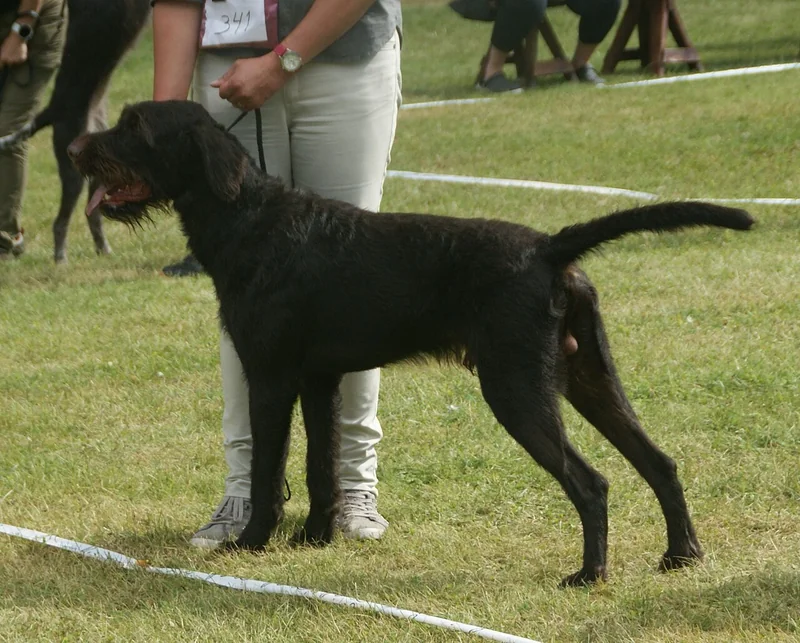 Featured photogerman-wirehaired-pointer.jpg
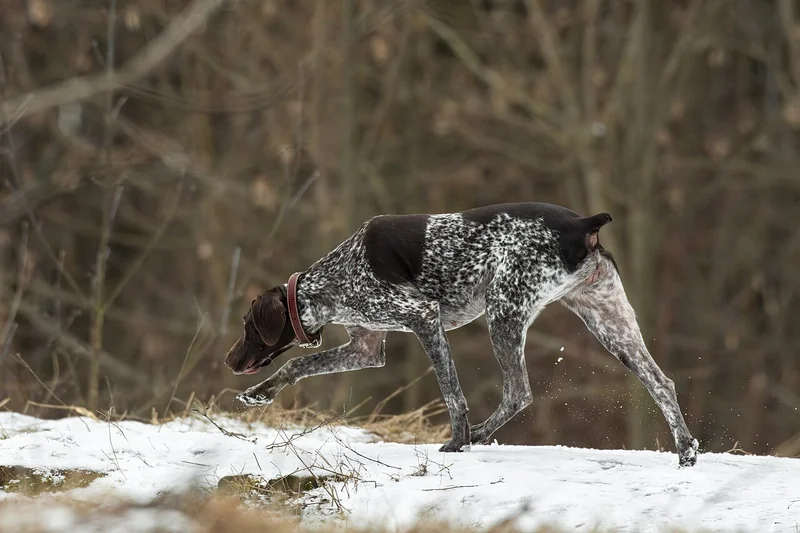
The German Wirehaired Pointer is a versatile continental gundog developed in Germany during the late 19th century as the ideal all-purpose hunting dog for the challenging terrain and game variety of the German countryside. Its defining feature is a harsh, wiry, weather-resistant outer coat with dense undercoat, which protects the dog from cold water, brush, and thorns. The breed can point, flush, and retrieve on both land and water with equal proficiency. The AKC admitted the German Wirehaired Pointer in 1959. Males stand 60–67 cm and weigh 25–34 kg.
Quick facts
- AKC group
- Sporting
- Origin country
- Germany
- Origin period
- Late 19th century
- Coat type
- Wirehaired
- Coat colors
- Liver and White, Liver, Liver Roan
- Average lifespan
- 14-16 years
- Recognition
- AKC 1959 · FCI 1954 · UKC 1948 · Group 7 — Pointing Dogs (Section 1.2: Continental Pointing Dogs, Wire-haired)
Origin
German hunters of the mid-to-late 19th century desired a single versatile gundog — termed a Gebrauchshund (utility dog) — capable of working all game and all terrain in Germany's varied landscapes. The Drahthaar was developed from the 1870s onward by crossing the wire-coated Stichelhaar, the Pudelpointer, the Griffon, and the German Shorthaired Pointer to combine pointing ability, a wire coat for protection in cover and water, and the drive to track wounded game. Sigismund von Zedlitz und Neukirch and a committee codified the standard in 1902, and the Verein Deutsch-Drahthaar (VDD) was established that same year to maintain breeding records.
Recognition
The VDD registered the German Wirehaired Pointer as a distinct breed in 1902. The FCI (FCI No. 98) recognised the breed in 1954, placing it in Group 7, Section 1.2 (Continental pointing dogs, wire-haired). The AKC admitted the German Wirehaired Pointer in 1959, placing it in the Sporting Group. The breed's German-language name — Deutsch Drahthaar — translates literally as 'German Wire-hair'.
Standard
The AKC and FCI standards describe a medium-to-large, well-muscled dog with a noble, intelligent expression and a distinctive beard and whiskers. The harsh, wiry outercoat lies flat against the body — not excessively long — and provides protection against brush, briars, and cold water; the dense undercoat thickens in winter. The liver-and-white, liver, or liver-roan coat is the standard; any other base colour is not accepted. Males stand 60–67 cm; females 56–62 cm.
Sources & further reading (3)
- kennel-club-registry — accessed 2026-05-07
- encyclopedia — accessed 2026-05-07
- fci-standard — accessed 2026-05-07
Frequently asked questions
What AKC group does the German Wirehaired Pointer belong to?
The AKC places the German Wirehaired Pointer in the Sporting Group alongside its short-haired counterpart, the German Shorthaired Pointer. Both breeds were developed in Germany as versatile all-purpose hunting dogs — pointing upland birds, tracking, and retrieving on land and water. The GWP's wire coat was specifically designed to protect the dog while working in rough terrain and cold water.
How does the German Wirehaired Pointer differ from the German Shorthaired Pointer?
The most obvious difference is the coat: the German Wirehaired Pointer has a harsh, wiry, weather-resistant outer coat with beard and whiskers, while the German Shorthaired Pointer has a short, dense, flat coat. The GWP is generally considered better suited to working in heavy cover, cold water, and harsh weather due to its protective coat. Both breeds are versatile hunting dogs capable of pointing, tracking, and retrieving.
What does 'Drahthaar' mean?
Drahthaar is the German word for 'wire-hair' — draht means wire and haar means hair. It is the breed's German-language name: Deutsch Drahthaar (German Wire-hair). This name precisely describes the breed's most distinctive physical characteristic, the harsh, wiry outercoat that protects the dog from rough vegetation, cold water, and adverse weather during hunting.