Canis lupus familiaris
German Shorthaired Pointer
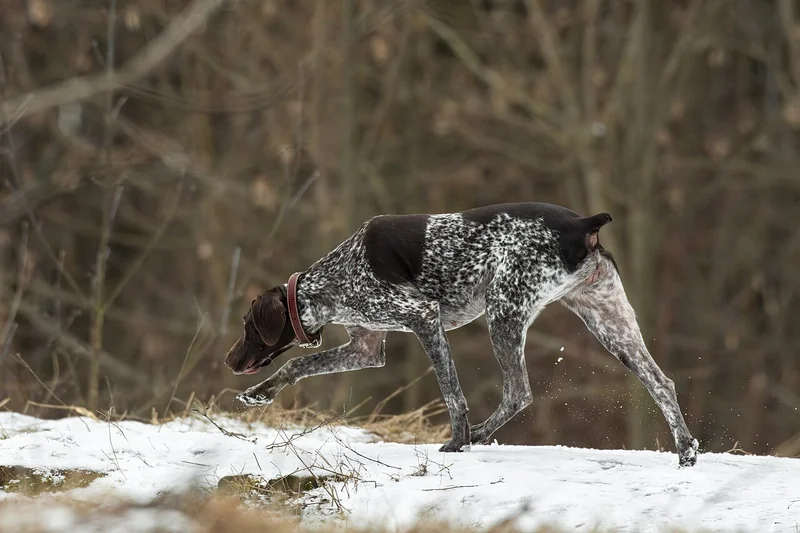 Featured photogerman-shorthaired-pointer.jpg
The German Shorthaired Pointer is a late-19th-century German all-purpose gundog (Mehrzweck-Jagdhund) — point, flush, retrieve, track. The German Shorthaired Pointer was developed in late-19th-century Germany by crossing the heavy old German Bird Dog (Deutscher Vogelhund) with the lighter English Pointer to produce a versatile gundog (Mehrzweck-Jagdhund) capable of pointing, retrieving on land and in water, and tracking wounded game.
Quick facts
- AKC group
- Sporting
- Origin country
- Germany
- Origin period
- Late 19th century
- Coat type
- Short
- Coat colors
- Liver, Liver and White (ticked, patched, or roan), Black, Black and White (FCI standard, AKC disqualifies black)
- Average lifespan
- 10-14 years
- Recognition
- AKC 1930 · FCI 1954 · UKC 1948 · Group 7 — Pointing Dogs (Section 1.1: Continental Pointing Dogs, Braque type)
Origin
The German Shorthaired Pointer was developed in late-19th-century Germany by crossing the heavy old German Bird Dog (Deutscher Vogelhund — the Continental pointer landrace) with the English Pointer (which contributed speed and styling) and a measure of Bloodhound (which contributed scent and tracking ability). The objective was a versatile gundog (Mehrzweck-Jagdhund) capable of pointing, flushing, retrieving on land and in water, and tracking wounded big game — a single dog suitable for the small-property hunting style of post-unification German foresters. The Klub Kurzhaar was founded in Stuttgart in 1891 and the first standard was published the same year. The AKC admitted the breed in 1930.
Recognition
The American Kennel Club admitted the breed in 1930, the United Kennel Club followed in 1948, and the Federation Cynologique Internationale published the international standard (FCI No. 119) in 1954. The FCI assigns the breed to Group 7 — Pointing Dogs (Section 1.1: Continental Pointing Dogs, Braque type).
Standard
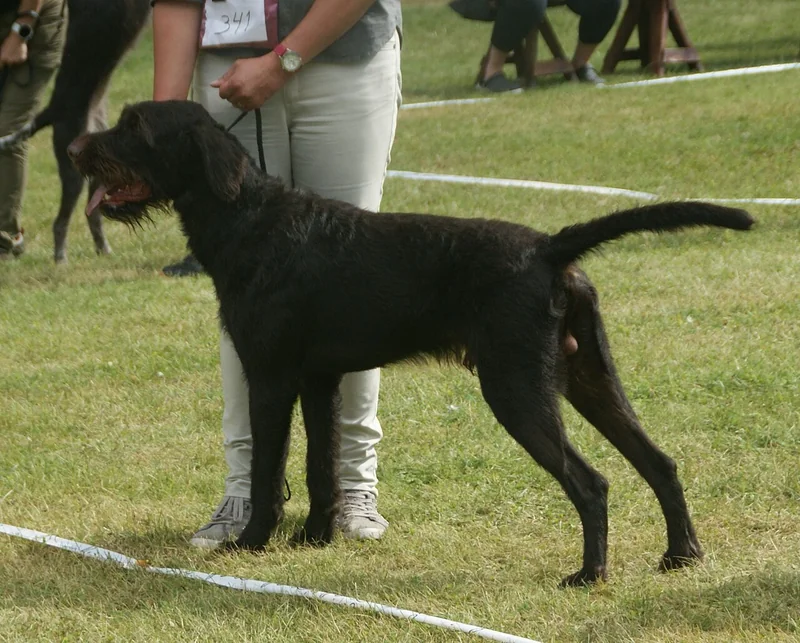
The AKC and FCI standards describe a versatile hunter, an all-purpose gundog capable of high performance in field and water, with a build that suggests power, endurance, and agility. The short, thick, water-repellent coat is the defining feature: harsh to the touch, lying smooth and tight on the body, slightly longer on the underside of the tail and the back edges of the haunches. Recognized colours are liver (solid or in combination with white as ticked, patched, or roan patterns); the FCI standard also accepts black and black-and-white, while the AKC standard disqualifies any black, red, orange, lemon, or tan.
Sources & further reading (3)
- kennel-club-registry — accessed 2026-04-30
- encyclopedia — accessed 2026-04-30
- fci-standard — accessed 2026-04-30
Frequently asked questions
What is the German Shorthaired Pointer's AKC group?
The American Kennel Club places the German Shorthaired Pointer in the Sporting Group. The Sporting Group gathers pointers, setters, retrievers, and spaniels — breeds developed to assist hunters in locating, flushing, or retrieving game birds. The breed's foundation working role was as a late-19th-century German all-purpose gundog (Mehrzweck-Jagdhund) — point, flush, retrieve, track.
When was the German Shorthaired Pointer officially recognized?
The American Kennel Club admitted the breed in 1930; the United Kennel Club followed in 1948; the Federation Cynologique Internationale published the international standard (FCI No. 119) in 1954.
What is the average lifespan of a German Shorthaired Pointer?
Kennel-club longevity surveys place the German Shorthaired Pointer's average lifespan in the 10-14 years range. The figure here represents the spread reported by the major parent-club studies and the Kennel Club (UK) purebred-dog health surveys.