Canis lupus familiaris
English Foxhound
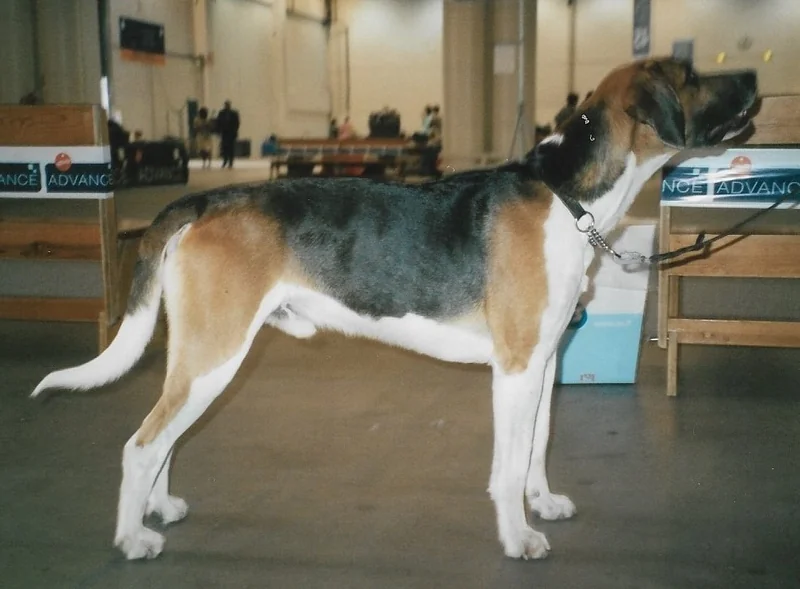 Featured photoenglish-foxhound.jpg
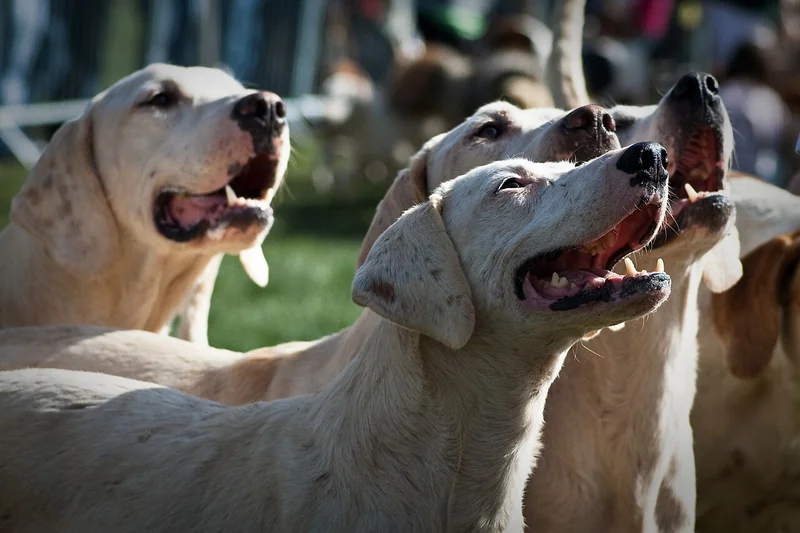
The English Foxhound is one of the oldest carefully recorded breeds, with stud-book entries dating to 1800 and development spanning from the 16th century. Bred for fox hunting in large packs, it exhibits extraordinary stamina, strong pack instinct, and a powerful nose capable of trailing a fox at full gallop for hours. Its tricolor coat — black, white, and tan — and level, efficient movement are hallmarks. The AKC admitted the breed in 1909. Males and females stand 58–64 cm and weigh 25–34 kg.
Quick facts
- AKC group
- Hound
- Origin country
- England
- Origin period
- 16th century
- Coat type
- Short
- Coat colors
- Tricolor (Black, White, and Tan), Bicolor
- Average lifespan
- 10-13 years
- Recognition
- AKC 1909 · FCI 1954 · UKC 1996 · Group 6 — Scent Hounds and Related Breeds (Section 1.1: Large-sized Hounds)
Origin
The English Foxhound's development accelerated in the 16th century after fox hunting replaced deer hunting as England's principal field sport when medieval royal forest laws were relaxed. Landed aristocracy — notably the Duke of Buckingham, the Earl of Yarborough, and others — maintained private packs and competed informally for supremacy of scent, speed, and drive. Bloodhound strains contributed nose and drive; Greyhound blood increased pace; Bulldog blood added the tenacity to push through cover. The Masters of Foxhounds Association (MFHA) began maintaining written stud books in 1800.
Recognition
The Kennel Club (UK) recognised the English Foxhound as a formal breed, but the breed's primary governance remains with the Masters of Foxhounds Association, whose stud book predates the KC by more than 70 years. The AKC admitted the English Foxhound in 1909. The FCI standard (FCI No. 159) places the breed in Group 6, Section 1.1 (Large-sized Scent Hounds). The English Foxhound is one of the rarest breeds in AKC registration statistics, as the vast majority of specimens are maintained in working hunting packs rather than as companions.
Standard
The AKC and FCI standards describe a medium-to-large, well-balanced hound with a broad, flat skull, a long, straight muzzle, and a strong, well-arched neck. The coat is short, dense, and hard — bred for outdoor pack life in all weather. The classic colour is tricolor (black, white, and tan), with pied (white with tan or black patches) also acceptable. The topline is level; the hindquarters are powerful with well-let-down hocks. The breed's movement should be covering and effortless, designed for endurance across miles of cross-country terrain. Males and females stand 58–64 cm.
Sources & further reading (3)
- kennel-club-registry — accessed 2026-05-07
- encyclopedia — accessed 2026-05-07
- fci-standard — accessed 2026-05-07
Frequently asked questions
What AKC group does the English Foxhound belong to?
The AKC places the English Foxhound in the Hound Group as a scent hound — a type of hunting dog that tracks prey primarily by nose. The English Foxhound is further classified as a pack hound, meaning it was developed to work in large groups rather than individually. Its extraordinary trailing ability and stamina were refined over four centuries of fox-hunting selection.
How old are the English Foxhound's stud-book records?
The Masters of Foxhounds Association (MFHA) has maintained written stud books for English Foxhound packs since 1800, making this breed one of the earliest domesticated animals to have a formal written pedigree system. Individual pack records in some private hunts date even earlier, to the 17th century, though these are not formally standardised.
Why is the English Foxhound so rare as a pet?
The English Foxhound was bred almost exclusively for pack fox hunting and its temperament, exercise requirements, and instincts reflect this working role. The vast majority of English Foxhounds worldwide are maintained in working hunting packs by Masters of Foxhounds. In AKC registration statistics, the English Foxhound is consistently one of the rarest recognised breeds; few breeders produce companion-quality litters, and the breed is functionally rare outside of Britain.