Canis lupus familiaris
Otterhound
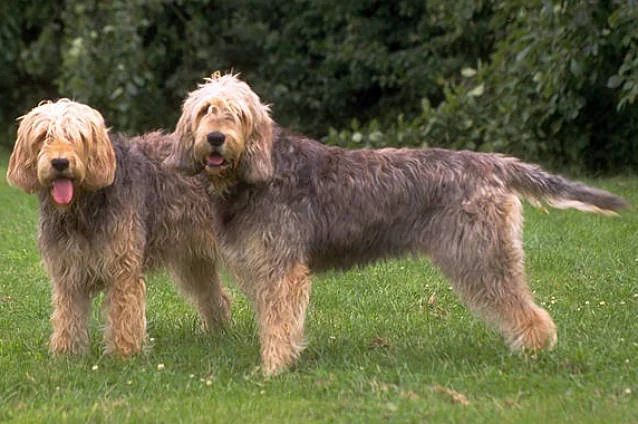 Featured photootterhound.jpg
The Otterhound is a medieval English riverine otter-hunting pack hound — water-resistant rough-coated scent hound. The Otterhound is one of the oldest British scent-hound breeds, with otter-hunting dogs documented in the 1212 Assize of the Forest under King John of England.
Quick facts
- AKC group
- Hound
- Origin country
- England
- Origin period
- Medieval (formalized 19th century)
- Coat type
- Wirehaired
- Coat colors
- Any hound colour acceptable — most common are grizzle, black-and-tan, blue-and-tan, liver-and-tan, wheaten, and tricolour
- Average lifespan
- 10-13 years
- Recognition
- AKC 1909 · FCI 1960 · UKC 1948 · Group 6 — Scent Hounds and Related Breeds (Section 1.2: Medium-sized Hounds)
Origin
The Otterhound is one of the oldest British scent-hound breeds, with otter-hunting dogs documented in the 1212 Assize of the Forest under King John of England. The breed was kept by the medieval English aristocracy as the hound for the otter-hunt — a riverine pack hunt for the European otter — and packs were maintained continuously by the English aristocracy from the 12th century to the 1978 ban on otter hunting in England and Wales. Foundation crosses likely involved the now-extinct Welsh Hound, Bloodhound, and unspecified rough-coated French scent hounds. The 1978 ban removed the breed's working role and the modern Otterhound is one of the most endangered AKC breeds, with fewer than 1,000 dogs worldwide. The Kennel Club registered the breed in 1873 and the AKC followed in 1909.
Recognition
The American Kennel Club admitted the breed in 1909, the United Kennel Club followed in 1948, and the Federation Cynologique Internationale published the international standard (FCI No. 294) in 1960. The FCI assigns the breed to Group 6 — Scent Hounds and Related Breeds (Section 1.2: Medium-sized Hounds).
Standard
The AKC and FCI standards describe a large, rough-coated, athletic, big-boned scent hound, capable of working long days in cold rivers and on rough hill country. The defining features are the dense, rough, hard, double coat (oily and water-resistant), the partially-webbed feet, and the long, broad, wide-nostrilled muzzle. Any hound colour is acceptable — grizzle, black-and-tan, blue-and-tan, liver-and-tan, wheaten, and tricolour are most common. Males stand 64-69 cm at the withers, females 61-66 cm.
Sources & further reading (3)
- kennel-club-registry — accessed 2026-04-30
- encyclopedia — accessed 2026-04-30
- fci-standard — accessed 2026-04-30
Frequently asked questions
What is the Otterhound's AKC group?
The American Kennel Club places the Otterhound in the Hound Group. The Hound Group gathers breeds developed for the hunt, broadly split into scent hounds (Bloodhound, Beagle, Coonhounds) and sight hounds (Greyhound, Whippet, Borzoi). The breed's foundation working role was as a medieval English riverine otter-hunting pack hound — water-resistant rough-coated scent hound.
When was the Otterhound officially recognized?
The American Kennel Club admitted the breed in 1909; the United Kennel Club followed in 1948; the Federation Cynologique Internationale published the international standard (FCI No. 294) in 1960.
What is the average lifespan of a Otterhound?
Kennel-club longevity surveys place the Otterhound's average lifespan in the 10-13 years range. The figure here represents the spread reported by the major parent-club studies and the Kennel Club (UK) purebred-dog health surveys.