Canis lupus familiaris
Canaan Dog
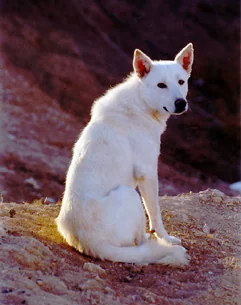 Featured photocanaan-dog.jpg
The Canaan Dog is Israel's national breed and one of the most ancient dog types still in existence. A pariah-type dog — one that has lived semi-feral on the margins of human settlements — the Canaan Dog is found in the ancient rock art of the Sinai Peninsula and the Negev Desert and has survived in the Middle East largely unchanged for thousands of years. The breed was reconstituted as a formal pedigree dog in the 1930s by Dr. Rudolphina Menzel, who captured and domesticated Negev desert dogs for use by the Haganah (Jewish defense forces). The AKC recognised the breed in 1997.
Quick facts
- AKC group
- Herding
- Origin country
- Israel
- Origin period
- Ancient
- Coat type
- Double
- Coat colors
- White with Brown or Black Markings, Solid Brown, Solid Black, Solid Sandy to Red Brown
- Average lifespan
- 12-15 years
- Recognition
- AKC 1997 · FCI 1966 · UKC 1992 · Group 5 — Spitz and Primitive Types (Section 6: Primitive type)
Origin
The Canaan Dog is one of the oldest domesticated dog types, its ancestors documented in the ancient Near East. Petroglyphs at Har Karkom in the Negev and in the Sinai Peninsula depict spitz-type pariah dogs closely resembling the modern Canaan Dog, dated to approximately 2200 BCE. After the Jewish diaspora, semi-feral dogs of this type survived in the desert for centuries, living in the wild Negev and Sinai, scavenging around Bedouin camps, and occasionally being used by Bedouin as flock guardians. The dogs were well-adapted to survival in extreme desert heat with scarce water and food.
Recognition
Dr. Rudolphina Menzel, a Viennese animal behaviorist who immigrated to Palestine in 1934, was commissioned by the Haganah to develop a working military dog suited to desert conditions. Recognising that the Negev's feral Canaan-type dogs were already superbly adapted to the environment, she began capturing and domesticating them. The Israel Kennel Club (IKC) recognised the Canaan Dog in 1953, and the FCI (FCI No. 273) followed in 1966 with Israel as patron country. The AKC admitted the breed in 1997, placing it in the Herding Group.
Standard
The FCI and AKC standards describe a medium-sized, squarely built, naturally alert dog with a wedge-shaped head, erect ears, and a bushy tail curled over the back when alert. The double coat has a short to medium-length, flat outer coat and a dense undercoat. Recognised colours are white with brown or black mask and spots, solid brown, solid black, and sandy to red-brown, with or without white trim. The overall impression is of a typical primitive breed — harmonious, self-sufficient, and naturally proportioned. Males stand 51–60 cm; females 48–55 cm.
Sources & further reading (3)
- kennel-club-registry — accessed 2026-05-07
- encyclopedia — accessed 2026-05-07
- fci-standard — accessed 2026-05-07
Frequently asked questions
What AKC group does the Canaan Dog belong to?
The AKC places the Canaan Dog in the Herding Group. The breed was used historically by Bedouin to guard flocks — an appropriate herding-group function — and Dr. Menzel's domesticated specimens proved highly effective at guarding and herding tasks when redomesticated in the 1930s. The FCI classifies it in Group 5 (Spitz and Primitive types) as a primitive pariah-type breed.
What is a 'pariah dog'?
A pariah dog is a dog that has reverted to or maintained a semi-feral existence on the margins of human settlements, surviving as a scavenger rather than through deliberate human breeding. Pariah dogs are among the most ancient dog types and tend to share a similar medium-sized, wedge-headed, erect-eared appearance driven by natural selection rather than artificial selection. The Canaan Dog is one of the few pariah-type dogs that has been formally reconstituted as a pedigree breed.
When was the Canaan Dog recognised by the AKC?
The AKC recognised the Canaan Dog in 1997, placing it in the Herding Group. The breed had been recognised by the Israel Kennel Club since 1953 and by the FCI since 1966 (FCI No. 273). The UKC recognised it in 1992. All modern registered Canaan Dogs trace to the domesticated Negev desert dogs collected by Dr. Rudolphina Menzel beginning in the 1930s.