Whiskey Sour
Bourbon, lemon juice, and sugar — the American sour formula documented in Jerry Thomas's 1862 guide.
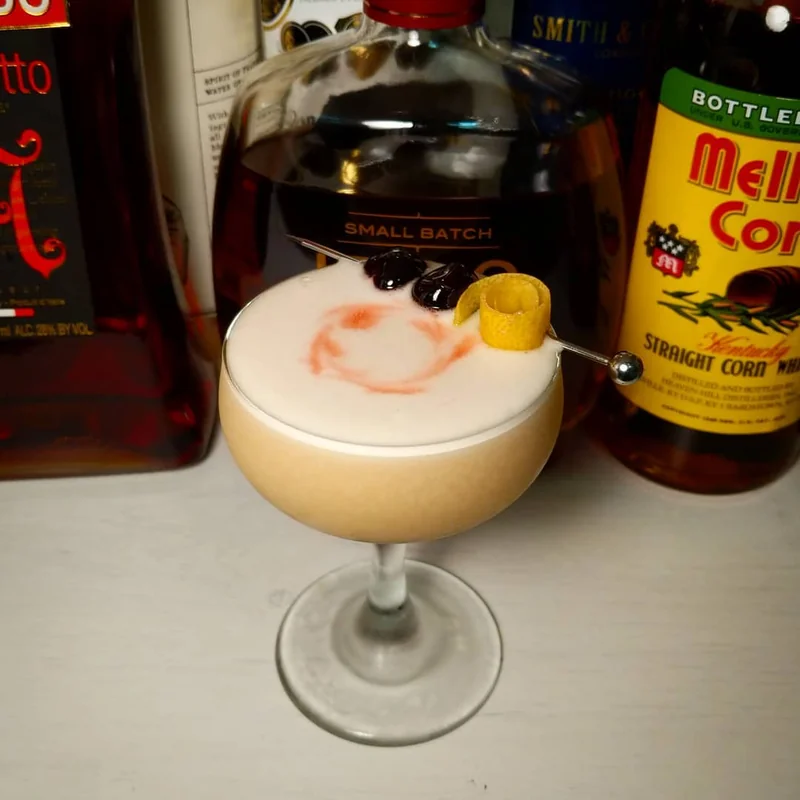
The Whiskey Sour is a three-ingredient sour cocktail combining bourbon (or rye whiskey) with fresh lemon juice and simple syrup, shaken and strained into a coupe or over ice in a rocks glass. The formula appears in Jerry Thomas's foundational 1862 *How to Mix Drinks, or The Bon Vivant's Companion* as 'The Whiskey Sour,' establishing it as one of the earliest documented American cocktail recipes. The modern 'Boston Sour' variant adds egg white to produce a silky froth layer; the 'New York Sour' floats red wine on top. The sour formula (base spirit + citrus + sweetener) is considered the most fundamental cocktail template and underlies dozens of derivative drinks.
Quick facts
- Type
- Classic Recipe
- Base spirits
- bourbon, rye whiskey
- Era
- 1862–present
- Origin
- United States
- Glass
- coupe
- IBA listed
- Yes — Official IBA cocktail
Jerry Thomas's 1862 Recipe
Jerry Thomas's How to Mix Drinks, or The Bon Vivant's Companion (1862) is the first major American bartender's guide and contains the earliest known printed recipe for the Whiskey Sour under that specific name. Thomas's formula: 1 tablespoon powdered white sugar dissolved in 1 small wine glass water, juice of ½ lemon, 1 wine glass (approximately 2 oz) bourbon or rye whiskey. Shaken over ice and strained into a glass, garnished with berries and a slice of lemon. The book's publication represents the beginning of the systematic documentation of American cocktail culture. Thomas himself was known as 'Professor Jerry Thomas' and worked at prestigious New York and San Francisco bars, contributing substantially to the professionalisation of American bartending.
Egg White Variant and the Dry Shake
The 'Boston Sour' (Whiskey Sour with egg white) adds 20–30 ml of fresh egg white to the shaker before ice. Egg white proteins (primarily albumen) unfold and trap air when shaken, creating a stable foam that floats as a creamy white layer on the drink's surface. To maximize foam, bartenders often use a 'dry shake' — shaking all ingredients without ice first for 10–15 seconds (which emulsifies the egg and creates more foam), then adding ice and shaking again to chill. The New York Sour adds a float of dry red wine (typically a Malbec or Pinot Noir) poured over the back of a spoon to rest on the foam layer, creating a distinctive red-on-white visual and a tannin-fruit note from the wine.
Sources & further reading (2)
- encyclopedia — accessed 2026-05-08
- encyclopedia — accessed 2026-05-08
Frequently asked questions
Is fresh lemon juice required or can bottled juice be used?
Fresh lemon juice is the professional standard because it contains active citric acid and volatile aromatic compounds (lemon oils from the expressed peel in squeezed juice) that bottled juice lacks. Most commercially bottled lemon juices contain preservatives (sodium benzoate or citric acid) that alter flavour. The IBA recipe specifies fresh lemon juice. Pasteurised bottled juice produces a flatter, less complex sour character.
What is the standard ratio for a Whiskey Sour?
The IBA recipe specifies 4.5 cl bourbon, 3 cl fresh lemon juice, and 1.5 cl simple syrup (approximately 3:2:1 ratio by volume, or slightly less sweet). Many bartenders use a 2:1:0.75 oz formula to achieve more whiskey prominence. The balance between sour (citrus) and sweet (syrup) is adjusted to taste and depends on the natural sweetness of the lemon batch.