Tom Collins
Old Tom gin, lemon juice, sugar, and soda water — an American highball documented in Jerry Thomas's 1876 revised guide.
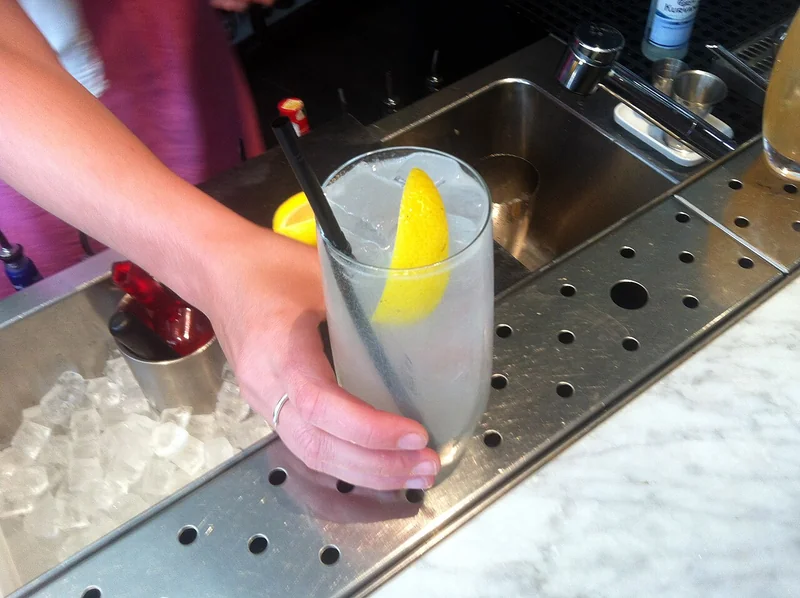
The Tom Collins is a gin-based highball combining Old Tom gin (or London Dry gin) with fresh lemon juice, simple syrup, and soda water, served over ice in a tall Collins glass with a lemon slice and cherry garnish. The recipe is documented in the 1876 revised edition of Jerry Thomas's bartender's guide. The name is associated with Old Tom gin — a mildly sweetened gin style popular in 19th-century Britain and America — though the drink works with London Dry gin and the name has since become generic. A John Collins (historically using Dutch genever) and Vodka Collins are documented variants. The Collins format (spirit + citrus + sweetener + soda in a tall glass) is a foundational highball template.
Quick facts
- Type
- Classic Recipe
- Base spirits
- old tom gin, london dry gin
- Era
- 1870s–present
- Origin
- United States / United Kingdom
- Glass
- collins
- IBA listed
- Yes — Official IBA cocktail
The Tom Collins and the Great Tom Collins Hoax of 1874
In 1874, a widespread prank swept New York City: one person would tell another 'Have you seen Tom Collins? He's at such-and-such bar, saying terrible things about you,' sending the victim to confront the nonexistent Collins. The prank was widely reported in newspapers of the era. Cocktail historians dispute whether the hoax predates or gave name to the cocktail, or whether an existing 'Tom Collins' cocktail gave substance to the joke. The earliest documented recipe with the name appears in Jerry Thomas's 1876 revised edition; however, a recipe under 'John Collins' appears in William Terrington's 1869 Cooling Cups and Dainty Drinks, with only the base spirit (genever vs. Old Tom gin) distinguishing the versions.
Old Tom Gin and the Collins Glass
Old Tom gin is a historical gin style between the unsweetened dryness of London Dry and the sweetness of Dutch genever. It was the dominant gin style in 18th- and 19th-century Britain, predating the development of the Coffey still and London Dry production. It was lightly sweetened with sugar or licorice root. The style nearly disappeared by the mid-20th century but has been revived by several distilleries since the 2000s. The Collins glass — a narrow, cylindrical 10–14 oz tall glass — is named after the drink category and appears in cocktail equipment literature from the late 19th century. Using a tall glass allows proper soda water volume while maintaining a proportion of ice that keeps the drink cold without overdiluting.
Sources & further reading (2)
- encyclopedia — accessed 2026-05-08
- encyclopedia — accessed 2026-05-08
Frequently asked questions
What is the difference between a Tom Collins and a Gin Fizz?
The Tom Collins and Gin Fizz share the same base formula (gin, lemon, sugar, soda) but differ in serving style. A Fizz is traditionally shaken and strained into a short glass without ice, the soda added last to create foam. A Collins is built over ice in a tall glass with soda added gently. The resulting drinks differ in texture (Fizz is frothier and drier), temperature (Collins is colder), and dilution rate (Collins dilutes as ice melts).
Can London Dry gin substitute for Old Tom gin in a Tom Collins?
Yes — London Dry gin is the modern standard in most Tom Collins recipes, including the IBA official recipe. London Dry's drier, more botanical character (stronger juniper) means the sweet balance is managed by the simple syrup rather than the gin itself. Old Tom gin, if available, produces a slightly rounder, softer drink due to its residual sweetness. The flavour difference is subtle enough that London Dry is the practical standard.