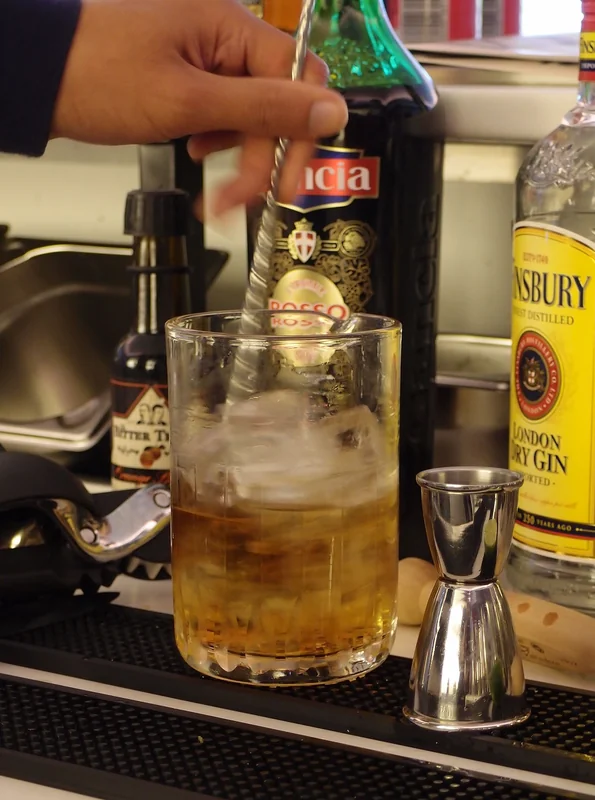
Stirring is a bartending technique used for cocktails composed entirely of spirits and liqueurs without citrus juice, cream, or egg. The method combines all ingredients in a mixing glass with ice, then uses a bar spoon to rotate the ice in a circular motion for 30–45 seconds to chill and dilute the drink. Stirring achieves approximately 20–25% water addition and chilling to -5°C while maintaining the cocktail's clarity and silky texture. Shaking would introduce air and ice chips that cloud a spirit-forward cocktail. Stirring is required for the Manhattan, Martini, Negroni, Vieux Carré, and other spirit-only formulas.
Quick facts
- Type
- Technique
Dilution Science: Why Ice Volume and Time Matter
When spirits are stirred with ice, two physical processes occur simultaneously: heat transfer from the liquid to the ice cools the drink, and water released from the melting ice surface dilutes the spirit. The equilibrium reached after 30–45 seconds of proper stirring with a full mixing glass of large, dense ice is approximately -5°C and 20–25% dilution by volume. Under-diluted cocktails taste sharp and alcoholic; over-diluted cocktails taste flat. The size of ice matters: larger, denser ice melts more slowly, giving the bartender more control. Wet, room-temperature ice melts faster (bad for control); cold, dry ice is more predictable. Professional mixing ice (large clear blocks) allows precise dilution management. The barometer used for 'done' is a combination of touch (the outside of the mixing glass should feel very cold) and count (typically 25–40 stirs depending on ice temperature).
Bar Spoon Technique
The bar spoon used for stirring has a long twisted handle (typically 28–40 cm) and a shallow spoon bowl or disc at one end. The technique involves holding the spoon's twisted handle between the thumb and forefinger of the dominant hand, resting against the middle finger, and rotating the spoon using the fingers (not the wrist) so that the back of the spoon bowl contacts the inside wall of the mixing glass while the spoon itself orbits the ice without turbulence. Proper technique keeps the ice rotating smoothly without splashing, maintaining a consistent contact between the cold ice surface and the liquid. Japanese bartending technique (as codified by Kazuo Uyeda and the Tokyo cocktail school tradition) emphasises a continuous, smooth, pendulum-like motion that maximises contact area between ice and liquid.
Sources & further reading (1)
- encyclopedia — accessed 2026-05-08
Frequently asked questions
How can you tell when a stirred cocktail is properly chilled and diluted?
The standard professional check is tactile: place your hand on the outside of the mixing glass. A properly stirred cocktail should feel very cold — at or below -5°C, the glass exterior will feel uncomfortably cold to hold for more than a few seconds. A secondary check is visual: the ice in the glass should have visibly melted at its edges, indicating significant heat transfer. Some bartenders weigh the drink before and after stirring to measure exact dilution; approximately 25–30g of added water in a 100ml cocktail is the target.
What is the difference between building on ice and stirring in a mixing glass?
An Old Fashioned can be 'built' by adding ingredients directly to the serving glass and stirring with the serving ice — a single-vessel process. Stirring in a separate mixing glass and straining into a chilled coupe or martini glass (the Manhattan and Martini technique) achieves more precise chilling and dilution, produces a clearer, more consistent drink, and allows the serving vessel to be pre-chilled separately. Building suits drinks served over ice in a rocks glass; the separate-mixing-glass method suits drinks served up (without ice) in a coupe.