Sazerac
Rye whiskey, Peychaud's bitters, absinthe rinse, and sugar — New Orleans' official cocktail, documented from the 1850s.
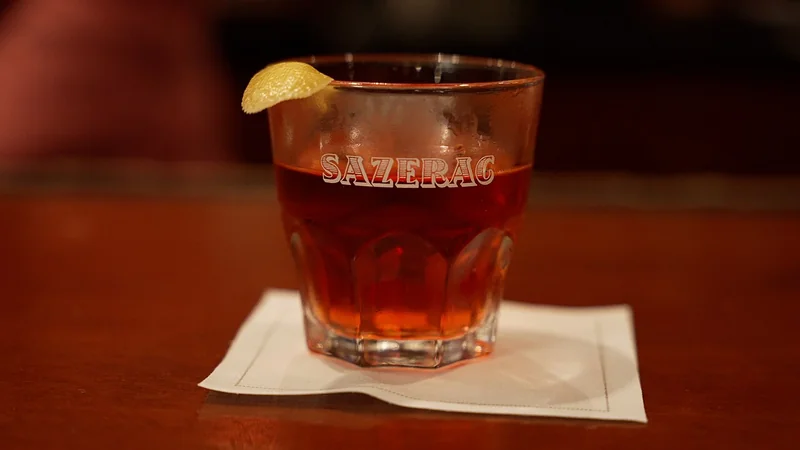
The Sazerac is the official cocktail of New Orleans, Louisiana, recognised by the Louisiana state legislature in 2008. The formula combines rye whiskey (or, in older versions, Cognac) with Peychaud's bitters, a small amount of sugar, and a rinse of absinthe (or pastis). The drink's history is tied to New Orleans apothecary Antoine Peychaud, who is documented in the 1850s–1860s as serving a brandy cocktail made with his proprietary bitters at his pharmacy on Royal Street. The modern formula using rye whiskey and the specific name 'Sazerac' is documented from the late 19th century. A lemon peel is expressed over the surface but not placed in the glass.
Quick facts
- Type
- Classic Recipe
- Base spirits
- rye whiskey, cognac, absinthe
- Era
- 1850s–present
- Origin
- New Orleans, Louisiana, United States
- Glass
- old-fashioned
- IBA listed
- No
Antoine Peychaud and the Cognac Original
Antoine Amédée Peychaud, a Creole pharmacist from Santo Domingo (present-day Haiti), settled in New Orleans and by the 1830s–1840s was dispensing his aromatic bitters — a compound of gentian, anise, and other botanicals — from his pharmacy at 437 Royal Street. Historical accounts from the 1850s describe him serving a brandy (Cognac) toddy seasoned with his bitters in a coquetier (egg cup) — possibly the origin of the word 'cocktail,' though this etymology is disputed. The original formula used Sazerac-de-Forge et Fils Cognac. As American rye whiskey became more economical than imported Cognac in the later 19th century, the spirit base shifted. Both Cognac and rye versions are documented in historical sources.
Absinthe Rinse Technique
A defining feature of the Sazerac is the absinthe rinse: a few drops of absinthe are added to the serving glass, swirled to coat the interior, and then the excess is discarded or poured out before the drink is poured in. The technique deposits a thin layer of anise-bitter aromatic on the glass interior without making the drink strongly anise-flavoured. Absinthe was banned in the United States from 1912 to 2007; during this period, Herbsaint (a New Orleans anise liqueur produced from 1934) was the standard substitute. The current IBA standard permits either. The combination of Peychaud's cherry-anise bitters with the absinthe aromatic and rye or Cognac is considered one of the most complex aromatic profiles in classic cocktail history.
Sources & further reading (2)
- encyclopedia — accessed 2026-05-08
- encyclopedia — accessed 2026-05-08
Frequently asked questions
Was Antoine Peychaud's pharmacy the origin of the word 'cocktail'?
The coquetier (egg cup) etymology — that Peychaud served his mixture in egg cups and English speakers corrupted 'coquetier' into 'cocktail' — is one of several competing etymology theories, none conclusively proven. Cocktail historian David Wondrich and others note that the word 'cocktail' predates documented accounts of Peychaud's pharmacy and appears in print in 1798 (in a British newspaper), making the New Orleans etymology chronologically implausible as the word's origin, though it may describe one early form of the drink.
What is the difference between Peychaud's bitters and Angostura bitters?
Peychaud's bitters (produced in New Orleans since the 1830s) have a distinctive cherry-anise flavour profile with lower proof and lighter colour than Angostura. Angostura bitters (produced in Trinidad since 1824) are darker, more intensely bitter, with complex spice notes (clove, cinnamon, gentian). The two are not interchangeable in the Sazerac — Peychaud's lighter, anise-forward character is integral to the drink's distinctive aromatic profile.