Mojito
White rum, lime juice, sugar, mint, and soda water — a Cuban highball with documented roots in 19th-century Havana.
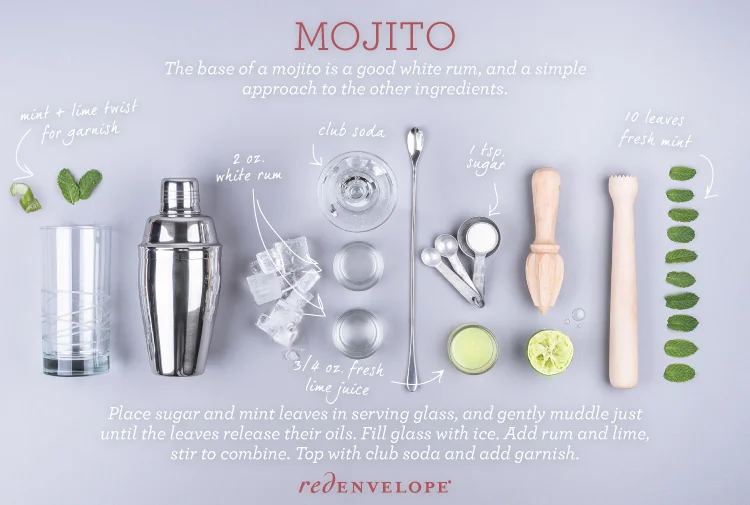
The Mojito is a Cuban highball cocktail combining white rum, fresh lime juice, sugar, mint leaves, and soda water, served over crushed or cubed ice. The drink has documented roots in 19th-century Cuba; the name appears in Cuban print sources from the late 1800s, and the formula is associated with Havana bar culture. A 16th-century predecessor — the 'El Draque,' a mixture of aguardiente, lime, sugar, and mint — is sometimes cited, though the continuous lineage to the modern Mojito is not conclusively established. The IBA recipe specifies white rum, lime juice, sugar, fresh mint, and soda water. The mint is gently muddled with lime and sugar to release oils without extracting chlorophyll bitterness.
Quick facts
- Type
- Classic Recipe
- Base spirits
- white rum
- Era
- 1800s–present
- Origin
- Havana, Cuba
- Glass
- collins
- IBA listed
- Yes — Official IBA cocktail
Historical Antecedents and Cuban Documentation
The 16th-century cocktail 'El Draque' — named after English privateer Francis Drake — is documented in historical accounts as a mixture of aguardiente (crude sugar cane spirit), lime, sugar, and mint used aboard Drake's ships as a treatment for dysentery and scurvy during his 1586 Caribbean expedition. The connection between El Draque and the Mojito is thematic rather than directly lineaged; the rum distillation techniques required for quality white rum were not developed until the 19th century. The word 'mojito' appears in Cuban sources from the 1890s. The modern recipe — specifically using light rum and soda water — is associated with the early 20th century Havana bar scene. La Bodeguita del Medio bar in Havana, established 1942, is historically associated with the Mojito, though it claims association with Hemingway (who frequented La Floridita for Daiquiris, not Mojitos, according to bar records).
Muddling Technique and Mint Varieties
The standard Mojito technique muddles mint leaves with lime juice (or lime wedges) and sugar before adding rum and soda. Gentle muddling bruises the mint leaf cell walls, releasing the aromatic mint oils (primarily menthol and menthone) without grinding the leaves, which would extract the green chlorophyll compounds and create bitterness. The key technique point is that the mint is pressed, not pulverised. Cuban spearmint (hierbabuena) is the traditional variety for authenticity, producing a slightly sweeter, less menthol-intense flavour compared to common peppermint. The soda water is added last, over ice, and gently stirred rather than shaken, to preserve carbonation.
Sources & further reading (1)
- encyclopedia — accessed 2026-05-08
Frequently asked questions
Why does over-muddling mint make a Mojito bitter?
Mint leaves contain two distinct compound groups: aromatic oils (menthol, menthone, carvone) concentrated in the oil glands of the leaf surface, and chlorophyll pigments in the cells throughout the leaf structure. Gentle pressing releases the aromatic oils. Hard grinding tears the cell walls and releases chlorophyll and plant tannins, which have a bitter, vegetal flavour. Standard technique calls for pressing with the muddler 3–5 times, enough to release aroma without pulverising the leaf.
Is the Mojito considered a sour or a highball?
The Mojito is classified as a highball (cocktail built in a tall glass with ice and topped with soda water) with sour components (lime juice). It shares the sour family's base architecture (spirit, citrus, sweetener) but the addition of soda water and the tall-glass serving format place it in the highball category. The Mojito's template — rum sour lengthened with soda and herbed with mint — is distinct from both the pure sour (no soda) and the pure highball (no citrus or sweetener).