Mixing Glass
A heavy glass vessel for stirring cocktails — designed for thermal stability and straining.
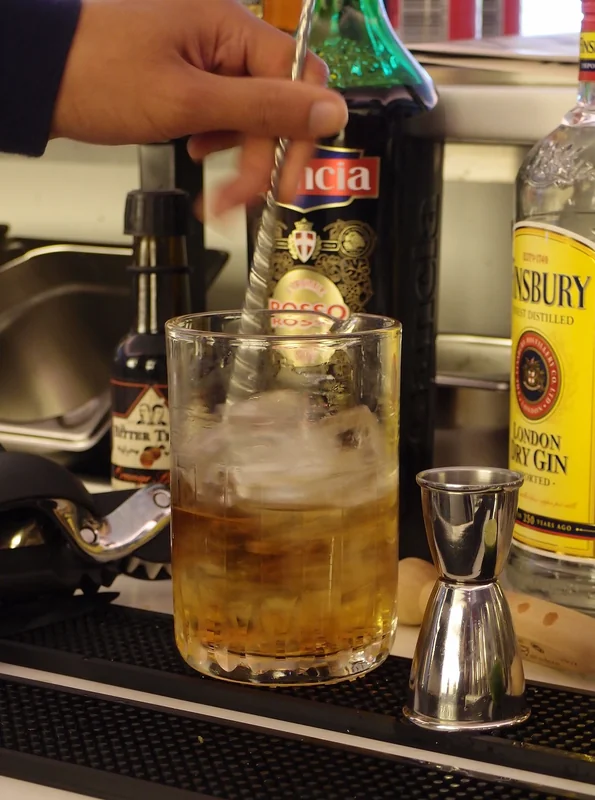
A mixing glass (also called a bar glass or stirring glass) is a heavy, cylindrical or tapered glass vessel used for stirring cocktails, typically holding 500–700 ml. It is distinguished from the serving glass by its weight, wall thickness, and shape, which provide thermal stability during stirring and a stable rim for Hawthorne or julep strainer placement. Stirred cocktails (Manhattan, Martini, Negroni, Vieux Carré, Negroni Bianco) are prepared in the mixing glass with ice, then strained into a pre-chilled coupe, martini, or rocks glass. The mixing glass is a critical tool for spirit-forward cocktail precision: its thermal mass slows temperature change during stirring, giving the bartender control over dilution and chilling rate.
Quick facts
- Type
- Bar Tool
Design and Thermal Properties
Professional mixing glasses are typically produced from thick-walled borosilicate glass or crystal glass, 500–700 ml capacity. The weight and wall thickness of the glass serve a functional purpose: the thermal mass of the thick glass absorbs cold from the ice slowly, keeping the bartender's grip comfortable during stirring and providing a stable temperature reference. A mixing glass can be pre-chilled (by filling with ice water, discarding, and drying before use) to further control stirring speed. The diameter and height of the mixing glass affect the ice-to-liquid contact surface area — taller, narrower glasses provide more vertical contact; shorter, wider glasses allow more lateral stirring motion. The Yarai mixing glass (a Japanese design with diamond-cut texture) became a design icon associated with the craft cocktail movement.
Spout and Strainer Lip Design
Professional mixing glasses typically have a slight outward pour spout or a flat, even rim that seats a Hawthorne strainer securely during straining. The Hawthorne strainer (with a coiled spring that adapts to the glass's rim diameter) is the primary strainer used with a mixing glass. A julep strainer (a perforated metal dome on a handle) was historically associated with the mixing glass before the Hawthorne became standard. Proper strainer seating is important: a strainer that sits too loosely will allow ice shards through; too tight will slow pouring. The combination of mixing glass, ice, bar spoon, and Hawthorne strainer constitutes the complete stirred-cocktail toolkit.
Sources & further reading (1)
- encyclopedia — accessed 2026-05-08
Frequently asked questions
Can a shaker tin be used for stirring instead of a mixing glass?
Yes — a metal shaker tin can be used for stirring, and many bartenders working at high volume do so. The metal tin is less transparent (you cannot see the drink colour as easily) and conducts cold faster than glass, making temperature assessment less consistent. The mixing glass's transparency allows the bartender to see the drink's colour and clarity during stirring, which is particularly useful for vermouth-based or coloured cocktails. Metal tins are also harder to seat a Hawthorne strainer on than the standardised rim of a mixing glass.
What is the Yarai mixing glass?
The Yarai (矢来, Japanese for 'bamboo fence') mixing glass features a distinctive diamond-cut surface pattern inspired by traditional Japanese bamboo lattice fencing. Originally produced by Toyo Sasaki Glass in Japan, the Yarai design became iconic in the Japanese cocktail tradition and has been widely imitated. The cut glass surface provides a grip texture and visual distinction. Functionally, the Yarai performs identically to other thick-walled mixing glasses; its popularity is primarily aesthetic and cultural.