Margarita
Tequila, triple sec, and lime in a salt-rimmed glass — a Mexican-American cocktail from the 1930s–40s.
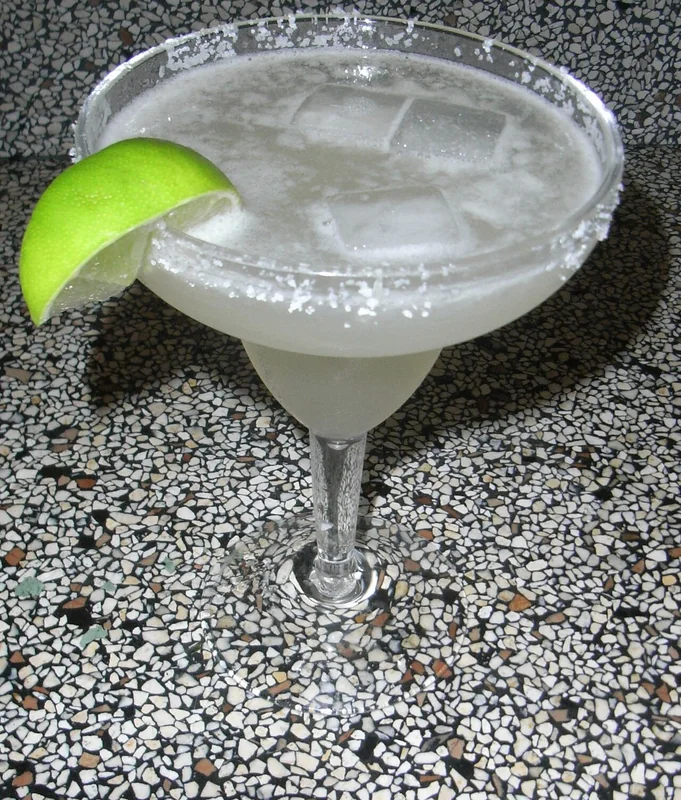
The Margarita is a shaken cocktail of tequila, orange-flavoured liqueur (triple sec or Cointreau), and fresh lime juice, typically served in a salt-rimmed glass. Multiple origin stories exist in the cocktail record, with claims dating from the late 1930s to 1948, none definitively established. The formula is the tequila variant of the Sidecar family (base spirit, orange liqueur, citrus). The IBA recipe specifies 5:2:1 tequila to Cointreau to lime juice. It is one of the world's most-ordered cocktails and is closely associated with Mexican-American border culture. The salted rim contrasts with the sour lime element — a technique with documented antecedents in the practice of drinking tequila with salt and lime.
Quick facts
- Type
- Classic Recipe
- Base spirits
- tequila, triple sec
- Era
- 1930s–present
- Origin
- Mexico / United States border region
- Glass
- margarita
- IBA listed
- Yes — Official IBA cocktail
Competing Origin Accounts
At least five named individuals claim credit for inventing the Margarita, and cocktail historians have been unable to definitively verify any single account. The most frequently cited stories include: (1) Dallas socialite Margarita Sames, who reportedly created the drink at a 1948 Acapulco party; (2) bartender Danny Herrera at Rancho La Gloria near Tijuana, who claimed to have invented it for showgirl Marjorie King around 1938–1942; (3) Enrique Bastate Gutierrez at Hussong's Cantina in Ensenada in 1941. Imbibe Magazine researcher David Wondrich notes that the formula (tequila, orange curaçao, lime juice) appears in a 1953 Esquire drinks article, providing an early published reference. The cocktail may have evolved independently at multiple locations.
Salt Rim Technique and Formula Variants
The salt rim is applied by moistening the glass rim with lime juice or running a lime wedge around it, then pressing it into coarse salt (typically kosher or sea salt). The technique is documented in Mexican tequila-drinking tradition where salt and lime are consumed separately as accompaniments. In the cocktail, the salt rim provides periodic saline contrast to the sour lime and sweet orange liqueur. Frozen Margaritas (blended with crushed ice) became commercially widespread from the 1970s after the invention of the Margarita machine. Tommy's Margarita (a modern variation substituting agave syrup for triple sec, credited to Julio Bermejo of Tommy's Mexican Restaurant, San Francisco, 1990s) is now a distinct IBA-listed recipe.
Sources & further reading (2)
- encyclopedia — accessed 2026-05-08
- encyclopedia — accessed 2026-05-08
Frequently asked questions
What is the difference between a Margarita and a Tommy's Margarita?
A classic Margarita uses triple sec or Cointreau (orange liqueur) as the sweetener, adding orange flavour alongside the sweetness. Tommy's Margarita, developed by Julio Bermejo at Tommy's Mexican Restaurant in San Francisco in the 1990s, substitutes 100% agave nectar (agave syrup) for the orange liqueur, resulting in a purer tequila-lime-agave flavour without orange notes. The Tommy's Margarita is now listed as a separate IBA official cocktail and is associated with the promotion of 100% agave tequila.
What tequila classification is conventionally used in a Margarita?
Blanco (unaged or rested no more than 60 days in stainless steel) tequila is the standard for classic Margaritas because its fresh, agave-forward character contrasts cleanly with the lime and orange. Reposado (2–12 months barrel-aged) tequila adds vanilla and oak notes that can complement a smoother, richer style. Añejo (1–3 years aged) tequila is less common in Margaritas and is more often sipped neat. The IBA recipe specifies Blanco tequila.